
Do not beat homogenous eggs
Only coarsely mixed eggs form differently soft yellow and white areas, which are typical for Oyakodon.
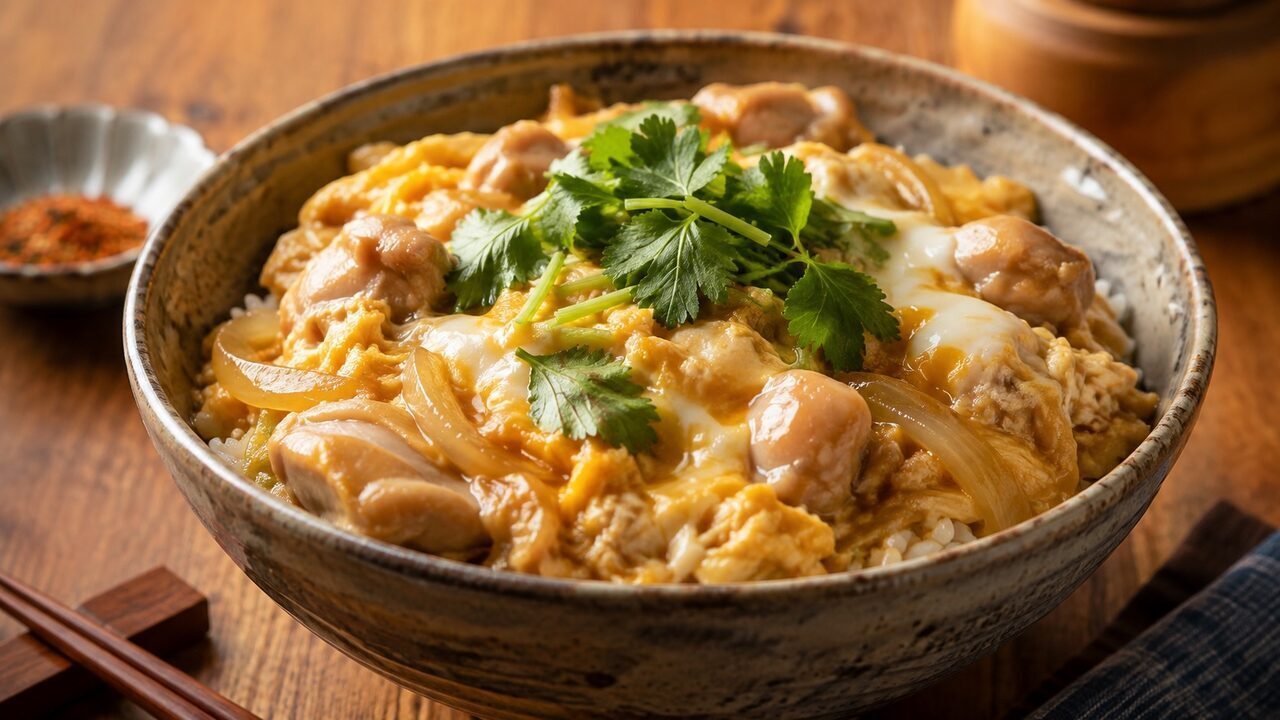
The chicken cooks completely at first in Dashi, Mirin and soy sauce. The egg is then added in two stages so that solid and soft areas are created.
Why this recipe works
Oyakodon means parent-child rice shell: chicken and egg lie together on rice. The dish lives from a juicy surface and a small amount of broth that pulls into the top layer of rice. For a safe everyday version, the chicken is cooked completely; the eggs can set soft or firm as desired.
Recipe
Oyakodon combines juicy chicken legs, soft onions and only loosely set egg in a spicy Dashi sauce on hot Japanese rice.
Mix Dashi, Mirin, Soy Sauce, Sake and Sugar in a large pan and let them boil once.
Spread the onions evenly in the broth, cover and cook softly for 5 minutes at medium heat.
Spread chicken pieces on the onions and simmer gently for 6 to 8 minutes covered. Turn the meat once and cook to at least 75 °C core temperature.
Mix eggs only to the extent that proteins and egg yolks still form streaks. Pour two-thirds spirally over the strongly simmering filling and let it stand for 60 to 90 seconds.
Spread the remaining egg, put on the lid and cook for 1 to 2 minutes according to the desired cooking grade. For fully set egg wait a little longer.
Spread rice over four bowls. Place the chicken-egg covering with a little brew, sprinkle with mitsuba or spring onions and serve immediately.
Kitchen know-how
Only coarsely mixed eggs form differently soft yellow and white areas, which are typical for Oyakodon.
In a pan with a diameter of 20 cm, the coating is best done in two portions and can be neatly placed on the rice.
Variations
Values are estimates per serving and may vary depending on the ingredients, brands, portion size and preparation method used.
Frequently asked questions
Keep cooking