How to Identify PFAS-Free Pans: What a New Market Check Found
Many non-stick pans do not clearly state what their coating contains. A new market check shows which claims are useful and how to use PTFE-coated pans safely.
In short: Many non-stick pans do not clearly state what their coating contains. A new market check shows which claims are useful and how to use PTFE-coated pans safely.
However, the distinction is useful for purchasing. Polytetrafluoroethylene, or PTFE, belongs to the large group of perfluorinated and polyfluorinated alkyl substances. Therefore, a statement such as PFOA-free does not exclude the possibility that a pan is coated with another PFAS such as PTFE.
What the market check actually examined
In June 2026, the NRW consumer advice centre observed a total of 31 panes in online commerce where the nature of the anti-adhesive effect was unclear at first glance. Information was sought on product pages, in operating manuals, via chatbots and through inquiries from retailers and manufacturers.
It is precisely this approach that illustrates the practical problem: even the simple question of material can take time. Fantasy names, indications of stone optics or ceramic particles and general environmental concepts do not say reliably whether the actual anti-adhesive layer contains fluorine. PFOA/PFOS-free also covers only two substances from a very large group.
Which details provide more clarity when buying
The clearest indications are, according to the consumer-centric formulations, PFAS-free, PFC-free, fluoride-free or 100 per cent PTFE-free. However, even then it is worth taking a look at the full product description and the instructions for use.
Conversely, warning signs may be indications for PTFE: a limited maximum temperature, the prohibition of empty heating and the recommendation to use only wood or silicone materials. Such indications do not prove the composition but are appropriate for a scratch and overheating sensitive plastic coating. If the material information remains unclear, a specific question makes sense: Does the coating contain PTFE or other PFAS?
An existing PTFE pan need not be discarded immediately
The desire for PFAS-free new purchases is primarily an environmental and transparency decision. The risk assessment of the Federal Institute for Risk Assessment is important for the use of existing pans.
The BfR indicates about 360 degrees Celsius as the area where PTFE can decompose and release harmful substances into the air. Therefore, coated pans should not be preheated at the highest level, especially on fast-acting induction or gas fields. Manufacturer's instructions on temperature, cleaning and tools should be followed.
Small accidentally ingested particles of a scratched layer of PTFE are not considered a health problem by BfR because of the material's resistance to reactions. However, a severely damaged pan works worse, can continue to lose particles and is often harder to keep clean.
Four material options without a conventional PTFE coating
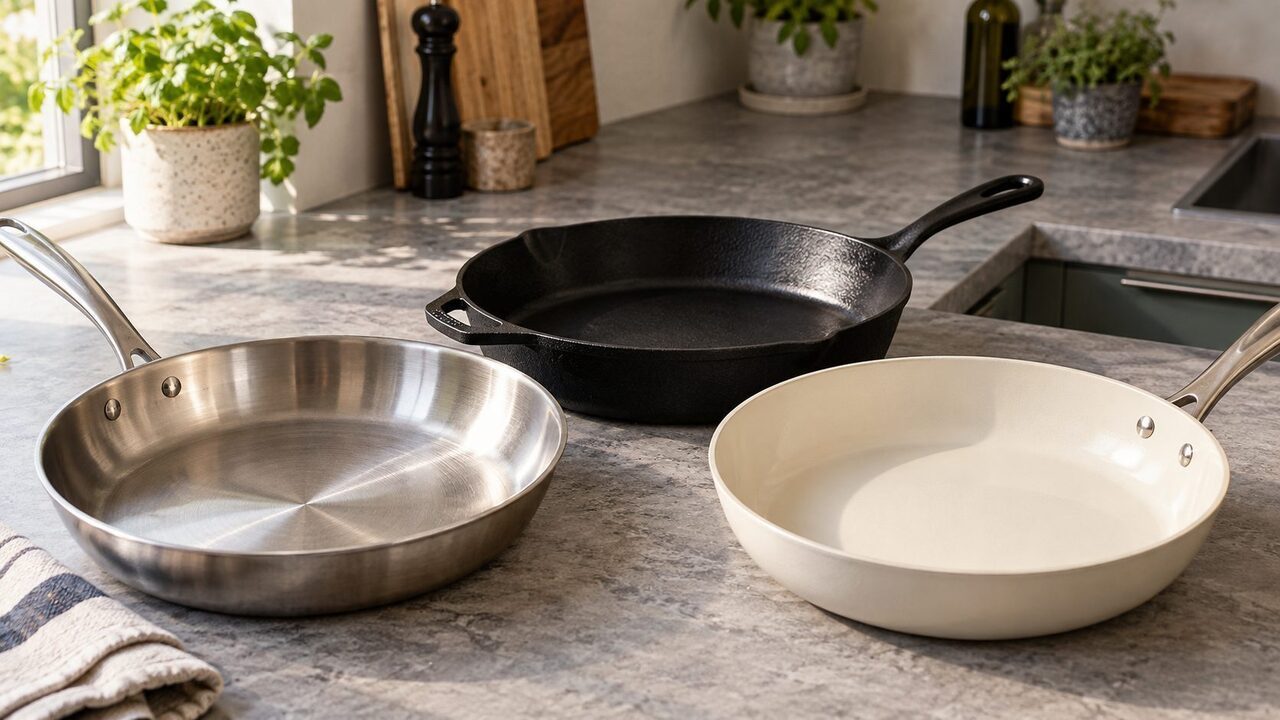
- Stainless steel: durable, robust and suitable for strong frying. Proper preheating, sufficient fat and patience will help to prevent sticking.
- Cast iron: saves a lot of heat and develops a good anti-adhesive effect with a well-groomed patina.
- Forged iron: reacts faster than heavy cast iron and is also burned. Strongly acidic foods can attack the patina and promote metallic flavours.
- Emails or specifically PFAS-free ceramic coatings: can be practical for more sensitive foods. These coatings are also not indestructible; care procedures and expected lifespan remain important.
There is no one pan for every dish. Eggs or pancakes have other requirements than deep-fried potatoes, tomato sauce or a snack dish. If you clear your own cooking profile before buying, you avoid making a mistake and can choose a long-lasting combination of one or two pan types. (Breakfast; vegetarian dinners; One-pot judgments)
Practical shopping checklist
- Searching for material instead of an advertisement: search the product page and instructions for PTFE, PFAS, PFC and fluorine.
- Require broad freedom of expression: PFOA-free is not sufficient to avoid the entire PFAS group.
- Documenting uncertainty: A written response from the supplier is more meaningful than a telephone conjecture in the sale.
- Plan for use: Weight, hardness, temperature range, acid resistance and care must fit into everyday life.
- Use it wisely: Do not overheat an intact PTFE pan, treat it gently and replace it only if it is lost or damaged.
What the market check does not prove
The 31 panes do not represent the entire market. The ratings are based on vendor information and do not indicate which PFAS are released in what quantities during production, use or disposal. Nor does it follow from PFAS-free that a pan is automatically more durable, ecologically better in every respect or more suitable for each dish.
The benefit of the check is therefore mainly in the orientation: it shows which terms are too narrow, where information is missing and which questions buyers can ask. The evaluation of the BfR remains decisive for a health classification of the normal use.
Conclusion: Clear material details matter more than marketing names
If you want to avoid PFAS the next time you buy a pan, don't be guided by natural, stone or ceramic concepts. Clear information such as PFAS-free or 100 percent PTFE-free and a comprehensible material description are more telling.
At the same time, no panic exchange is necessary. An existing, intact PTFE pan can be used further, according to BfR assessment, with proper use. The reasonable strategy is: do not overheat empty, conserve coating, ask specifically and choose a durable material that fits your own dishes when re-purchasing.
Sources and status
- NRW consumer advice centre: Pans and PFAS: How dangerous is Teflon coating?, updated market check, published on 17 September 2026. (How dangerous is the Teflon coating?)
- consumer advice centre NRW: Anti-adhesive tapes: This is how to identify PFAS-free coatings, press release dated 15 September 2026. (Non-stick pans: this is how to identify PFAS-free coatings)
- Federal Institute for Risk Assessment: questions and answers on PTFE coated utensils, current risk assessment and instructions for use. (Questions and answers on PTFE-coated vessels)
Author: Kochzauber editorial team. Information and update status: 17 September 2026. The post orders a market check and regulatory risk indication; it does not replace individual product testing. The title image is an editorial icon image.