Floods and Wildfires Together: Risks to Staple Foods
A new global analysis links overlapping flood and wildfire risks with lower production of rice, maize, wheat and soy. We explain what the modelled figures mean and what they do not predict.
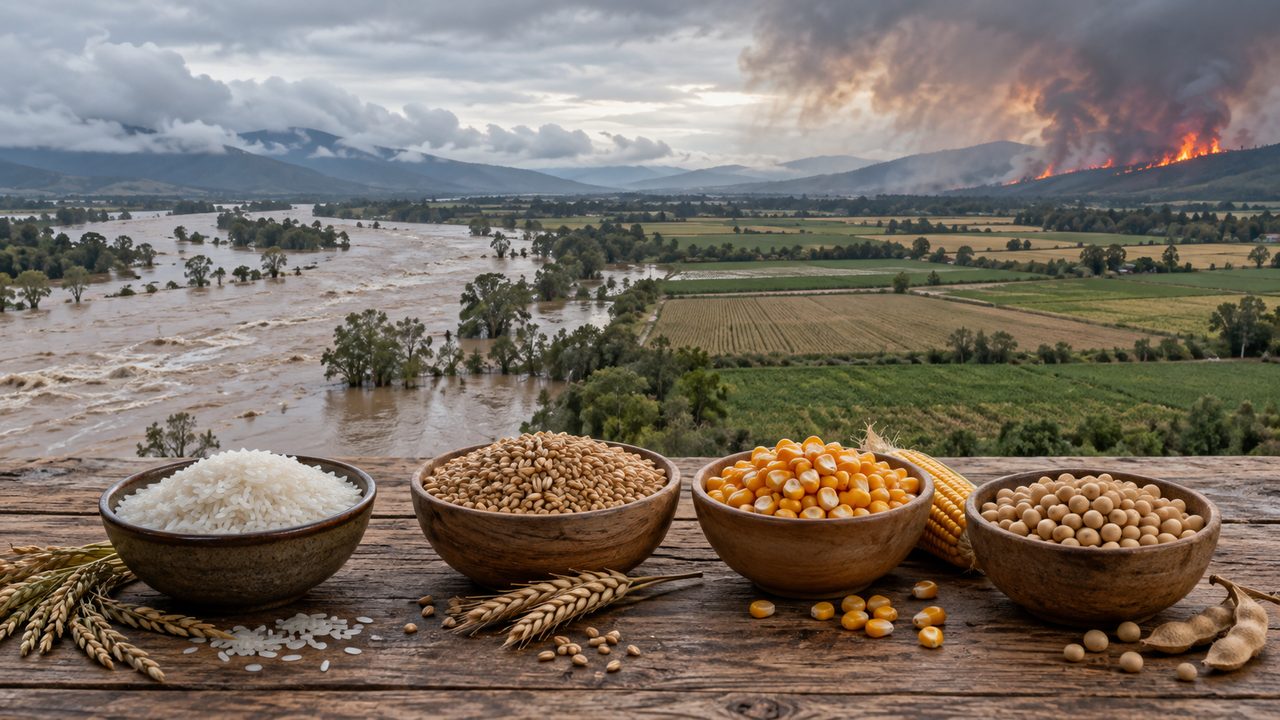
In short: A new global analysis links overlapping flood and wildfire risks with lower production of rice, maize, wheat and soy. We explain what the modelled figures mean and what they do not predict.
Why two hazards amount to more than two headlines
Floods can damage fields, storage facilities and transport routes. Wildfires threaten farmland and infrastructure, and may coincide with further yield losses following a drought. When different hazards affect the same region or occur in quick succession, their consequences can overlap. Researchers therefore refer to compound or cascading risks.
The new model combines satellite-derived and other risk data with information on production, trade and sustainability. The researchers found the highest concentrations of the recorded flood-wildfire combinations in Central Africa and mainland Southeast Asia. The study period ends in 2018, however. The paper therefore describes historical relationships and model calculations based on them, not the current 2026 harvest.
The percentages show associations, not a forecast for the kitchen
According to the calculations, a one percent increase in the combined risk was associated with production decreases of three percent for both maize and rice, and two percent for both soy and wheat. The authors also modelled possible declines in global export volumes. The United States and Thailand receive particular attention as major exporting countries.
The word "associated" is crucial. A statistical association does not prove that every individual increase in risk automatically causes a harvest loss of the same size. Yields and trade also depend on weather patterns, irrigation, crop varieties, stocks, infrastructure, policy, exchange rates and demand. The large modelled export quantities are not reported losses from a particular year.
Why the study is still relevant
Many analyses consider floods or fires separately. This new study instead attempts to connect their combined pressure with production and trade networks. That fits a broader finding of the Intergovernmental Panel on Climate Change: the effects of weather and climate extremes can travel across borders through supply chains, markets and flows of goods.
According to the Food and Agriculture Organization of the United Nations (FAO), international agricultural markets are also vulnerable to several kinds of shock. Trade can cushion regional shortfalls, but it can also transmit disruption. Whether this produces a price surge depends on stocks, alternative sources of supply, trade policy and the expectations of market participants.
What cannot reasonably be concluded from the study
- No price for bread or rice: The study does not calculate German retail prices or give a date for possible changes.
- No current harvest balance: The event period analysed, from 2002 to 2018, must not be confused with the supply situation in September 2026.
- No reason for panic buying: Stocks, trade and alternative sources can cushion shocks. Panic buying can place additional pressure on availability and prices.
- Regions are not interchangeable: Exposure, the share of land under cultivation, infrastructure and capacity to adapt differ considerably.
A sensible pantry is varied, not enormous
The study does not prescribe a new minimum quantity of flour, rice or oil for households. A modest supply of foods that are regularly eaten and replenished remains sensible. Anyone comfortable cooking with several staple ingredients can adapt more easily when prices or availability change.
Rather than relying on just one side dish, potatoes, rice, pasta and pulses can serve different purposes. Rice works in curries and pan dishes, lentils in stews and salads, and potatoes in traybakes and soups. The key is to keep supplies dry and organised and to use the oldest items first.
Four steps for assessing striking price headlines
- Check the source and trading level: A global commodity quotation is not the same as the shop price of a processed product.
- Read the time period: Historical associations, scenarios and current measurements answer different questions.
- Look for alternatives within the dish: A one-pot dish or stew can often be adapted with a different filling staple without abandoning the whole recipe.
- Store only what you will use: Large quantities save nothing if quality deteriorates or food goes unused.
Conclusion: take supply-chain risks seriously without sounding a price alarm
The new study shows why floods and wildfires in agricultural areas should not be considered in isolation. Their combined risks can affect production and trade at the same time. This matters for policymakers, agriculture, storage and trade planning.
For the household kitchen, the practical conclusion is more modest: assess price stories carefully, keep a rotating pantry and be able to use several everyday staples. The study supports greater attention to resilient food systems, but it does not provide a specific price forecast or a reason to make a bulk purchase.
Sources and status
- Huan et al.: Flood-wildfire co-occurrence risks disrupt global staple food trade and erode SDG progress, npj Science of Food, published on 9 September 2026, DOI 10.1038/s41538-026-01111-z.
- FAO: The State of Agricultural Commodity Markets 2026, background on trade, resilience and food security.
- IPCC: Climate Change 2022: Impacts, Adaptation and Vulnerability – Technical Summary, background on cross-border and compound climate risks.
- FAO: Food Price Index, methodology for tracking international food commodity prices.
Author: Kochzauber editorial team. Information and update status: 10 September 2026. This article assesses a global modelling study and is not a price or supply forecast. The cover image is an editorial illustration.