
Check the sweetness of the melon
Very ripe melon may need only 40 g sugar. The unfrozen mass may taste a little sweeter, because cold dampens the sweetness perception.
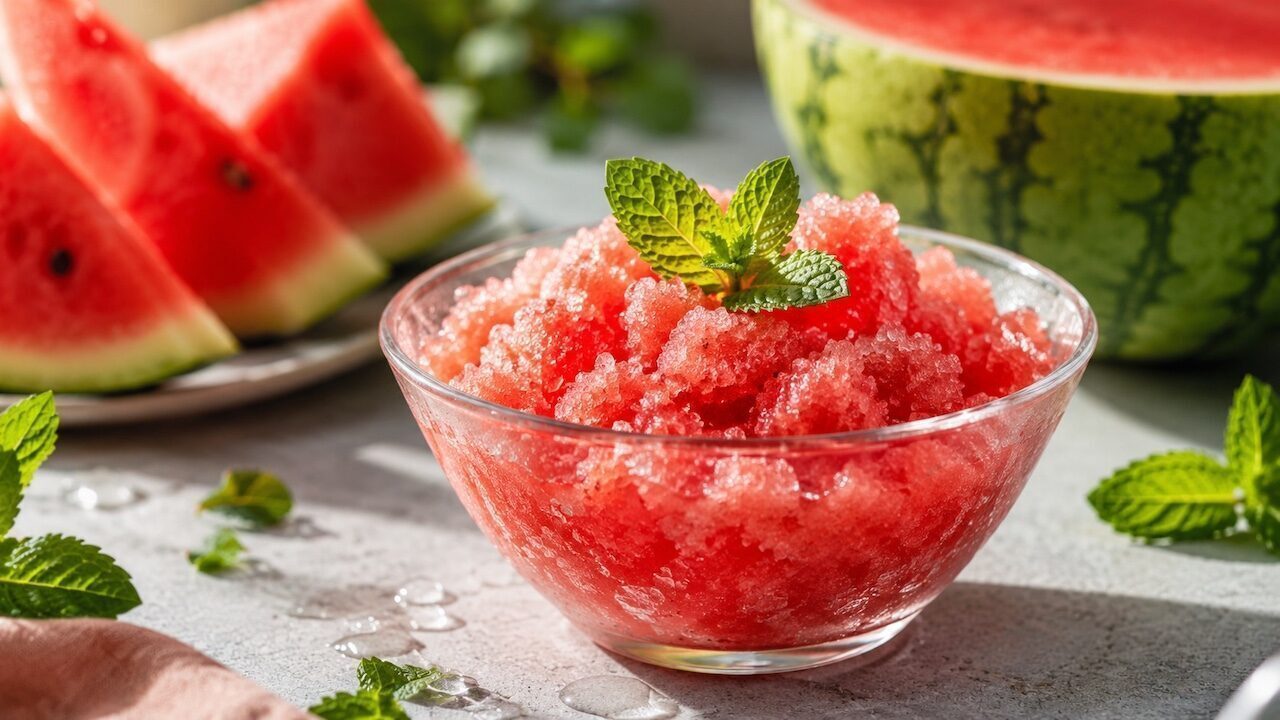
For the Granita, low-core water melon flesh is finely pureed and frozen in a flat metal shell. Regular scraping with a fork produces the typical grainy structure.
Why this recipe works
Sugar lowers the freezing point and keeps the crystals spoonful, lime balances out the sweetness of ripe melon. The decisive factor is a large, flat shell: the mass freezes more evenly and can be loosened from the edge to the middle. Four scrapers result in a fine, but still noticeable grain.
Recipe
Watermelon granita does not need an ice machine. Lime, a light sugar syrup and repeated scratching turn melon into loose, refreshing ice crystals.
Boil sugar and water in a small pot until the sugar is completely dissolved. Remove syrup from the stove and let it cool to room temperature.
Dice watermelon and puree finely. Rub the lime peel, squeeze out both limes and mix juice, zest, salt and the cooled syrup under the puree.
Pour puree at most 2 cm high into a flat metal bowl and freeze horizontally for 60 minutes.
Raise frozen edges with a fork to the middle. Repeat this process three more times every 30 to 40 minutes until even ice crystals are formed.
Scratch Granita again vigorously immediately before serving, fill in loosely and garnish with mint as desired.
Kitchen know-how
Very ripe melon may need only 40 g sugar. The unfrozen mass may taste a little sweeter, because cold dampens the sweetness perception.
In a metal bowl, the mass freezes faster than in glass or ceramics. A thin layer facilitates regular scratching.
Variations
Values are estimates per serving and may vary depending on the ingredients, brands, portion size and preparation method used.
Frequently asked questions
Keep cooking