Whole Grains in Everyday Life: What the New Meta-Analysis Really Shows
Eighty-seven randomised trials show improvements in several cardiovascular risk markers. How large the effects are, where the limits lie and how whole grains fit into everyday meals.
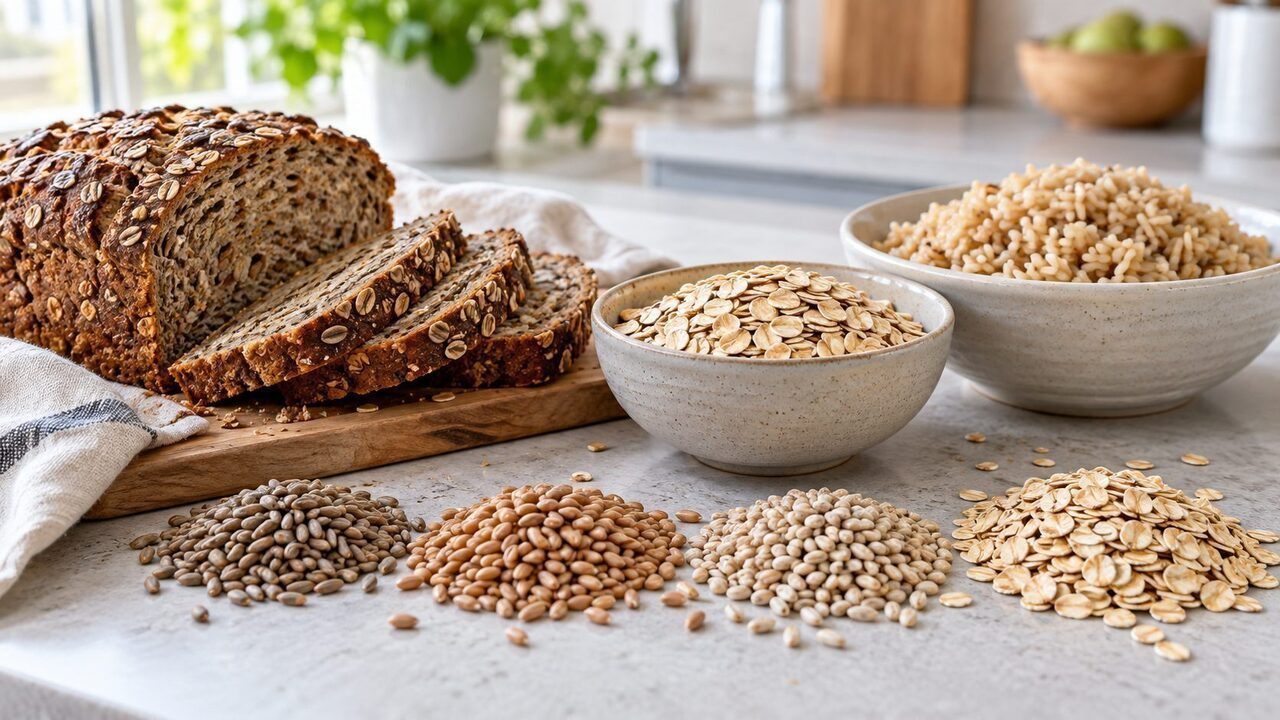
In short: Eighty-seven randomised trials show improvements in several cardiovascular risk markers. How large the effects are, where the limits lie and how whole grains fit into everyday meals.
The new evaluation is useful because it not only compares whole grains with control foods, but also looks for dosage patterns. At the same time, the specialist publication itself warns against using caution: many experiments were short, high amounts of food were rarely tested, and the safety of evidence varied by measurement value.
What exactly was analysed
The research team included randomised trials in adults lasting at least two weeks. Depending on the trial, whole-grain products were compared with refined grains, a diet low in whole grains, usual diets or general lifestyle advice. The products were not uniform: oats, whole-grain wheat, rye, brown rice and mixed whole-grain sources appeared in different amounts and preparations.
For an additional 48 grams of dry weight of whole grains per day, the dose analysis calculated on average, among other things, 0.20 kilograms less body weight, 0.22 centimeters less waist circumference, 0.07 millimeter per liter less LDL cholesterol, and 0.82 millimeter of mercury column less systolic blood pressure. Such averages help to understand the order of magnitude. They do not predict how much a single person changes.
For body weight and fasting blood glucose, the authors considered the changes in direct group comparisons to be clinically small. For LDL cholesterol, the average difference was more likely to fall within a relevant range. This distinction is crucial: a statistically measurable effect is not automatically large in everyday life or medically significant for every individual.
Why 60 to 100 grams is not a new target
In the nonlinear analyses, the greatest improvements in many risk markers occurred at roughly 60 to 100 grams of dry weight per day. Converted, the study gives about 115 to 190 grams of ready-to-eat whole-grain products, or four to six servings. This conversion depends heavily on the food and its water content: cooked brown rice cannot be directly equated with dry oats or a slice of bread.
Above certain quantities there were significantly less data and wider areas of uncertainty. The area found should therefore be understood as a plateau in the evaluated experiments, not as exactly optimal daily dose. Those who eat hardly any whole grain, do not have to plan from today to tomorrow six portions.
Short trials, no measured clinical events
The tests lasted on average about eight weeks. This is enough to observe blood values, blood pressure or weight, but not to reliably investigate heart attacks, strokes or life spans. Thus, the metaanalysis records risk markers and no long-term disease events.
Adverse reactions were also not systematically recorded in all studies. The evaluation found no clear increase in mild to moderate complaints, but the evidence was low. People with certain intestinal disorders, intolerances or a medically prescribed diet should adjust larger dietary changes individually.
What German recommendations already say
The German Society for Nutrition generally recommends the whole grain variant for bread, pasta, rice and flour. For adults, a guideline value of at least 30 grams of fiber per day applies. Whole grain is only one component: vegetables, pulses, fruits, nuts and seeds also contribute to fiber intake.
The new meta-analysis does not replace these food-related recommendations. Rather, it strengthens the statement that refined cereal products are more frequently replaced by whole grains. In many studies, the benefit arises precisely from the exchange within an overall similar energy supply, not by any additional food.
How to make the change without fixating on numbers
- Choose one meal: start at breakfast, for example, with oats or wholemeal bread. Find inspiration under Breakfast.
- How to trade: Replace a portion of white bread, light rice or regular noodles with the whole grain variant, instead of eating the portion in addition.
- Increase slowly: More fiber will often be better tolerated if the quantity is gradually increased and sufficiently drunk.
- Use variety: oats, rye, whole-grain wheat, brown rice, barley and other grains offer different flavours and cooking properties.
- Total product testing: Whole grains do not automatically make a highly sugary or highly salty product the ideal choice.
Three practical everyday combinations
For breakfast, combine oats with fruit and plain yoghurt or a suitable plant-based alternative. At lunchtime, brown rice can accompany stir-fried vegetables. In the evening, pair wholemeal bread with a lentil or bean spread. Grains and pulses also complement each other in terms of protein quality; suitable dishes can be found under Pulses and Vegetarian dinners.
If whole grains taste too strong at first, mix them: half wholemeal pasta and half regular pasta, or combine brown rice with a familiar rice variety. This is not a scientifically dosed programme, but a realistic way to change habits for the long term.
Conclusion: Replace rather than overdo
The new meta-analysis provides the widest randomized overview of whole grains and cardiometabolic risk markers so far. It shows small to moderate improvements in several measurement values, but no guarantee against cardiovascular diseases. Particularly high amounts cannot be derived as a binding target due to thin data.
For everyday use, the message is simpler than statistics: whole grains are more often substituted for refined cereal products, slowly grown, and combined with vegetables, pulses, fruits, and nuts. A single meal doesn't have to be perfect; it's the repetitive pattern that counts.
Sources and status
- Naghshi et al.: Whole-grain consumption and cardiometabolic risk: a meta-analysis of randomized trials, European Heart Journal, 16 September 2026, DOI 10.1093/eurheartj/ehag519. (Whole grain consumption and cardiometabolic risk: a meta-analysis of randomized trials)
- European Society of Cardiology: Four to six servings of whole grain per day lowers risk factors for heart disease, press release of 15 September 2026; data on study scope and average study duration.
- German Nutrition Society: Whole grain is the best choice, practical classification and examples of food.
- German Society for Nutrition: FAQ Fiber, recommended for adults at least 30 grams per day. (FAQ Fiber materials)
Author: Kochzauber editorial team. Information and update status: 16 September 2026. The article provides general nutritional information and does not replace medical advice.