3D-Printed Rice and Lentils: What the New Study Can Do
Researchers printed shape-stable foods from rice and lentil flour with little or no hydrocolloid. What worked—and what is not yet ready for the plate.
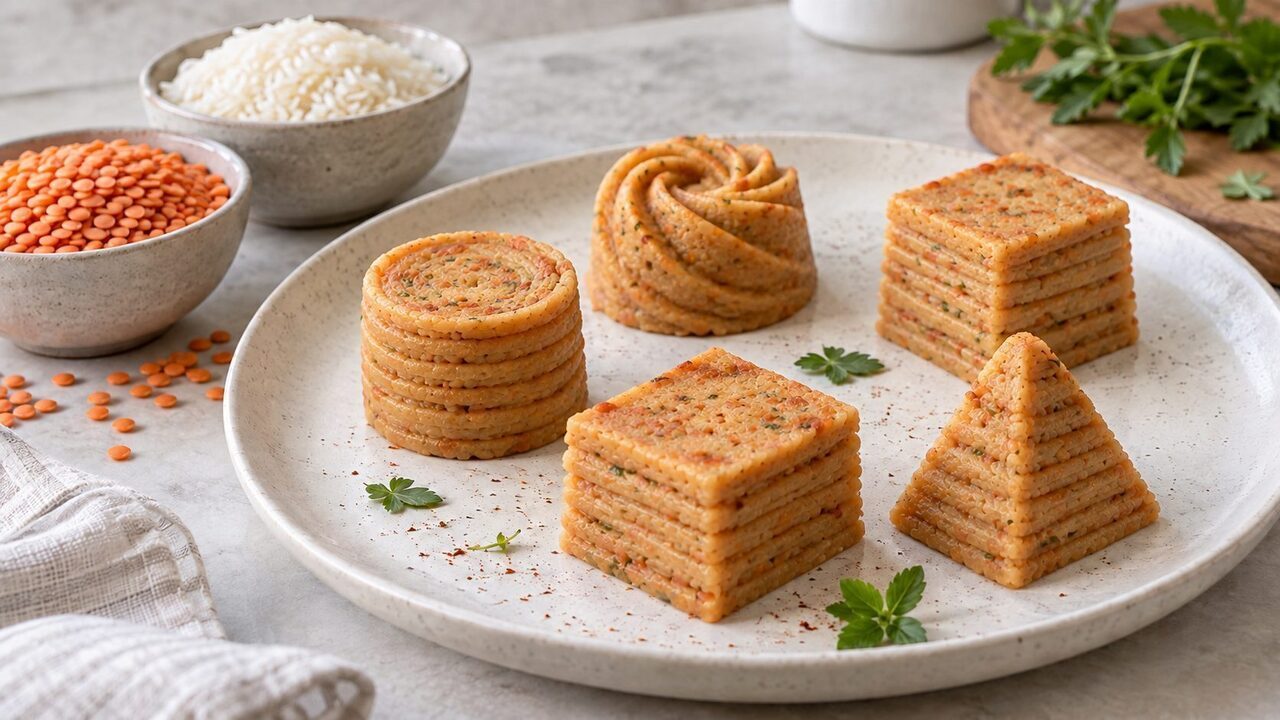
In short: Researchers printed shape-stable foods from rice and lentil flour with little or no hydrocolloid. What worked—and what is not yet ready for the plate.
The research report was published on 15 September 2026 and the underlying paper appeared in Innovative Food Science & Emerging Technologies. Less interesting is the butterfly or cloud shape of the samples than the ingredient strategy: Instead of purified protein isolates and large amounts of structural donors, the team focused on complete rice and lentils flour with their natural proteins, starches and fiber.
Why whole flours are harder to print
In extrusion pressure, a nozzle presses a soft mass layer by layer into a specified shape. For this, the paste must have opposite properties: under pressure it must flow lightly but be stable enough immediately afterwards so that the next layer does not sink.
Refined starch, protein isolates, and hydrocolloids can be more targeted. Whole flour behaves more complexly because proteins, starch, fat, and fiber bind to water and change fluid properties at the same time. This is exactly the challenge the team wanted to tackle with more everyday raw materials.
Eleven mixtures, three candidates
The researchers varied the ratio of rice flour to lentils and small amounts of other flour. Three formulations were selected for the detailed printing and gardening tests. One consisted essentially of rice flour and lentils. A second contained tapioca flour and only 0.05 percent xanthane by weight.
All three pastes became thinner as they flowed through the nozzle and stabilized afterwards. The xanthan-rich variant held particularly much water, but tended to clump when printing. The pure rice-lentil mix and the wheat and tapioka variant produced more uniform shapes. According to the team, the simple rice-lentil recipe cut particularly well when interacting with pressure and subsequent processing.
Why the shapes were frozen first
The freshly printed samples came into the freezer overnight at minus 18 degrees Celsius. This step reduced the deformation in the later preparation and made the fragile pieces easier to handle. Only after that they were steamed, dried, cooked hot air or treated in the microwave.
The garment method significantly altered the texture. Dried samples were denser, firmer and more cohesive. Dry heat withdrew water and produced cracks and browning. Hot air and microwaves caused some shapes to light up; the hot air fridge also provided a crust. The study thus shows not only whether a paste is printable, but how strong the subsequent process determines the final product.
Clean label is a research goal here, not a seal
The work addresses a common development objective: to make ingredient lists shorter and closer to familiar raw materials. Clean Label is not, however, a uniformly protected legal concept.
Furthermore, less processing must remain concrete. Milling, mixing, printing, freezing and grinding are processing steps. The main difference here is that the starting material was not first broken down into isolated protein and starch fractions and only one of the three selected mixtures contained a very small amount of xanthane.
What the study does not prove about nutrition
The team investigated flow behaviour, form fidelity, water binding, microstructure and texture. It was not a nutritional study with humans. Statements about saturation, blood sugar, long-term health or a better protein supply cannot be derived directly from the pressure tests.
Rice and lentils are nonetheless a nutritional-physiologically meaningful combination. The German Society for Nutrition explains that grains and pulses can have different amino acid patterns and complement each other specifically. No 3D printer is needed for this: lentils with rice, beans with bread or a coating of pulses with whole grain bread use the same basic principle.
What households can take from it today
- Use a proven combination rather than futuristic equipment: combine rice and lentils in curries, stews, salads or patties. Rice dishes and pulse recipes offer inspiration.
- Controlling texture over water and garlic: more water gives a softer mass; steaming, baking or hot air evaporation changes crust and firmness. This is a kitchen observation, not an exact transmission of pressure parameters.
- Fully garnished pulses: the usual safety information applies to even grilled or raw pulses; packaging information is complied with and raw beans or lentils are not tasted.
- Look closely at products: If 3D-printed food goes on sale, ingredient lists, nutritional value, allergens, and portion sizes will remain more important than the spectacular form.
Where the technology could actually be useful
3D food printing is capable of repeatedly adapting shapes and textures. These can be used in Community food, in individualised portions or in food for people with special intake and intake needs. However, this study did not test these target groups. Speed, cleaning, energy consumption, costs and large-scale production remain open.
For manufacturers, work is above all a building block of material development. It shows that complete flour, despite its complex composition, can be controlled and that post-treatment must be considered from the outset. Whether it becomes a good product is decided later on by taste, safety, nutritional value, price and everyday viability.
Conclusion: Interesting technology, familiar ingredients
The rice lens study is not a ready-made recipe for the supermarket, but a convincing proof of feasibility: with little or no extra hydrocolloid, it produced printable shapes whose texture could be deliberately altered by evaporation, drying, hot air and microwaves.
Even so, the most immediate benefit is not buying a printer. Rice and lentils already complement each other in classic dishes. Anyone wishing to try new plant protein sources can start with this simple combination and look for suitable ideas under vegetarian dinners.
Sources and status
- Pant et al.: 3D printing and post-processing of multicomponent rice-lentil based flour blends, Innovative Food Science & Emerging Technologies 112 (2026), 104684, DOI 10.1016/j.ifset.2026.104684.
- Singapore University of Technology and Design via Phys.org: 3D food printing of balanced vegetarian dishes from rice and lentil flours, 15 September 2026; research report with details on formulations and post-treatment.
- German Society for Nutrition: Protein Reference value and food sources, background for the combination of cereals and pulses.
- German Society for Nutrition: pulses and nuts, practical classification of plant protein sources. (Vegetables and nuts)
- Food clarity: Clean label, voluntary no advertising and indication of the ingredients list.
Author: Kochzauber editorial team. Information and update status: 16 September 2026. The article lists laboratory and material research and does not give product or health promises. The title image is an editorial icon.