Protein from CO₂ and Yeast: How Close Is the New Process to Supermarkets?
A university spin-off plans to turn CO₂, renewable hydrogen and microorganisms into protein-rich yeast biomass. Promising—but not yet a finished food.
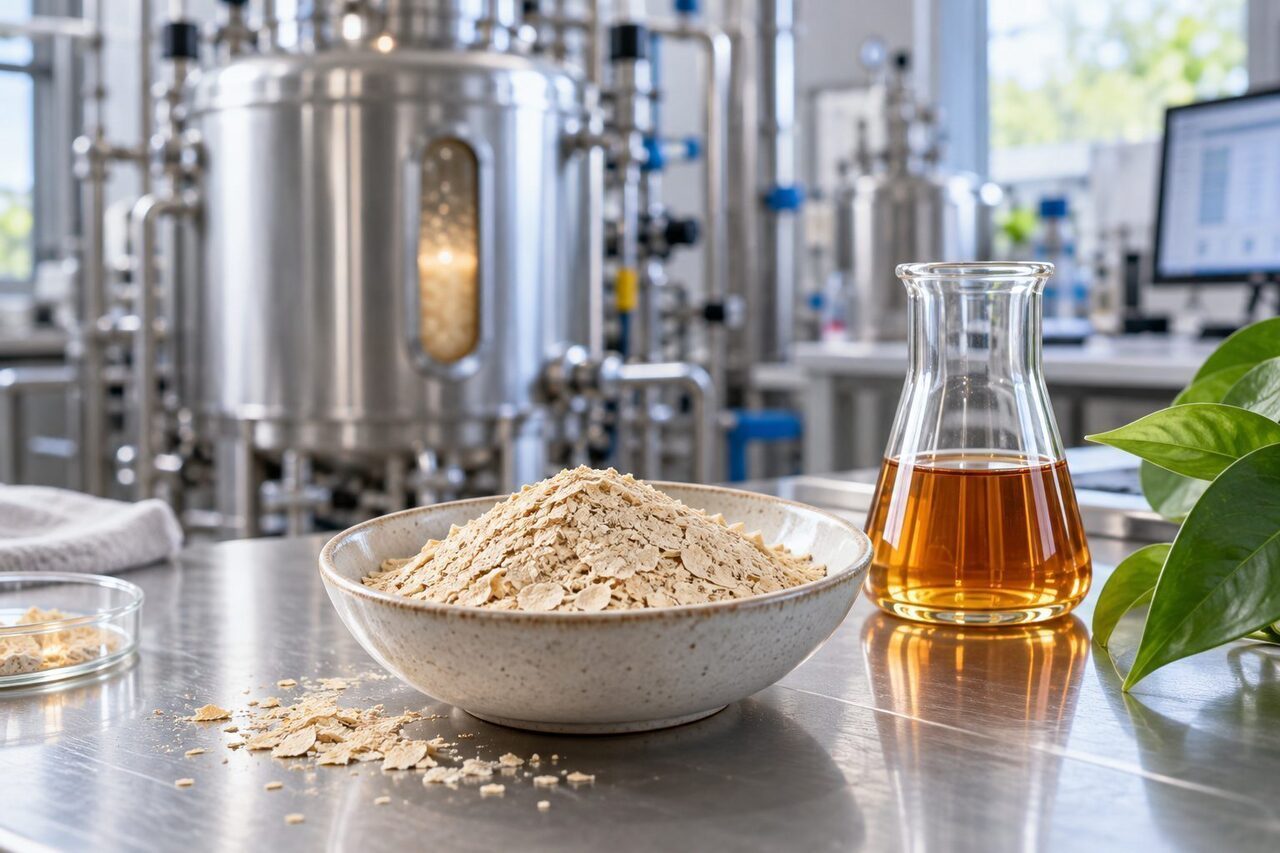
In short: A university spin-off plans to turn CO₂, renewable hydrogen and microorganisms into protein-rich yeast biomass. Promising—but not yet a finished food.
The approach belongs to the group of microbial proteins or single-cell proteins. Unlike peas, soya or wheat, the yeast does not need arable land to build biomass. However, it requires controlled fermentation, energy, water, nutrients and processing that ensures taste, safety and technological properties for food.
How CO₂ is turned into yeast
In the first process step, special microorganisms use carbon dioxide and hydrogen and form acetate. Acetate is the salt or conjugated base of acetic acid and serves as an intermediate, not as a finished ingredient. In the second step, yeast grows on this acetate and forms high-protein cell mass.
The university explicitly describes that this biomass needs to be further processed. Only methods for the disruption of cells, for the separation of unwanted components and for the adjustment of taste, texture and function can make it an appropriate food ingredient. The project investigates for this purpose, among other things filtration, heat treatment, pH adjustment and enzymes.
The new spin-off aims to combine the individual stages in a pilot plant at Campus AU Viborg into an integrated system. This is precisely the novelty value: not only a laboratory test, but the interaction of gas fermentation, yeast production and subsequent processing should be tested under more realistic conditions.
What the earlier PNAS analysis showed
The technical basis did not emerge only when the company was founded. A study published in the Proceedings of the National Academy of Sciences in August 2026 modelled an industrial system with a total reactor volume of 1,750 cubic metres. In the baseline scenario, 31,300 tonnes of CO₂ per year would be processed into 12,900 tonnes of dried yeast biomass, containing around 5,600 tonnes of protein.
These figures are not measured annual production of an existing factory. It is a techno-economic model. It shows the order of magnitude possible under the assumptions made and at what costs the product would be conceivable. The result was particularly strongly influenced by the electricity price and the energy demand of hydrogen production.
The study calculated additional heat treatment to reduce nucleic acids for a variant that is intended to cover the entire protein requirement. As a result, the modelled minimum selling price increased. This is an important counterpart to a simple promise of the future: More protein is not only a matter of fermentation, but also of safe preparation.
Why ‘made from CO₂’ does not mean ‘climate-neutral’
In this process, CO2 serves as a carbon source. Whether the finished protein has a low climate footprint depends, among other things, on the origin and preparation of carbon dioxide, the generation of electricity, the efficiency of electrolysis, heat requirements, drying, nutrients, transport and plant construction. A complete life cycle analysis cannot be replaced by the mere use of CO2.
The term "without agriculture" also needs precision. No additional arable land is needed for carbon production, but energy and raw material chains remain. The approach could complement existing protein sources; it does not make vegetables, cereals, pulses or agriculture superfluous.
Four hurdles before it reaches the food aisle
- Scaling: The two biological stages must work together in a stable and efficient manner over a long period of time.
- Taste and function: A high-protein biomass must be convincing in sensory terms in real formulations and must function for example in binding, emulsifying or providing structure.
- Safety and composition: Microorganisms, residual substances, nucleic acids, allergy risks and process controls must be evaluated for the specific substance.
- Authorisation: Novel foods may only be placed on the EU market if their status has been clarified and a Novel Food authorisation, if necessary, has been granted.
The fact that other yeast biomasses in the EU already have certain authorisations is not a free ticket for this specific product. Species, production processes, specification, use and consumption are part of the evaluation.
What consumers can take from this today
In the short term, the announcement does not change the purchase. There is no list of ingredients, no confirmed price, no approved amount of use and no reliable comparison in the finished product. Those who want to cook more plant-based meals, find established protein sources such as lentils, beans, chickpeas, tofu, nuts and cereals already on the market.
Our categories of pulses, vegetarian dinners and one-pot dishes offer practical ideas. Should a CO2-based yeast protein come onto the market later, the same tests would be useful as with other new ingredients: What exactly does it contain, how much protein provides a realistic portion, which allergens or hints the label calls, and what purpose does the ingredient in the product fulfil?
Conclusion: A new protein route, not yet a finished substitute
React Foods turns a research route into a pilot and scaling project. This is relevant because new protein sources do not have to exist in the laboratory alone, but also have to function technically, economically, in regulatory and sensory terms.
The previous studies provide a plausible basis for this and at the same time show the open points. Whether protein from CO2 and yeast will become affordable, resource-saving and culinary convincing in the future, is only decided in the integrated piloting and subsequent approval.
Sources and status
- Aarhus University: University spin-out sets out to turn CO₂ into food protein, university news published 16 September 2026.
- Schmitz et al.: Power-to-vitamins or Power-to-protein: An evaluation of the integrated system at an industrial scale from techno-economic perspectives, PNAS, August 2026, DOI 10.1073/pnas.2535684123.
- Aarhus University, Department of Food Science: Single cell protein from CO2-acetate – Proof-of-concept of downstream processing, overview of food processing.
- European Commission: Novel Food Authorizations, Procedures and Preconditions before placing on the market.
Author: Kochzauber editorial team. Information and updating status: 18 September 2026. The article puts a pilot announcement into context and model studies; it does not describe an already approved product. The title image is an editorial illustrative image.