Plant-Based Milk and Meat Alternatives: What the Safety Review Shows
A new official review compares risks and nutrients in plant-based alternatives. The products are generally considered safe, but differ by raw material, recipe and storage.
In short: A new official review compares risks and nutrients in plant-based alternatives. The products are generally considered safe, but differ by raw material, recipe and storage.
The current event is an official report of 9 September 2026. It summarizes a scientific review article of the Finnish Food Authority and the Research Center VTT. The paper was published in July. Important for the weighting: It is a narrative literature overview with a targeted search, not a formally pre-registered systematic overview work.
Why plant-based does not simply mean the same risks
Milk, meat, oats, soya, rice, peas and nuts come from different biological systems. This also makes possible loads different. The technical overview describes chemical hazards in plant raw materials, such as certain mycotoxins and metals. In animal foods, other microbiological hazards are more often in the foreground, depending on the product.
This is not a quality assessment of an entire product group. Proof in individual studies does not say that each product is contaminated or causes a health risk. The decisive factors are measured concentration, consumption quantity, manufacturing process and controls. The authors themselves stress that the available data for several substances is limited.
Raw material and processing shape the profile
Rice can absorb comparatively more inorganic arsenic. For rice-based beverages, maximum levels apply in the EU. Nuts and oilseeds may contain other metals or mould poisons depending on their nature and origin. Grains and pulses in turn bring their own raw material risks. The review also mentions newer or previously less comprehensively monitored mycotoxins, which still lack data.
More highly processed meat alternatives may also form substances that depend on the recipe and heating, such as acrylamide. This possibility does not justify a blanket assessment of the finished product range. The Finnish authority has announced further studies of specific products on its domestic market.
Spores survive heat better than many other germs
Many plant drinks are effectively heated. The evaluated literature found harmful microorganisms there as a whole rare. Bacillus cereus appears as a commonly called germ. Its spores can survive heating and germinate if stored inappropriately. The Federal Institute for Risk Assessment generally points out that fast cooling of heated foods or sufficient heat retention can limit the growth of spore-forming bacteria.
For households, the package instructions are decisive: an unopened shelf-stable product may tolerate different conditions from an opened drink or a chilled meat substitute. After opening, products should be refrigerated as stated on the label and consumed within the specified period. A homemade drink is not technologically equivalent to an industrially bottled and heat-treated product.
For nutrients, the specific label matters
Plant alternatives can contain fiber, are lactose-free and supply less filling fatty acids depending on the recipe. However, their protein content and protein quality differ greatly. The German Society for Nutrition points particularly to calcium, iodine, vitamin B2 and vitamin B12 in plant drinks when cow milk is replaced. Products from pulses, especially soy, are often closer to cow milk than many grain or nut drinks in the protein – however, the concrete nutrition table decides.
An enrichment prolongs the list of ingredients, but can be nutritionally useful. A short list is therefore not automatically the better choice. Even organic plant drinks may not be enriched with the same nutrients after the DGE classification for legal reasons. Anyone who regularly replaces dairy products should consider the supply throughout the diet.
Five checks for your next shop
- To clarify the purpose: An occasional shot in the coffee requires different requirements than a daily milk substitute or a main component of the meal.
- Compare protein per 100 millilitres or 100 grams: The same reference values make differences visible. The raw material name alone is not enough.
- Check for enrichment: Take care of calcium, iodine, vitamin B2 and vitamin B12 for regular milk replacement or plan suitable other sources. If you have individual questions, a qualified nutrition consultation will help.
- Read sugar, salt and ingredients completely: Few ingredients say nothing about all nutritional values. Compare similar products instead of completely different categories.
- Keep in mind the cold chain and the deadline: label open packs, pour them out clean and store them according to the manufacturer's specification. Do not use suspiciously smelly, bloated or visibly spoiled goods.
Less replacement product, more basic ingredient is also an option
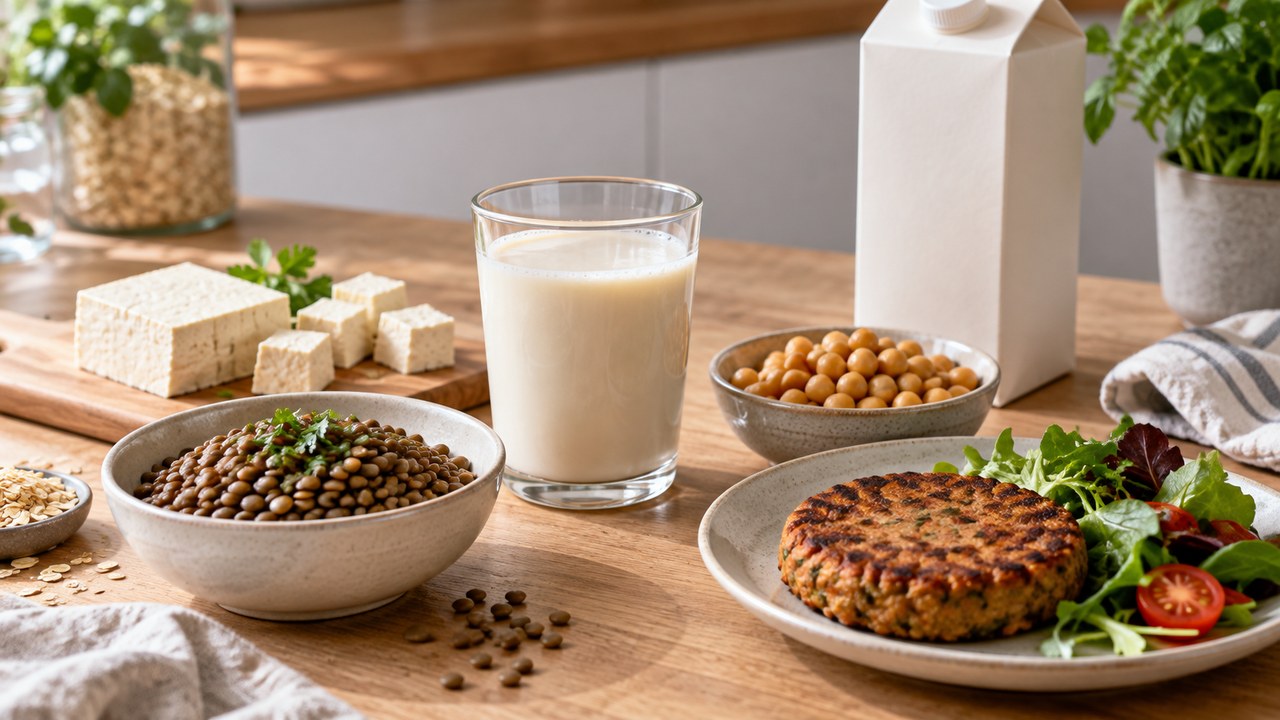
A plant-focused meal does not have to rely on highly developed substitute products. Lentils, beans, chickpeas, tofu, grains, nuts and vegetables can be combined directly. Our pulse recipes, breakfast ideas and vegetarian dinners offer practical inspiration.
Here, too, the usual safety rules apply. Raw dried pulses must be soaked correctly and cooked completely depending on the variety. Nuts and dry ingredients belong to cool, dry and protected storage. "Littlely processed is no substitute for hygiene, cooking time and suitable storage.
What the new overview does not prove
- It does not show that herbal alternatives are generally more risky or safer than milk and meat.
- It is not a current market comparison of individual German brands or batches.
- It does not allow for diagnosis or personal risk after consumption of a particular product.
- It does not replace allergen labelling. Soya, nuts, lupine or cereals containing gluten can be relevant for individual persons.
Conclusion: Product groups are too different for a flat-rate judgment
The Finnish classification provides above all a meaningful change of perspective: plant alternatives do not simply have the same safety and nutritional profile as their animal models. Overall, the products currently offered are considered safe, but raw materials, formulation, enrichment and storage remain crucial.
This is manageable for consumers. Compare ingredients list and nutrition table, take cooling advice seriously and consider the entire menu instead of a single advertising promise – this routine is more helpful than looking for a flat-rate "best" alternative.
Sources and status
- Finnish Food Authority: Plant-Based Alternatives to Milk and Meat Are Generally Safe, but Not Entirely Risk-Free, Report of 9 September 2026.
- Sohlberg et al.: Food Safety and Nutritional Aspects of Plant-Based Dairy and Meat Alternatives: A Review, Food Science & Nutrition, published July 7, 2026, DOI 10.1002/fsn3.72062.
- German Society for Nutrition: Plant-based milk alternatives, background to nutrients, enrichment and product selection. (Vegetable milk alternatives)
- Bundesinstitut für Risikobewertung: Bacillus cereus, background to spores, cooling and heating.
Author: Kochzauber editorial team. Information and updating status: 11 September 2026. The article provides general consumer information and does not replace individual medical or nutritional counselling. The cover image is an editorial symbol.