New Technique Gives Pulses a Fibrous Bite
An ETH Zurich team uses water, heat and directional freezing to turn whole lentils, beans and peas into fibrous gels. Here is what the method can do and which questions remain open.
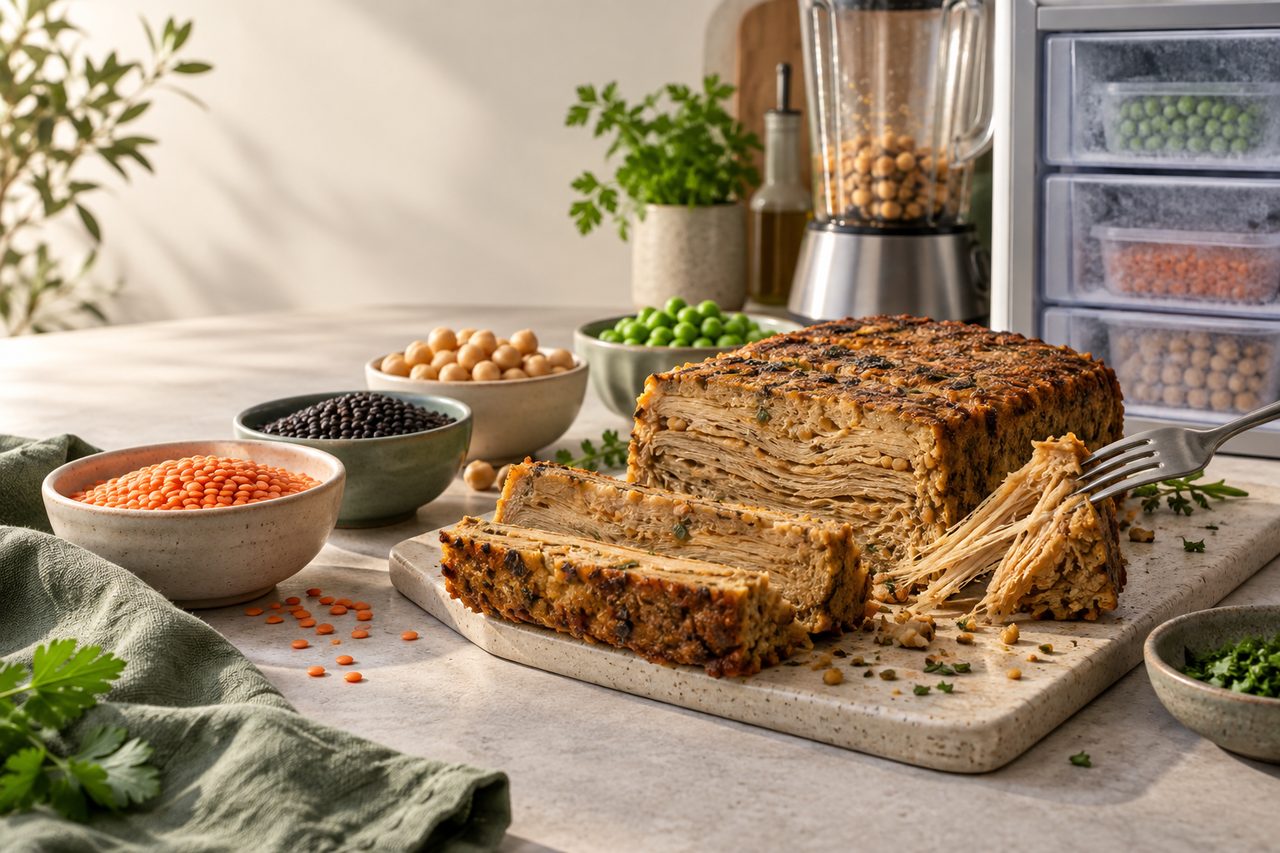
In short: An ETH Zurich team uses water, heat and directional freezing to turn whole lentils, beans and peas into fibrous gels. Here is what the method can do and which questions remain open.
What's new about the method
Many plant-based alternatives start with separate ingredients: protein, starch, fat and other ingredients are isolated and later reassembled. ETH team takes a different approach. It uses the whole soaked pulses as the starting material and dispenses with fractionation and additives in its process.
The study, published in npj Science of Food on 1 September 2026, describes this as freezing structure. Among other things, chickpeas, soybeans, peas, lentils, lupines, garden beans and mung beans were tested. Together, according to the study, these species represent 96 percent of the world's pulses production.
So ice crystals produce parallel fibers
During the experiment, pulses are soaked and finely pureed with water. By heating, a gel is formed: starch is glued, proteins change their structure and the mass becomes more stable. Subsequently, the gel freezes specifically from one side.
The growing ice crystals displace starch, protein and cell wall components into the interspaces. Because the ice grows along a temperature gradient in a preferred direction, parallel flakes are created. After thawing, this network remains intact. When cutting and chewing, the structure thus acts more fibrous than in a randomly frozen mass.
An all-round cold form provides less directed pores. For their experiments, the researchers therefore isolated the sides of the form and released an area for the cold input. Thus, the technology uses a physical process, not subsequently added fibers.
Which pulses provided which bite
All the species studied could be structured, but not with the same result. Red and black lentils as well as mung beans resulted in particularly solid, stable structures in the tests. Soybeans and black beans provided softer gels. In addition, the water content influenced the firmness.
These differences are interesting for product development: A soft mass could fit to a different food than a firm and hold their shape block. However, the study does not yet show which variant consumers prefer to taste. Sensory acceptance, seasoning, marinades, storage time and reliable preparation are further development steps.
What "minimal processing" means here
In the study context, minimal processing means above all: The pulses is not first decomposed into protein isolate, starch and other fractions. Purification, heating, freezing, thawing and later roasting still remain clear processing steps. "Minimally processed" is therefore not synonymous with raw or automatically healthier.
Nutritional physiologically, the use of whole pulses is plausibly interesting, because in addition to protein, starch, fiber and other plant components remain in the starting mass. However, the study was a study on structure and mechanics. It has not tested long-term health effects nor the actual nutrient intake in humans.
Can you try this at home?
ETH provides a one-sided quick guide: soak 100 grams of dry pulses for 12 to 16 hours, drain, clean with 250 millilitres of fresh water, heat with stirring, freeze, thaw in the refrigerator and then fry or bake the slices. According to the instructions, side-insulated, deep-coolable forms strengthen the alignment.
Raw beans, chickpeas, soybeans and lentils contain natural lectins. The Federal Centre for Nutrition advises that dried pulses are cooked completely softly after soaking in fresh water according to the package specification; fresh beans should cook for at least 15 minutes. Therefore, the research guide is not to be understood as a free letter for short-heated bean masses. Anyone experimenting should only choose suitable varieties, consistently adhere to the heating step and try no raw or semi-cooked mass.
Three safe ideas without laboratory setup
- Start with familiar textures: Use completely cooked lentils, beans or chickpeas for fryings, balls or spreads. You can find inspiration in our recipes with pulses.
- Control firmness over the variety: Red lentils disintegrate quickly and are suitable for creamy masses, while Beluga or Berglinsen remain grainier. This is classic kitchen experience and does not equate with the exact freezing structure of the study.
- Outside roasted aromas, inside juice: Form cooked pods as flat thalers and brown in pan or oven. Ideas offer our vegetarian recipes, vegan recipes and fast dishes.
Why research is relevant for the kitchen
Texture decides whether vegetable dishes are experienced as varied and satisfying. If a fibrous structure can be produced from whole, cheap pulses with existing refrigeration technology, the producer and kitchen could enable new recipes. At the same time, the complex extraction of protein isolates and a long list of additives are eliminated in the examined process.
How energy-efficient and economical the process is on a large scale cannot yet be conclusively derived from the laboratory results. Also the durability after thawing and the acceptance of different dishes must be investigated. The potential is currently in the simple process idea, not in an already proven market success.
Conclusion: Ice as a structural tool
The ETH study shows convincingly that directed freezing from whole pulses can form fibrous gels. The broad raw material base from chickpea to mung bean and the absence of isolated proteins and additives is particularly remarkable. For the day-to-day kitchen, the method remains an exciting experiment with clear safety rules. For food development, it is an approach to combine bite, plant diversity and less separated raw material use.
Sources and status
- Bach, Perler, Lemcke and Rühs: Freeze structuring unlocks minimal-processing strategies for legume texture, npj Science of Food, published on September 1, 2026. (Source)
- ETH Zurich: Innovation for your own kitchen: How to get pulses new bite, university report of 1 September 2026.
- ETH Zurich: Pulses in the kitchen – instructions for directed freezing, one-sided practical instructions of the research group.
- Bundeszentrum für Ernährung: Pulses: From shopping to the kitchen, background source for safe preparation; retrieved on 8 September 2026.
Author: Kochzauber Redaktion. Information and updating status: 8 September 2026. The article assigns an experimental study and does not replace a tested recipe instruction. The title image is an AI-generated symbol image.