Chickpeas as a Structural Toolkit: What the New Study Shows
A new study examines protein-rich and starch-rich chickpea fractions. In plant-based foods, the interaction of the whole matrix may matter more than maximising protein alone.
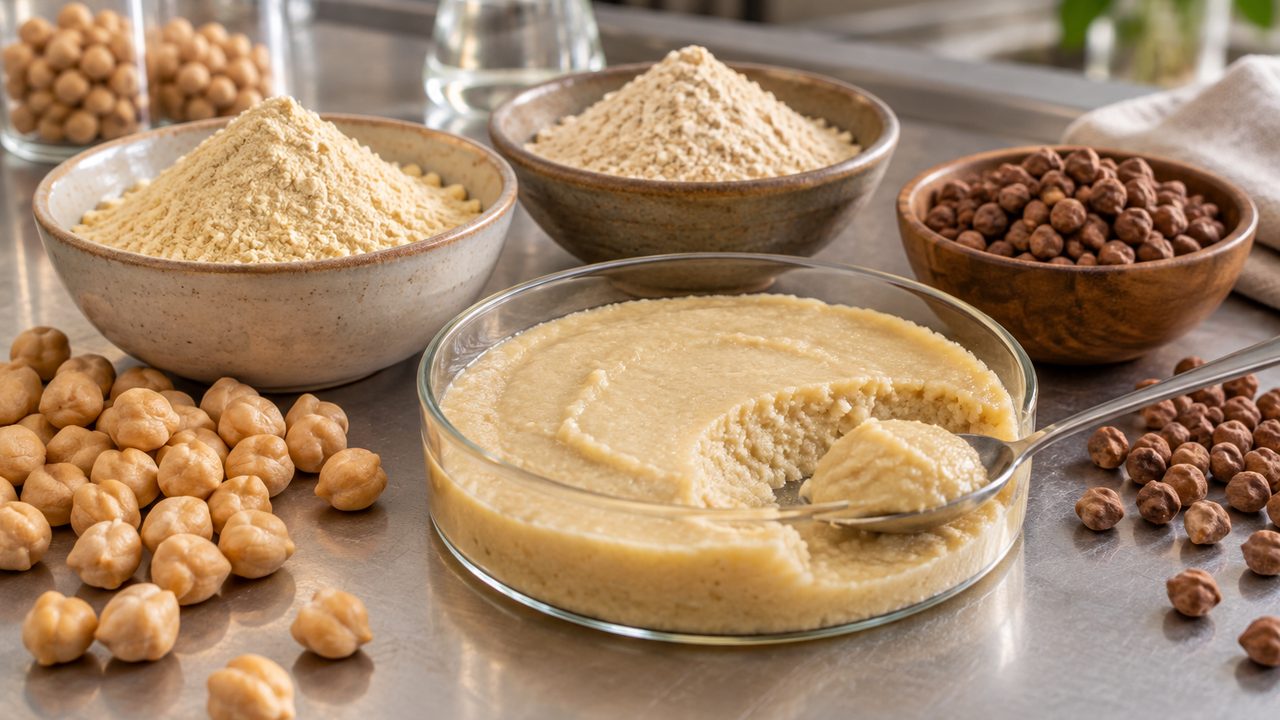
In short: A new study examines protein-rich and starch-rich chickpea fractions. In plant-based foods, the interaction of the whole matrix may matter more than maximising protein alone.
The work of CSIRO and partner institutions was published in ACS Food Science & Technology. Desi and Kabuli chickpeas were examined, which were ground with two rotor speeds and then separated by air classification. This is a dry sorting technique: Smaller, lighter and more protein-rich particles enter a fine fraction, larger stronger particles enter a coarse fraction.
Two types of chickpeas, two grinding steps, several matrices
Desi chickpeas are usually smaller and darker, Kabuli chickpeas are larger and brighter. The researchers did not treat both types as an exchangeable raw material. With greater grinding, the starch content in the fine Desi fraction decreased from 21 to 17 percent, while in the fine Kabuli fraction it rose from 8 to 12 percent. Thus, the same process step shifted the composition in different directions depending on the variety.
The coarse fractions each contained more than 50 percent starch and showed the highest viscosities and elastic moduli. Under strong shearing, all examined matrices decreased and recovered only partially. More starch was associated with better structural recovery, higher protein and fiber components with less recovery. The authors interpret starch as a bearing, space-filling phase; protein and fiber can interrupt this compound as individual inclusions.
Why "protein rich" does not automatically mean more functional
For food developers, an ingredient must do more than increase a nutritional value on the label. Depending on the product, it should bind water, thicken a sauce, rebuild structure after stirring or create a pleasant texture. If fractionation only optimizes protein enrichment, this technological function can be lost.
The new study therefore proposes a joint optimization of protein content, starch distribution and matrix architecture. This is also interesting for clean label development: If a comparatively little purified chickpea fraction itself provides structure, it could reduce additional modified strengths or hydrocolloids in individual formulations. However, the study did not test a finished commercial product and does not prove that additives generally become superfluous.
What "dry fractionation" means practically
During air classification, flour is first ground in such a way that protein and starch areas form particles of different sizes. They sort an air flow and centrifugal forces afterwards. Unlike many wet extraction processes, the separation itself does not need water and can leave native components in a less strongly purified matrix.
However, the process cannot be equated with simple chickpea flour from the supermarket. Rotor speed, particle size, variety and classifier determine the fractions. Also terms such as "naturally", "minimally processed" or "Clean Label" are not measured values for taste, nutritional value or environmental balance. For an overall assessment, energy requirements, yield, transport, formulation and side current use would be necessary.
Which product ideas can be derived from this – and which do not
Gel formation and structural recovery are relevant for creamy fillings, spreads, sauces, herbal alternatives and other soft to semi-solid foods. The results can help developers select a fraction to match the desired texture, rather than just comparing protein percentages. Whether a product tastes good, stays stable and works industrially, but needs to be tested in the specific formulation.
- It was shown: The composition and variety influence viscosity, gel strength and recovery after shearing.
- It has not been shown that the fractions replace meat, egg or milk in each food.
- Not studied: an advantage for health, satiety or digestion in consumers.
- It is still open: how sensoryly attractive, stable in storage and economically are products with these fractions.
The difference to the most recent freezing structure study
Kochzauber has already reported on another new method in which whole pulses get a fibrous structure after heating by directed freezing. The current work investigates something else: industrially produced fine and coarse chickpea fractions and their gel behavior after grinding and air classification. One process forms a husk fruit-based food, the other characterises ingredient building blocks for later formulations.
What already arrives in the kitchen
No air classifier is needed at home. Whole or precooked chickpeas are already versatile, inexpensive ingredients for hummus, curries, salads and soups. Germany’s Federal Centre for Nutrition notes that raw dried chickpeas must be soaked and cooked thoroughly; precooked chickpeas from a jar or tin can be used straight away.
The basic idea of the study can be observed in culinary terms: starch, protein, fiber, water and mechanical processing together determine the consistency. For hummus chickpeas are cooked very softly and finely pureed, for a salad they remain form-stabil. With liquid, tahini or oil the matrix changes again. Matching recipes are among pulses, vegetarian dinner and one-pot dishes in Kochzauber.
Conclusion: The whole matrix deserves attention
The study adds an important point to the debate about plant protein sources: a highly enriched fine fraction is not automatically the best ingredient for every application. Starch-rich coarse fractions can provide valuable technological functions, while the variety and milling process can substantially alter their properties.
For new products, this could encourage more resource-efficient use of both fractions and enable recipes with fewer additional structuring agents. For now, that remains a prospect arising from materials and process research. The next stage of development will determine the taste, market price, nutritional value of the finished product and its actual list of ingredients.
Sources and status
- Ratanpaul et al.: Starch-Dominated, Matrix-Modulated Gelation and Structural Recovery in Air-Classified Protein-Rich and Starch-Rich Chickpea Fractions, ACS Food Science & Technology, released September 11, 2026.
- Ratanpaul et al.: associated ChemRxiv preprint, method and result version; the journal version is decisive.
- CSIRO Data Access Portal: Low Moisture Extrusion Dataset for Six Plant Protein Isolates and Binary Blends, background for the use of chickpea and other plant proteins in textured foods.
- Bundeszentrum für Ernährung: Pulses: From shopping in the kitchen, preparation and safe use. (pulses: From shopping to the kitchen)
Author: Kochzauber editorial team. Information and last updated: 14 September 2026. This article puts laboratory and materials research into context and makes no health or product claims. The cover image is an editorial illustration.