AI Identifies 787 Plant-Based Emulsifier Candidates
A study published on 3 September 2026 identified 787 plant proteins with structures that may suit emulsification. The results narrow the search for new ingredients, but they are not ready-made supermarket replacements.
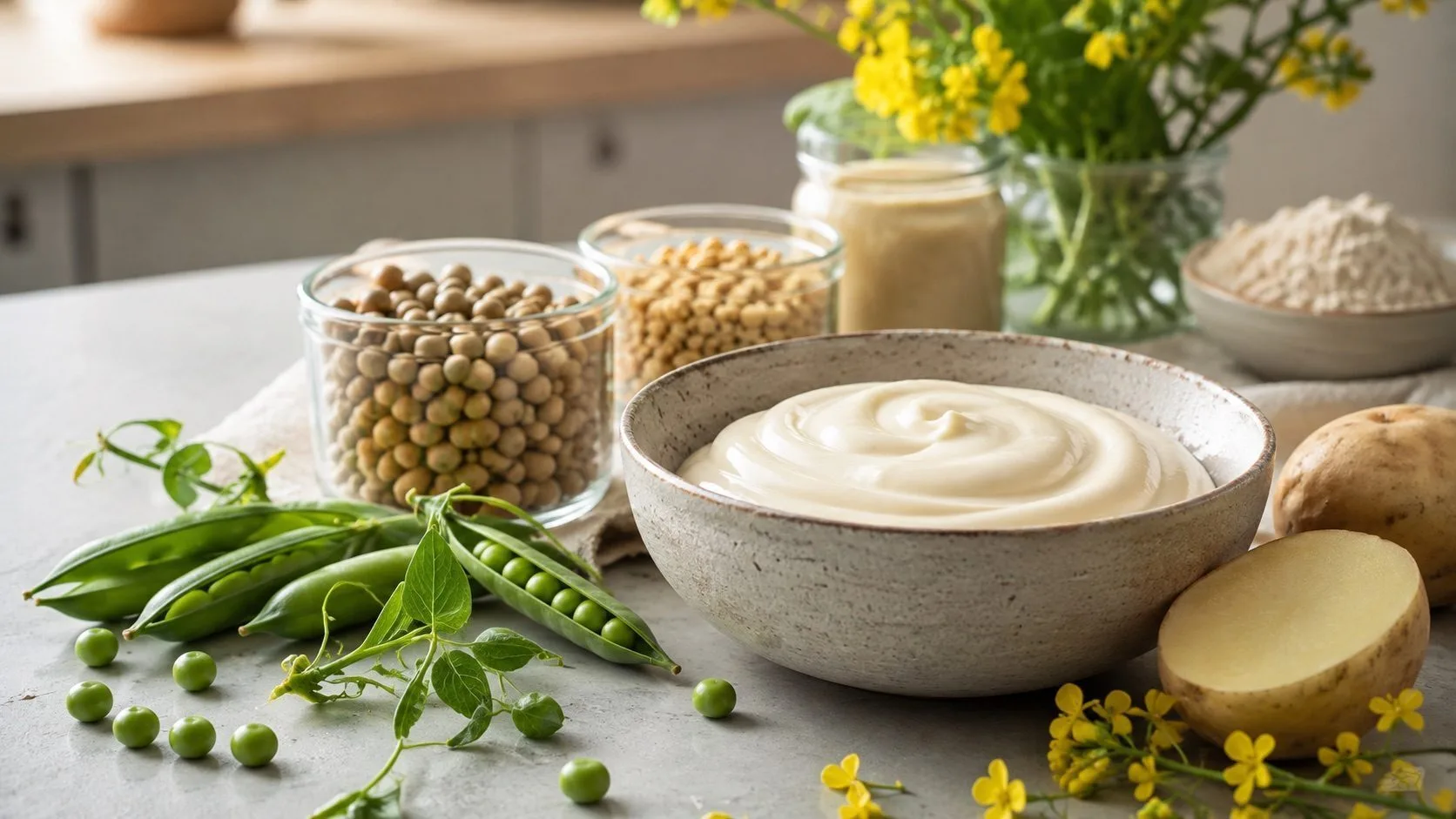
In short: A study published on 3 September 2026 identified 787 plant proteins with structures that may suit emulsification. The results narrow the search for new ingredients, but they are not ready-made supermarket replacements.
Why Emulsifiers are Important for Food
Oil and water usually separate. Emulsifiers gather at the interface of both phases and help to keep a mixture stable. This is important, for example, for mayonnaise, creamy sauces, ice cream or vegetable drinks. In many recipes, egg yolks take over this task; in industrially produced foods, other ingredients and additives can be used depending on the product.
Plant proteins are interesting because a protein can not only be a nutrient, but also fulfils a technological function. Therefore, suitable proteins for plant-based products could also give structure and stabilize oil-water mixtures. If you want to try out the basics practically, Kochzauber will find suitable ideas with pulses and potatoes.
So out of millions of sequences, 787 candidates were selected.
The work, published in Communications Chemistry on 3 September 2026, combines statistical physics with machine learning. The starting point was a very large protein database. The team selected 1,950 experimentally tested plant protein sequences for calculations via several filters; for 1,858 of them the simulation model converged.
A so-called diblock-like arrangement was sought. In simple terms, such a protein has an area that is rather attached to a fat-like surface, and another, which is more protruding into the watery phase. Precisely this division of work can stabilize an emulsion. Two groups found in the model comprised together 787 proteins with this signature.
Machine learning was then used to distinguish the characteristics of the two protein ranges and to compare candidates with the milk protein beta-casein as a reference. According to the study, not only the mere amino acid sequence was decisive, but above all the simulated arrangement of the protein at the interface.
Peas and potato passed a first laboratory test
For the experimental test, the team selected proteins that were already available in sufficient quantities: Legumin B from peas and patatin, the main protein of the potato. Both were able to form oil-in-water emulsions in the experiments; the measured droplet sizes were in a similar range as the reference beta-casein. A tested sunflower protein, however, without the desired structure stabilized the emulsion.
These results are an important proof of feasibility for the selection method. However, they do not mean that pea or potato protein replaces casein equivalent under all conditions. The study reports differences in rejection forces and droplet distribution. Above all, legumin B and patatin were chemically developed with urea and dithiothreitol before the measurements. This creates suitable laboratory conditions for the model, but is not a usual food preparation.
What the study has not yet answered
- No 787 finished ingredients: The number indicates selected candidates. Only a small, available part was tested experimentally.
- No statement about durability in the supermarket: long-term stability, taste, colour, processing, costs and behaviour in real recipes must be examined separately for each candidate.
- No automatic clean label guarantee: A vegetable origin alone does not say anything about the length of the ingredients list or the degree of processing of the finished product.
- No equivalence with casein under all conditions: The tests support the selection principle, but at the same time show measurable differences to the milk protein reference.
What consumers have of it
In the short term, the study does not change the list of ingredients. Its benefits are that developers can choose promising proteins more specifically, rather than testing millions of possibilities individually in the laboratory. If this results in marketable ingredients, manufacturers of vegetable sauces, desserts or drinks could choose from more functional protein sources in the future.
When purchasing, the list of ingredients remains the most reliable guide. According to the EU Food Information Regulation, additives with their functional class and their specific name or E-number are called, for example, "emulsifier: ...", whereas a pea protein or potato protein used as an ingredient may appear under its specific name. Therefore, one should not only search for E-numbers, but also read the entire list of ingredients and the advertised product property.
The new technique is not necessary for your own kitchen: Classic emulsions continue to work with a suitable combination of emulsifier, slowly added oil and strong mixing. Those who cook vegetable can use, for example, mustard, pulses puree or, depending on the recipe, soy or pea ingredients. Our vegetarian dinners and one-pot dishes offer inspiration.
Conclusion: a better searchlight, not yet a supermarket product
The actual novelty is not a single miracle substance, but a method: Physical simulations and machine learning can greatly limit the search for functional plant proteins. The 787 candidates show how large the previously little investigated space is. Whether better, cheaper or more understandable declared foods arise from this is only decided in further experiments under real production conditions.
Sources
- Sridharan et al.: Data-driven pipeline enables discovery of plant protein surfactants, Communications Chemistry, published on September 3, 2026.
- University of Leeds: AI identifies hundreds of promises plans proteins for sustainable food ingredients, accompanying report to the study. (Source)
- Research Data Leeds: Data set for the study, raw data of the main and supplementary images, CC BY 4.0.
- Regulation (EU) No 1169/2011, and in particular Article 18 and Part C of Annex VII thereto.