Blue when dry, pink when damp: What the new packaging sensor can do
A porous starch sensor changes colour as crackers lose crispness in humid packaging. The idea is clear, but cobalt chloride means the prototype is not food-safe yet.
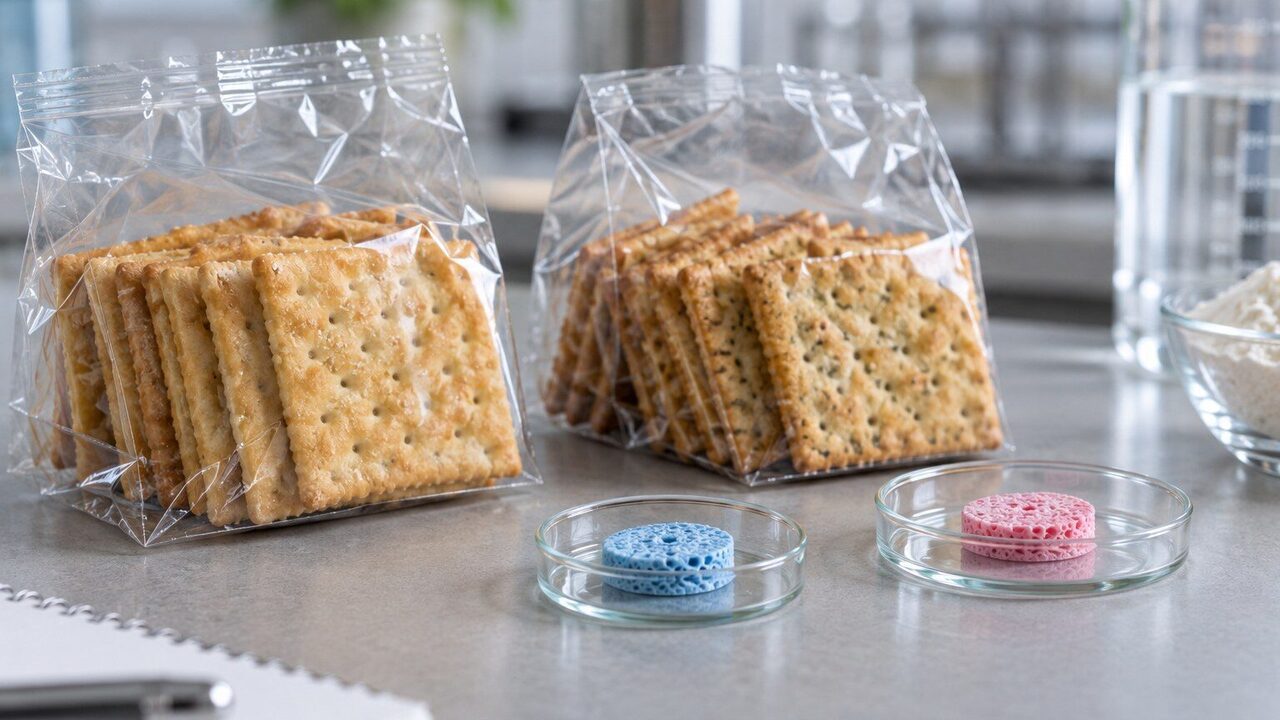
In short: researchers at the University of São Paulo developed a porous starch-based sensor that changes from blue to pink as humidity rises. In cracker tests, the colour value correlated with internal humidity and texture loss. The research release published on 23 September 2026 describes a prototype, however: its cobalt chloride is toxic and must not touch food directly.
How the sensor is made
The team produced starch cryogels. A gel is frozen and freeze-dried, leaving a porous structure. Embedded cobalt chloride binds water: it looks blue when dry and pink when hydrated. The large internal surface makes the small cylinder sensitive to changing humidity.
Which conditions were tested
The researchers compared several cobalt chloride concentrations. Cryogels containing 20 percent showed the greatest humidity sensitivity. Initial tests used 18, 60 and 99 percent relative humidity. Further experiments ran at 45 and 75 percent and inside polypropylene, polyethylene and gelatin-film packs containing crackers. Image analysis linked colour values to humidity and declining crispness.
What is new and potentially useful
A visible indicator could eventually show whether a dry food experienced unfavourable moisture. Unlike a printed best-before date, it would reflect a condition inside that particular pack. The colour response appeared within seconds and could also be analysed from a smartphone image.
This does not show that the sensor detects spoilage, pathogens or every quality problem. The work mainly examined humidity and cracker texture. Meat, cheese and fresh produce would require different indicators and separate validation.
The decisive limitation: cobalt chloride
The research group explicitly states that the prototype is toxic because of cobalt chloride and cannot contact food directly. A starch base does not automatically make the whole component edible, compostable or safe. Any application would need reliable separation from food, migration testing and redesigned packaging.
PFAS-free is a separate question
The study did not test PFAS and does not prove that a package is PFAS-free. New EU limits for PFAS in food-contact packaging have applied since 12 August 2026. In addition, every food-contact material must avoid transferring harmful quantities of substances or unacceptably changing food composition, taste or smell. A bio-based sensor has to meet the same safety rules.
What consumers can use today
- Do not treat a colour dot as a safety seal: without validated instructions, a humidity indicator says nothing about microbes or whether food is safe to eat.
- Avoid damaged packs: broken seals or condensation can be warning signs for dry foods.
- Follow storage instructions: reseal packs and protect dry goods from steam and high humidity.
- Do not copy the laboratory chemistry: cobalt chloride does not belong in kitchen experiments.
For simple pantry ideas, browse our breakfast recipes and vegetable recipes. The study itself does not provide a new storage rule for commercial products.
Conclusion: a clear prototype with a long safety path
The starch body responded visibly and sensitively to moisture, and its colour followed texture loss in crackers. That makes it interesting for intelligent packaging. Before a product is possible, researchers still need safer indicator chemistry, migration tests, protection from food contact, long-term trials, scalable manufacture and regulatory assessment.
Sources and status
- FAPESP/University of São Paulo via EurekAlert: Starch-based sensor changes color to indicate moisture in food packaging, research release dated 23 September 2026.
- Nakashima et al.: Starch-based cryogels incorporating cobalt chloride as colorimetric moisture sensors for food packaging, Food Chemistry, 2026.
- European Commission: Food-contact materials and safety requirements.
- EUR-Lex: Regulation (EU) 2025/40, PFAS limits applying since 12 August 2026.
Author: Kochzauber editorial team. Information updated: 24 September 2026. This article explains a laboratory prototype and is not an approval for food contact. The header image is an editorial symbolic image.