Packaging inks: new study improves migration models
A new laboratory study examines five photoinitiators from UV-curable inks and their migration into milk powder. Volatility, temperature and humidity matter more than a single blanket value.
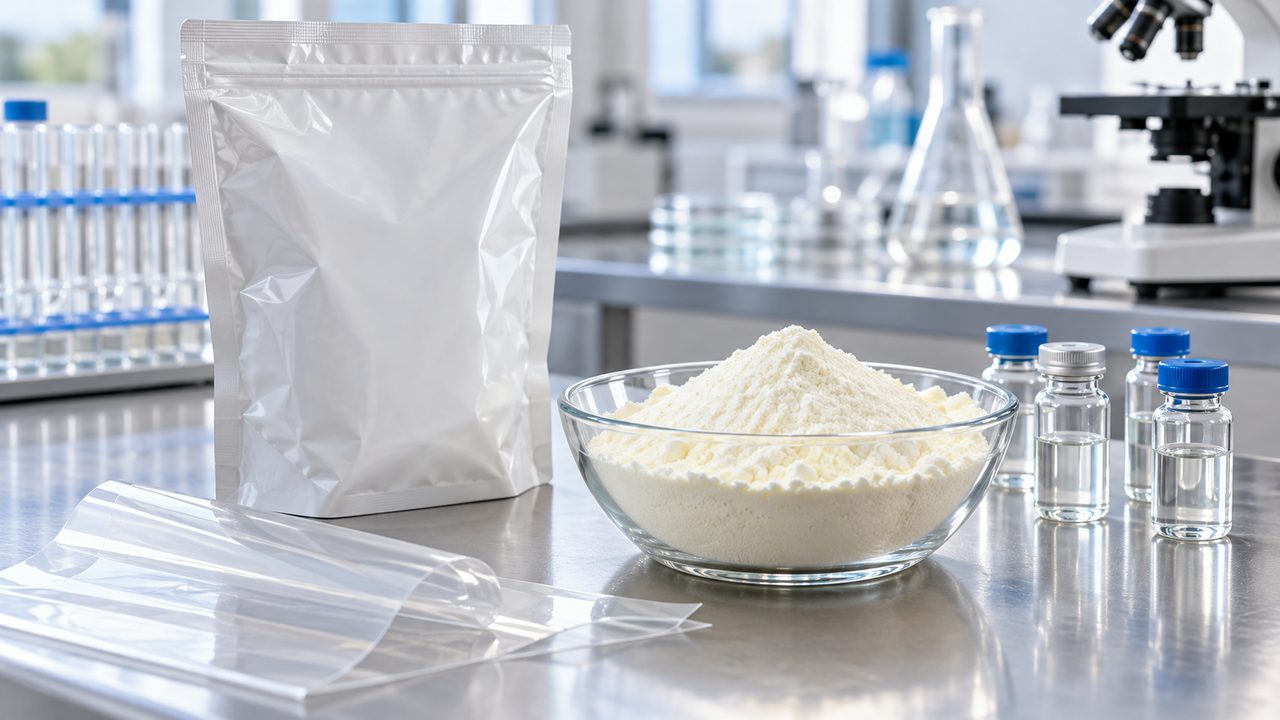
A study published in Analytica Chimica Acta on 8 October 2026 investigates in the laboratory how five photoinitiators migrate from plastic material into milk powder. These substances help UV-curable printing inks to harden. The result is not a recall or a test of a branded product; it is an effort to calculate migration more realistically according to volatility.
Why printing-ink components can move
Food packages are often printed on the outside. Components may nevertheless diffuse through a material, transfer through the gas phase, or move from the printed exterior to the eventual food-contact side while rolls or stacks are stored. Specialists call the last route set-off. The amount transferred depends on the substance, material, food, storage time and temperature.
Photoinitiators start the curing of certain inks under UV light. Residues may remain after printing. The new work addresses a recognised difficulty: volatile substances may behave differently from less volatile ones. A model that ignores this distinction can find it harder to reconcile laboratory results obtained under different conditions.
Five substances, two modelling approaches
The more volatile substances 4-MBP, PI-184 and EDB and the less volatile substances EHA and PI-907 were studied. The researchers varied migration time, temperature, starting concentration, humidity, and the thickness and type of the migration medium. They therefore tested several influences in a simplified system rather than only one final measurement.
For the less volatile photoinitiators, a model based on Fick’s second law described transfer and produced diffusion and partition coefficients. A Weibull model fitted the more volatile substances better. According to the study, temperature and humidity sometimes had opposing effects in the two groups. Volatility should therefore be considered explicitly in safety assessment and in the selection of printing-ink systems.
What the study does not say
The experiments do not establish a specific level in milk powder sold in Germany and do not calculate an individual health risk. They examine a laboratory setup with selected substances and plastic as the migration medium. Real packs add layer construction, barriers, printing method, manufacturing quality, storage and the actual food matrix.
In the European Union, food-contact materials must not release components at levels that endanger health or alter food unacceptably. Plastics are subject to migration limits and standardised testing conditions. Germany’s Federal Institute for Risk Assessment also explains the national printing-ink rules, including a positive list and possible specific restrictions. The new modelling work can complement such tests, not replace them.
Practical points for households
- Use bags, containers and films only for food and within their intended temperature range; a package is not automatically suitable for heating.
- Do not transfer food into printed shipping, craft or storage materials that were not designed for food contact.
- Follow manufacturer instructions on storage and shelf life, and replace badly damaged packs when their protective function is no longer reliable.
- Do not infer risk from bright colours or a glossy surface alone; material structure, substances, barriers and tested use are what matter.
Responsibility for compliance rests with manufacturers and official controls, not a household visual inspection. Consumers can follow the intended use, but they cannot reliably assess chemical migration from an intact package themselves.
Conclusion: test more precisely, not warn indiscriminately
The study shows why volatility deserves more attention in migration models and why one calculation pattern cannot fit all photoinitiators. It provides methods for packaging assessment, not a reason to avoid a particular product. Anyone wishing to reduce packaging can plan more meals from basic ingredients, including breakfast or dishes rich in vegetables.
Sources
- Analytica Chimica Acta: photoinitiator migration study
- German Federal Institute for Risk Assessment: printing inks
- European Commission: food-contact material legislation
Author: Kochzauber editorial team. Updated: 9 October 2026. The laboratory study evaluates selected substances in a model system, not specific products on sale.