Oat dessert with balangu gum: What the new food study really shows
A new study combines an oat base, encapsulated lactic acid bacteria and plant gum from balangu seeds. The product remained stable for 21 days—but that is neither proof of a health benefit nor a market-ready dessert.
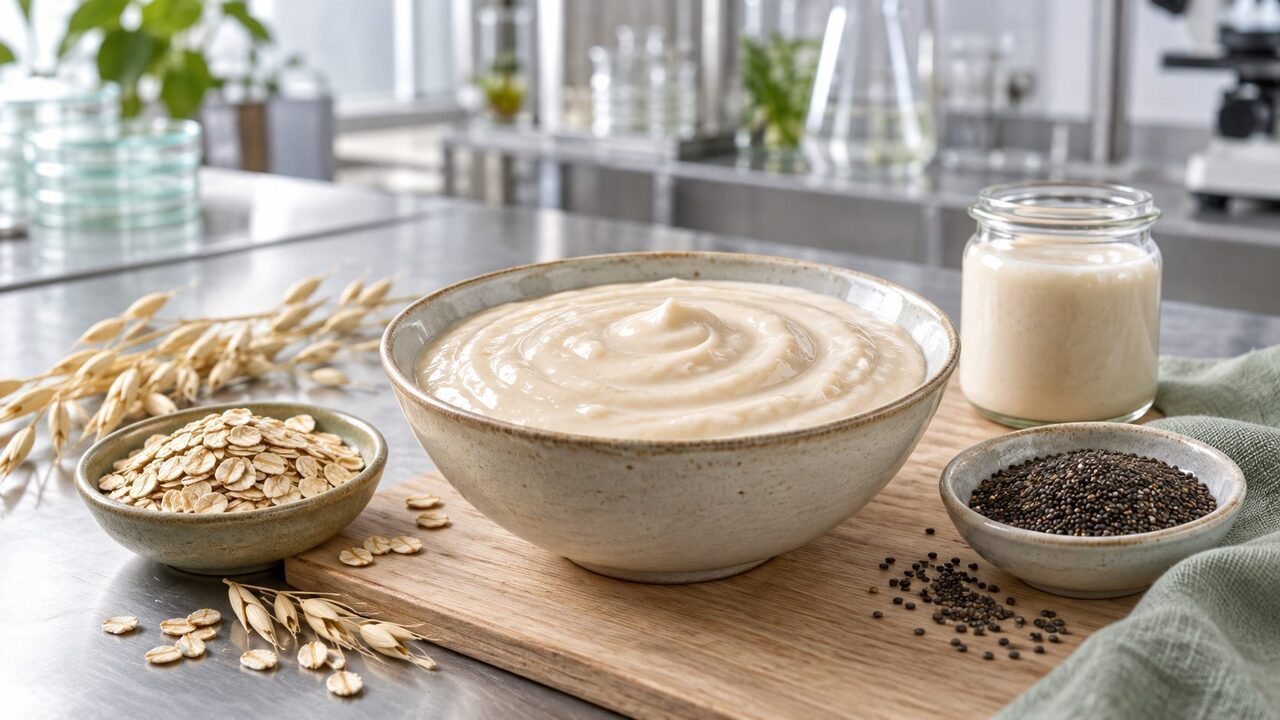
In short: researchers have developed an oat-based herbal dessert with microencapsulated lactic acid bacteria and a plant gum made from Balangu-Shirazi seeds. In the study published on September 18, 2026, the combined formulations remained relatively stable at four degrees Celsius for 21 days, microbiologically and sensorially.
What balangu gum is
Balangu Shirazi is the common name for Lallemantia royleana, a plant in the lipblower family. Its seeds form a mucous layer in water, from which a polysaccharide-rich plant gum can be obtained that binds, thickens and stabilizes food structures.
Such hydrocolloids are of interest to product developers because non-milk-white vegetable drinks and desserts require other structural designers. The rubber is not the source of the product's protein: in the sample studied, it consisted predominantly of carbohydrates and contained little protein. Its main task was in texture and water binding.
How the experiment was designed
The team compared a control recipe without balangu gum or added culture with three combined recipes. These contained the same amount of microencapsulated Lactiplantibacillus plantarum culture but different amounts of balangu gum. The desserts were stored for 21 days at four degrees Celsius.
Among other things, the study examined moisture, composition, texture, presumed lactic acid bacteria, and yeasts and moulds. In addition, 28 trained participants aged between 22 and 40 assessed colour, aroma, sweetness, firmness, and overall acceptability on three measurement days.
With increasing Balangu content, the combined recipes became more moisturized and softer. Sensory changes during storage were less severe than during control, and high numbers of suspected lactic acid bacteria remained measurable.
The main limitations of the study
The authors themselves point to a central limitation: because the control contained neither the plant gum nor the encapsulated culture, the effect of the two components on the control cannot be clearly separated.
In addition, the nutritional medium used was not specific, so the colonies counted after storage were correctly designated as suspected lactic acid bacteria; their identity was not confirmed molecularly. The sensory sample was small and consisted of trained persons from an establishment.
- No human studies: It has not been examined whether consumption affects digestion, immune system or other health values.
- No finished product on the market: industrial scale, costs, authorisation, transport and longer durability remain open.
- It's not a simple kitchen instruction.: microencapsulation, sterile work steps and microbiological controls are laboratory procedures.
- No automatic clean label statement: Plant origin alone does not say anything about the comprehensibility, length or overall quality of an ingredient list.
What consumers can learn from this
For the time being, the practical benefit lies in a better look at ingredient lists. Terms such as plant gum, thickening agents or cultures describe different functions: a hydrocolloid primarily provides texture, an added culture for fermentation or a defined amount of microorganisms. Both are not automatically a health promise.
In the EU, there are specific rules for health-related advertising. statements about a link between food and health must be scientifically evaluated and approved. The EU Registry lists permitted and unauthorised information and conditions.
If you buy a vegetable dessert today, you can therefore carefully compare which ingredient comes first, how much sugar is in it, what protein source is used, what allergens are labeled, and what portion size fits your diet plan. (Breakfast; Vegetarian dinner)
Why the Approach Is Still Exciting
Plant alternatives often fail in product development not on a single ingredient, but on the interaction of texture, water binding, taste, microbiological stability and storage. The study shows how a little used seed rubber and a protected bacterial culture can be studied together, thus providing a blueprint for further testing rather than a finished product promise.
For future research, separate controls with only balangu rubber or only encapsulated culture would be important, as would larger consumer panels, a clear identification of the surviving strains of bacteria, and studies under real production and transport conditions.
Conclusion: Textural innovation instead of health wonders
The new oat dessert remained stable for three weeks under laboratory conditions and became softer and wetter as the proportion of seed gum grew, making balangu gum an interesting plant structuring agent, but the study does not prove any effect on the human body and does not allow for any unambiguous statements about probiotics or plant desserts.
Therefore, the product in question is still relevant: the list of ingredients, the nutritional value table, allergen indications and permitted advertisements are more meaningful than keywords such as functional, natural or probiotic.
Sources and status
- Daneshniya et al.: Development and characterization of a functional oat milk-based cereal dessert, Food Science and Biotechnology, published on 18 September 2026.
- European Commission: Nutrition and Health Claims, legal framework for nutrition and health information.
- European Commission: EU Register of Health Claims, database of authorised and unauthorised claims.
Author: Kochzauber editorial team. Information and update status: September 19, 2026. The article orders a laboratory and product development study and does not contain any health promises.