Mung bean starch broke down more slowly: why this is not yet a kitchen trick
A new laboratory study combines thermosonication with calcium chloride and changes mung bean cell walls and starch. Estimated glycaemic index fell, but human studies and finished foods are absent.
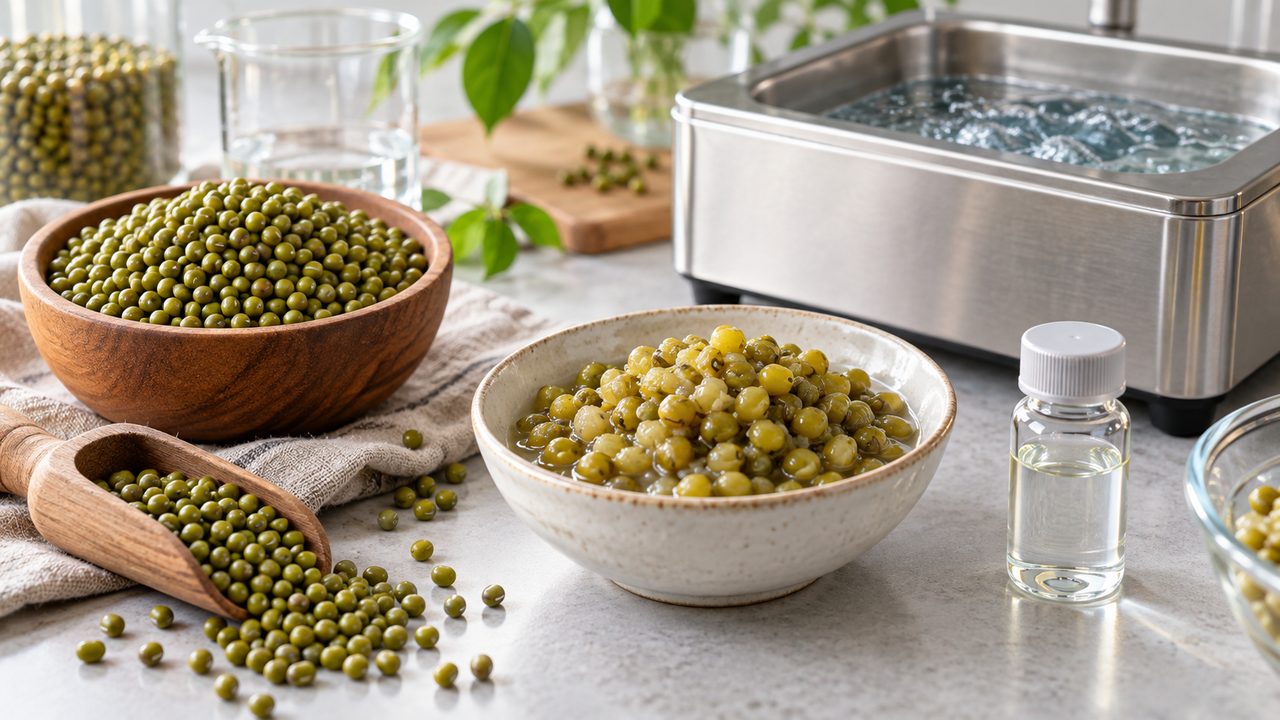
A study published on 9 October 2026 examines how a combined treatment using heat, ultrasound and calcium chloride changes mung bean cell walls and starch. The starch was subsequently hydrolysed more slowly in the laboratory and its glycaemic index was estimated to be lower. This is a product-development approach, not yet evidence of an effect in people.
Why the cell wall helps determine starch digestion
Starch is not eaten in isolation. In an intact bean cell, cell walls can restrict access by digestive enzymes. Processing may weaken this barrier but can also promote new bonds or more ordered starch structures. The researchers therefore wanted to consider the cell wall and starch granule together.
Thermosonication combines heat and ultrasound. In the study, this step first increased cell-wall permeability and facilitated calcium uptake. Added calcium chloride then altered pectin-related structures. It is a controlled technical process, not ordinary soaking or boiling.
Which structural changes were observed
The combined treatment increased non-methyl-esterified galacturonic-acid structures and, in the team's interpretation, strengthened the cell wall's barrier properties. Greater adsorption and inhibition of alpha-amylase were observed at the same time. This enzyme helps break starch down.
The starch itself also changed: the study reports less starch damage and greater granule aggregation, more amylose, increased short-range order, V-type structural features and more resistant starch. Double-helical organisation and relative crystallinity decreased. The interaction, rather than one marker, was associated with slower hydrolysis.
Estimated GI is not a human blood-glucose test
The wording 'estimated glycaemic index' is crucial. The value was derived from a laboratory digestion model. No participants were studied after a mung bean meal, and neither individual blood-glucose curves nor long-term effects were measured.
The result therefore supports neither a treatment recommendation nor a health promise for a product. Before a commercial application could be assessed sensibly, formulation, taste, texture, calcium content, process stability and digestion in the finished food would all need examination. Suitable human trials would then be required.
Why calcium chloride is not a home experiment
Calcium chloride is used in various food processes, but concentration, contact time and process control determine the outcome. The study cannot be recreated by adding a salt by eye during cooking. Such a shortcut might change flavour and composition without producing the investigated structure.
At home, safe standard preparation remains more important: soak dried pulses as directed on the pack where required, and cook them fully. Germany's Federal Centre for Nutrition explains that soaking water may be discarded depending on the purpose and that cooking times vary by type. The DGE advises heating mung bean sprouts before eating.
Pulses already offer everyday value
There is no need to wait for a newly processed product to plan pulses into varied meals. The DGE recommends at least 1 portion a week and gives 125 g ready-to-eat or about 60-70 g dried pulses as guidance for 1 portion. This is general advice for healthy adults, not individual diet therapy.
Cooked mung beans work in curries, soups and salads; other beans or lentils can take the same role depending on availability and price. Kochzauber offers ideas under pulses and vegetarian dinners. For a household budget, comparing dried goods, tins and actual cooked yield is more useful than a future functional promise.
Conclusion: an interesting process, not a finished nutrition message
The study plausibly shows that cell wall and starch can be influenced together through processing. The lower estimated GI is a laboratory-model result and should be described exactly that way. For consumers, the practical message remains grounded: cook pulses safely, vary them regularly and assess new products only after complete testing.
Sources
- npj Science of Food: thermosonication and calcium chloride in mung beans, published 9 October 2026
- German Federal Centre for Nutrition: soaking, cooking and using pulses
- German Nutrition Society: pulse portion size and recommendation
Author: Kochzauber editorial team. Updated: 11 October 2026. The paper reports laboratory digestion and an estimated glycaemic index; it is not a human study and does not establish individual therapy.