Microplastics in Food: What a New Review Really Shows
A new systematic review traces microplastics and nanoplastics from production to people. It finds widespread evidence of particles, but no robust answer yet on the health risk.
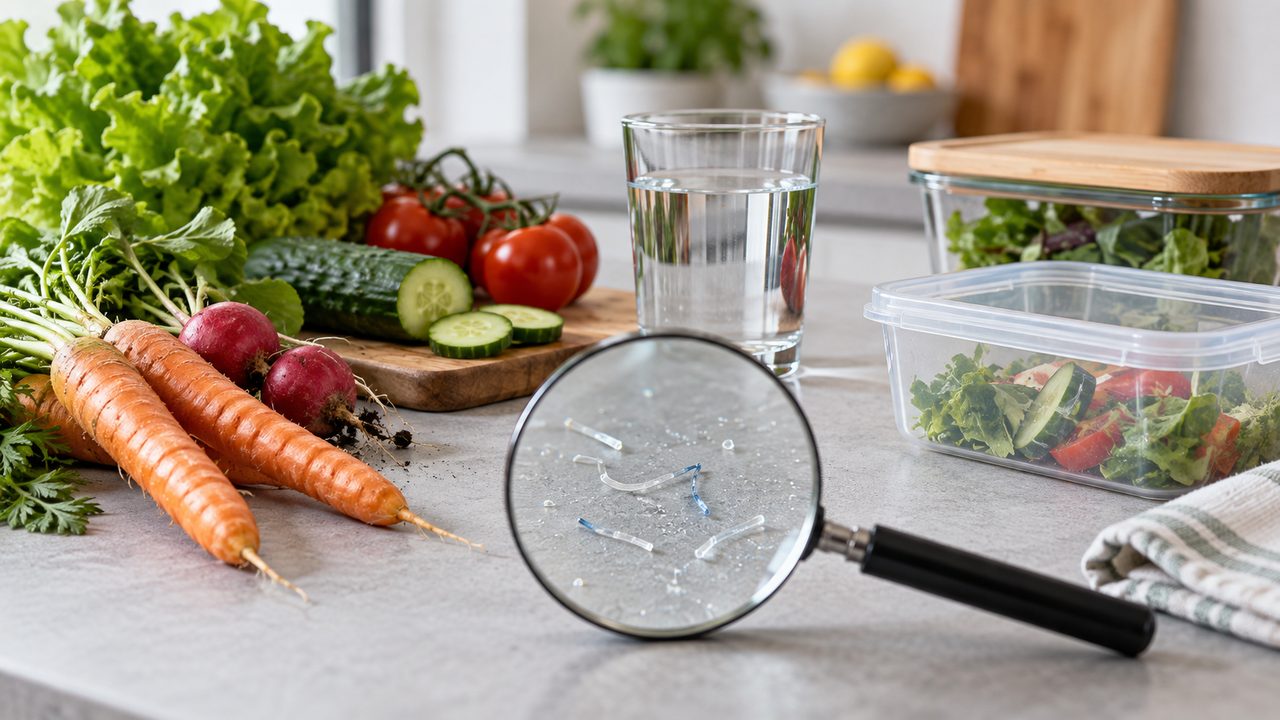
In short: A new systematic review traces microplastics and nanoplastics from production to people. It finds widespread evidence of particles, but no robust answer yet on the health risk.
What the new review examined
The team followed the PRISMA guidelines for systematic reviews and divided the analysis into two parts. A total of 37 studies examined exposure along the food chain and biomonitoring. A further 18 investigated how machine learning can analyse spectra from Raman or infrared measurements.
Fibres were reported particularly often at several stages of the chain. In the literature reviewed, the highest reported concentrations concerned aquaculture and processed foods. Soils and land-based agricultural crops, by contrast, had been studied much less thoroughly. This ranking is therefore not a complete league table of all foods; it also reflects where and how intensively measurements have been made to date.
Detection in the body does not answer the question of risk
The review cites studies that reported plastic particles or polymer signatures in stool, urine, blood and tissue samples. The authors regard food as an important possible route of exposure. Such findings alone do not show how much came from a particular food, how long particles remain in the body or whether they caused an illness.
This is precisely why public authorities urge caution. The European Food Safety Authority (EFSA) states that data on actual intake and possible health effects remain limited. Under the current timetable, a comprehensive new risk assessment is due by the end of 2027. Germany's Federal Institute for Risk Assessment (BfR) considers health risks from microplastics in food unlikely on current evidence, while also stressing that data for an overall assessment are still lacking.
The measurement problem is a key finding
Microplastics generally include particles between one micrometre and five millimetres; nanoplastics are smaller still. Samples can easily be contaminated during collection and analysis by fibres from the air, clothing or laboratory equipment. Studies also use different size ranges, sample preparation methods, instruments and reporting units.
As a result, figures from two publications often cannot be compared meaningfully. A higher reading may indicate greater contamination, but it may also result from a more sensitive method or a broader particle-size range. The new review therefore calls for minimum standards covering the origin of datasets, spectral preprocessing, validation, polymer classes, colourants and misclassification.
AI may speed up analysis, but important reservations remain
In the 18 machine-learning studies examined, some models achieved accuracies above 95 percent. That may sound like a breakthrough, but the results mainly apply to curated or artificially generated spectral libraries. Independent testing with complex food, water and environmental samples is often missing.
The immediate potential therefore lies in the laboratory: automated systems could classify spectra more quickly and consistently. Before they can support comparable routine monitoring, the models need to be tested with real, unknown samples and across different laboratories.
Packaging is one route, but not the only one
Plastic can enter the food chain through soil, water, air, fishing equipment and agricultural materials. Further input may occur during processing, transport, packaging and preparation. In its own 2025 literature review, EFSA confirmed that food-contact materials can release particles, although the quantities identified were substantially lower than some earlier reports had suggested.
Microplastic particles are also not the same as PFAS, bisphenol A or other chemicals that may migrate from materials. A claim such as "BPA-free" or "PFAS-free" does not automatically reveal anything about particle release. Conversely, the detection of microplastics does not prove exposure to those chemicals.
Four measured decisions for the everyday kitchen
- Follow the intended use: Heat packaging or containers only when they are expressly designed for it. Take instructions concerning microwaves, dishwashers and temperature limits seriously.
- Replace damaged containers: Do not keep using severely scratched, brittle or deformed reusable containers indefinitely. Suitable glass or porcelain containers are a durable alternative for many stored foods.
- Avoid unnecessary single-use items: Loose produce and effective reusable systems can reduce packaging waste. That is an environmental benefit, not a proven detox programme.
- Do not buy detox claims: The BfR is not aware of any scientific basis for claims that substances such as lemon oil can remove microplastics from the body.
Kochzauber offers practical planning ideas in the sections on vegetables, recipes by ingredient and one-pot dishes. Avoiding unnecessary purchases and using leftovers well can reduce both packaging waste and food waste without relying on unsupported health claims.
Funding and potential interests belong in the assessment
The review received support from the Northern Ireland Department for the Economy, the Thailand Science Research and Innovation Fundamental Fund and Merck in France, among others. One co-author is affiliated with Merck KGaA. This does not automatically make the findings unreliable, but it is relevant to a transparent assessment of the publication. Clear search rules, disclosed limitations and independent confirmation of the proposed measurement standards remain essential.
Conclusion: better measurements, less alarmism
The new review shows that microplastics and nanoplastics are being investigated and detected at many points in the food chain. Its most important finding is also a limit to current knowledge: inconsistent methods still prevent a robust overall estimate of intake and health risk.
For households, this is no reason to panic or to replace every plastic package immediately. Sensible steps include using products as intended, replacing damaged containers, avoiding unnecessary single-use items and treating exaggerated detox or health claims critically. The main task lies with researchers and monitoring bodies: measurements must become more comparable and methods must be validated more thoroughly with real samples.
Sources and status
- Gormley et al.: Micro- and nanoplastics in food and water from farm-to-fork, systematic review in npj Science of Food, published on 9 September 2026, DOI 10.1038/s41538-026-01054-5.
- EFSA: Microplastics and nanoplastics in food, last reviewed on 17 April 2026; current status of risk assessment and measurement questions.
- BfR: Microplastics: facts, research and open questions, official assessment of detection, intake and potential health risks.
- German Environment Agency: questions and answers on packaging and packaging waste, updated on 28 August 2026.
Author: Kochzauber editorial team. Information and update status: 10 September 2026. This article does not replace individual medical advice and does not infer illness from the detection of particles. The cover image is an editorial illustration.