Leucaena flour as protein: drying changes more than colour
A new study examines flour from the underused legume Leucaena esculenta. Sun and shade drying changed selected traits but did not resolve the safety question.
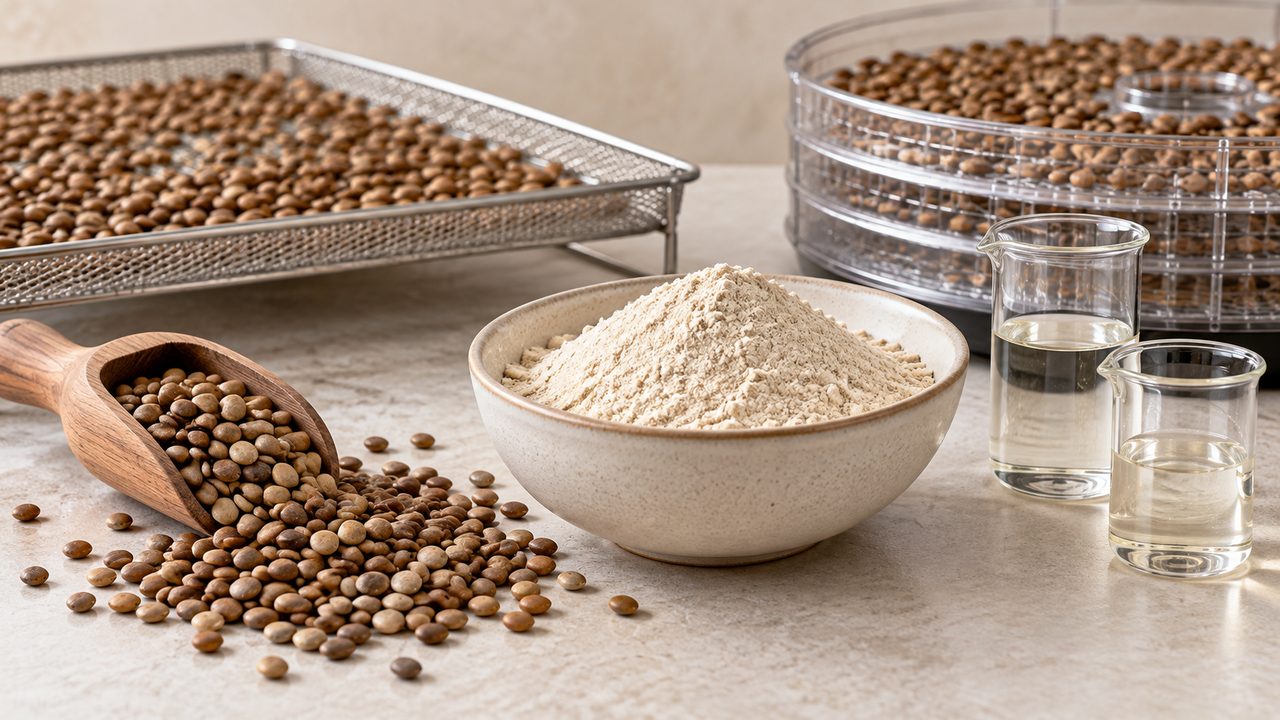
An open-access study published on 14 October 2026 examines Leucaena esculenta, a legume traditionally eaten in Mexico but little used outside its region of origin. The researchers compared sun-dried and shade-dried flours. Both samples showed potentially useful processing traits, but the laboratory result is neither EU authorisation nor a recommendation to gather or eat the seeds independently.
An alternative ingredient with a regional tradition
Leucaena esculenta belongs to the legume family. The new work considers it as a potential flour ingredient and examines composition, colour, starch and protein digestibility, foaming and emulsifying behaviour, and the plant compound mimosine. It therefore addresses nutritional value, technical function and a known safety issue at the same time.
The boundary matters: one traditionally used species and a precisely prepared experimental material cannot be generalised to other Leucaena species, harvests or preparations. Origin, processing, the plant part analysed and dose all matter.
Sun and shade produced no simple winning flour
Sun-dried flour was darker and less green. It had about 1.2 times the total phenolics and 2.6 times the ABTS laboratory capacity of shade-dried flour. Shade-dried flour contained more total dietary fibre. The researchers found no significant difference in the soluble and insoluble fibre fractions.
Protein digestibility in the in-vitro model remained above 76% with both methods. Foaming and emulsifying properties were also generally maintained. These figures may help product development, but they do not yet describe flavour, acceptance, long-term consumption or performance in a particular recipe.
Mimosine remained the decisive reservation
Measured mimosine concentrations were below 411 mg/kg dry weight and did not differ significantly between drying methods. Neither simple treatment therefore substantially reduced mimosine. The authors explicitly call for further safety, processing and food-application studies.
That is central to interpreting the work: a flour can foam or emulsify effectively and still require additional safety evidence. Laboratory antioxidant-capacity values do not cancel that need and do not establish a health effect.
Why EU marketability needs a separate assessment
Foods not consumed to a significant degree in the EU before the relevant cut-off may fall under novel-food rules. The European Commission decides on authorisation; following an application, EFSA assesses matters including composition, production, toxicology, allergenicity and intended use.
Publication of a research paper does not replace that process. Anyone placing a product on the EU market has to establish its precise legal status and any authorisation conditions. For consumers, a research result is therefore not an invitation to grow or experiment with the ingredient at home.
Useful lessons that still emerge
- Assess new proteins across several dimensions: protein content alone is insufficient.
- Name the process precisely: sun and shade drying changed different properties.
- Do not skip safety markers: neither process clearly reduced mimosine.
- Check market status: traditional use elsewhere does not automatically equal EU authorisation.
For everyday meals, established and assessed pulses remain the straightforward choice. Ideas are available in Kochzauber’s pulses and vegetarian dinners sections.
Conclusion: promising research, not a kitchen recommendation
The study found that Leucaena esculenta flour retained protein digestibility above 76% and useful technical properties after either simple drying method. At the same time, mimosine remained measurable under both conditions and was not decisively lowered. That makes the ingredient an interesting research case, not yet a generally available or finally assessed protein source.
Sources
- International Journal of Food Science and Technology: open-access original study, published 14 October 2026
- European Commission: principles, definition and authorisation of novel foods
- EFSA: procedure and scientific requirements for novel-food applications
Author: Kochzauber editorial team. Updated: 16 October 2026. This article describes early laboratory research and is not advice to consume or cultivate the plant.