Keeping Plums Fresh: What a New Cold-Storage Study Shows
A new study kept plum-apricot hybrids firm and aromatic for longer by storing them just above their freezing point. We explain the findings and why −1 °C is not a setting for a home refrigerator.
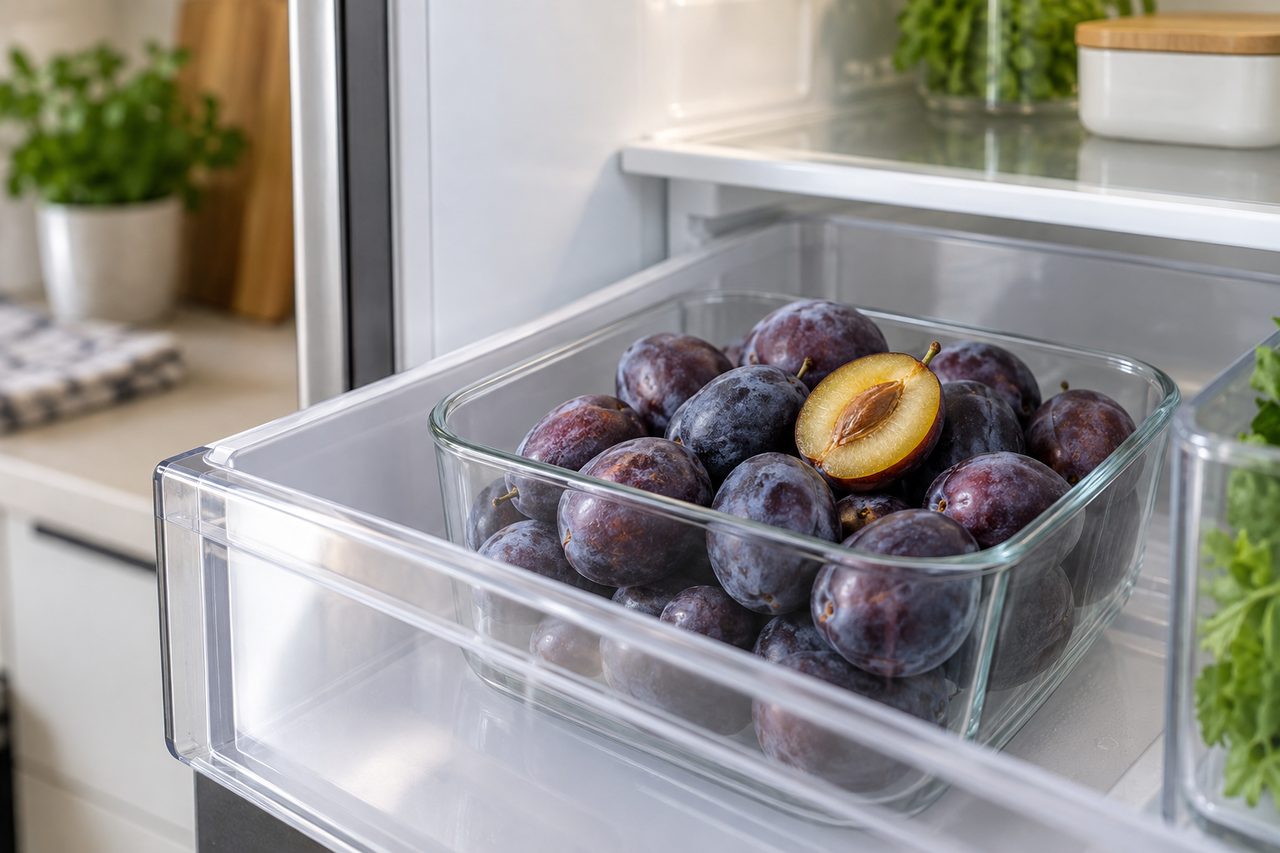
In short: A new study kept plum-apricot hybrids firm and aromatic for longer by storing them just above their freezing point. We explain the findings and why −1 °C is not a setting for a home refrigerator.
The simple rule remains for home: buy solid, undamaged fruit, put ripe plums into the vegetable compartment and consume them in a timely manner. The new study explains why precise temperature management could reduce future losses in the supply chain. However, it does not provide a directly transferable storage protocol for any plum or plum variety.
A special plum-apricot-crossing was investigated.
The research team worked with fruits of the crossing Prunus domestica × armeniaca, in the technical article referred to as "apricot plum" . It combines characteristics of plum and apricot and is considered to be particularly sensitive after harvest. Precisely this botanical classification is important for the interpretation: a result with this crossing is not automatically valid to the same extent for every European plum, plum or mirabelle.
The fruits were compared under three conditions: at room temperature, in conventional refrigerated storage and at a temperature close to freezing point. Previously, the researchers determined a freezing point for the fruits used of approximately −3.1 °C. As experimental temperature they chose −1.0 °C, thus significantly above it. The goal was to slow down the metabolism more strongly without freezing the tissue.
Which was better preserved at −1 °C
More fruits remained marketable under storage near freezing point. They lost less weight and better preserved their firmness, the content of soluble solids and the titrable acid. Changes in aroma-relevant volatile substances were also less pronounced. These measures are important for trade and processing because they give indications of juiceness, texture, ripening and aroma.
Microscopic and biochemical analyses indicated that cell walls and membranes were degraded more slowly. At the same time, the amount of starch and sucrose decreased more slowly. Researchers also found differences in the activity of genes related to carbohydrate metabolism. From this, they derive a possible mechanism: The precise cold slows down several degradation processes at the same time, helping to maintain structure and aroma precursors.
This does not mean that a single number such as −1 °C is universal "the best temperature". Freezing point, cold sensitivity and ripening speed depend on variety, degree of maturity, harvest conditions, packaging and air flow. Professional storage technology monitors these factors more closely than a normal vegetable compartment can.
Why the household refrigerator does not belong to −1 °C
The study describes controlled research conditions for a particular fruit. A household refrigerator, on the other hand, has temperature zones and fluctuations. In the case of minus degrees, sensitive foods could inadvertently freeze. Freezing damage destroy cells; after thawing, fruits often become soft and lose juice. That would be the opposite of the investigated effect.
The Federal Institute for Risk Assessment recommends a maximum of +7 °C for household refrigerators, and a minimum of +5 °C for perishable foods. This hygiene rule applies to the entire refrigerator. It is not equivalent to the experimental −1 °C storage of a single fruit species.
Freezing is also another process. Food should freeze completely and then remain frozen. The new study, on the other hand, examines a temperature above the determined fruit freezing point. Between "very cold storage" and "freezing" there is a technological difference.
How to store plums and plums at home
- When shopping, look carefully: ripe fruits should be firm, undamaged and not excessively soft. The natural whitish scent film on the skin is not mold, but protects the fruit from dehydration. Therefore, wash only shortly before eating.
- Leave immature fruit to mature: Hard fruits can lie at room temperature at first. Mature plums then belong in the vegetable compartment. The Federal Center for Nutrition mentions a storage period of about three to four days. (Source)
- Avoid pressure and moisture: Store fruits loosely and as single layer as possible. Wet fruits spoil more easily. Worked specimens first and check the stock daily.
- Plan in surpluses early: Plums can be frozen, boiled or processed into mus. Thus, the fruit does not have to wait until the last day in the fridge. Matching ideas can be found in our recipes with fruit and autumn recipes.
The general BZfE stock overview also classifies plums and plums as fruit that can be re-ripened at room temperature and then cooled. This robust orientation is more suitable for everyday use than reproducing a laboratory test.
What the study has not yet answered
The technical article is initially available as an accepted manuscript: it has passed through the review, but not yet the final editorial sentence. The publicly available information does not allow a general statement as to how many additional days each plum variety would gain in the private household. Nor does the investigation prove that consumers can safely recognise a difference in taste under real purchasing and transport conditions.
Moreover, it remains open how expensive and energy-efficient a very precise cooling system in different supply chains is. Less spoilage can save resources, but additional technology and energy must also be taken into account in an overall balance. Only further tests with different varieties, maturity levels and practical transport chains can show where the process is economically and ecologically worthwhile.
Conclusion: Precise cold is research, the vegetable compartment is everyday
The new work provides a plausible insight into how a storage just above the varietal freezing point can preserve texture, sugar metabolism and aroma profile of a plum-apricot-crossing. For producers and retailers, this could result in a technique against post-harvest losses.
In the household, the consequence is not "put up to −1 °C". Store ripe fruits cool, dry and protected from pressure, use damaged specimens first and process surpluses in good time: this enables the practical part of the message to be implemented already today.
Sources and status
- Chen et al.: Near-freezing temperature storage maintains apricot plum quality and aroma-related volatile profiles associated with retained starch and sucrose, Food Quality and Safety, accepted manuscript, published on 9 September 2026, DOI 10.1093/fqsafe/fyag073.
- Federal Center for Nutrition: Perfect duo: plums and plums, September 3, 2025; as well as food storage properly. (Source)
- Bundesinstitut für Risikobewertung: Correct cooling of food in private households, background source for safe refrigerator temperature.
Author: Kochzauber Redaktion. Information and updating status: 9 September 2026. The article assigns research results and does not replace individual advice on commercial storage technology. The title image is an AI-generated symbol image.