Fermented okara and oyster mushrooms: A new route to plant protein
Oyster mushroom mycelium made okara richer in protein and umami compounds in a laboratory study. Why this is not yet a finished meat substitute and what makes the by-product idea interesting.
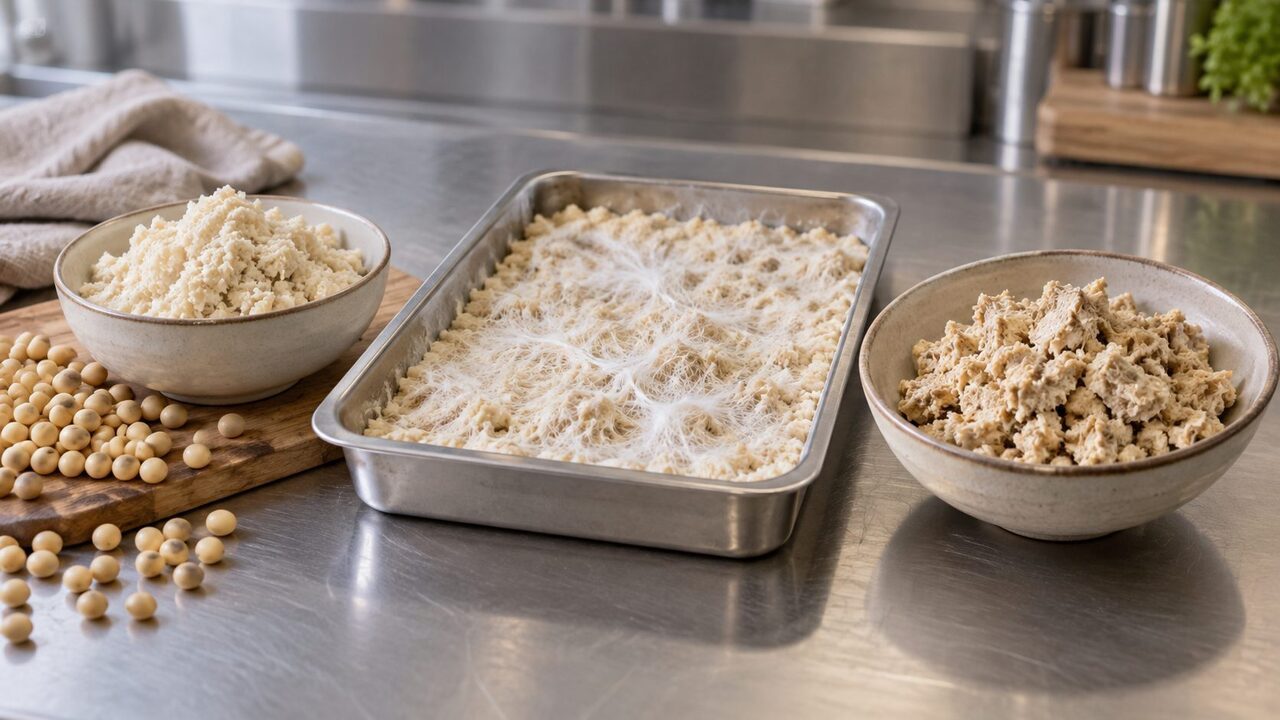
In short: researchers at Nanyang Technological University in Singapore have fermented moist soy pomace with the mycelium of the oyster mushroom. In the laboratory study, the measured protein content increased to 27,7 to 30,2 percent of the dry matter. At the same time, the acid perception decreased, while umami and taste fullness increased. This makes okara an interesting candidate for new plant-based ingredients, but not yet a market-ready food.
What okara is and why it often goes unused
Okara is the moist, fiber-rich residue that remains in the production of tofu and soy drink after filtering the soybean mass. It still contains protein, fiber and other components of the bean. At the same time, the high water content, the coarse texture and the short shelf life make it difficult to use economically. One part is used as feed, other material is discarded.
This is exactly where the new work starts. The team used Pleurotus ostreatus, the oyster mushroom, not as a visible fruit body, but as a fine fungal braid. This mycelium grew directly through the moist soy pomace. In contrast to liquid fermentation, so-called solid fermentation does not require a large liquid nutrient medium.
How the laboratory experiment worked
The researchers examined fresh and dried okara as well as mixtures with wheat bran or sawdust. The mycelium densely colonised fresh okara within just over eleven days. The researchers then compared nitrogen content, free amino acids, sugar, organic acids and taste-active nucleotides before and after fermentation.
The nitrogen content served as the basis for the calculation of the protein content. According to fermentation, this was 27,7 to 30,2 percent of the dry matter, depending on the approach. This is not a value for the wet product in the shopping shelf and also not a direct comparison with meat, tofu or protein powder. Water content and calculation method must always be considered for such information.
The concentration of free amino acids increased to 2,2 to 6,6 times compared to unfermented samples. Glutamic acid and asparagic acid, which contribute to the perception of umami, increased to 4,1 times in individual approaches. Certain 5′-nucleotides and succinic acid were also measured more frequently. An electronic tongue detected less acidity and more umami and fullness.
Why more protein does not automatically mean higher nutritional value
As the fungus grows, it consumes parts of the carbohydrates and forms its own biomass. This can increase the relative protein content in the dry matter without creating any amount of new protein from the raw material. The study also did not examine the digestibility in humans or the quality of the amino acid pattern in a finished meal.
A sensor cannot replace broad tasting panels either. The electronic tongue measures chemical taste patterns, but not willingness to buy, mouthfeel or long-term acceptance. In some fermented samples, bitterness and dryness increased. Therefore, the research team mentions further optimization and human sensor tests as next steps.
Still unclear: safety, shelf life and energy demand
A favourable laboratory profile is not enough for a food ingredient. Reproducible cultures, hygienic process management, possible unwanted metabolic products, storage stability and a safe end of fermentation must be clarified. In addition, there are drying, energy requirements, costs and the question of whether fluctuating Okara batches can be standardized.
The researchers themselves point out that food safety, aroma, storage, scaling and consumer acceptance still need to be investigated. The work therefore provides a proof of feasibility and no release for the domestic fermentation experiment. Moist Okara is easily perishable; without defined starter culture and controlled conditions, visible fungal growth cannot be reliably distinguished from unwanted spoilage.
What the idea could mean for everyday cooking
Fermented oyster fungus ocara is currently not a common standard product in German trade. Those who want to use vegetable protein sources do not have to wait for this development. Tofu, tempeh, lentils, beans and chickpeas are widely available and easy to combine. You can find suitable dishes on Kochzauber under pulses and vegetarian dinners.
When purchasing new fermentation products, it is worth looking at the list of ingredients, cooling instructions and intended use. Terms such as “upcycled”, “mycelium-based” or “high in protein” alone say nothing about the taste, nutritional value or regulatory status of a specific product. The actual composition and the method of production tested are decisive.
What the study does not show
- No finished meat substitute: The study examined fermented okara, not a market-ready cutlet or minced-meat alternative.
- No health promise: There was neither a human study nor evidence of weight loss, improved gut health or disease prevention.
- No complete life cycle assessment: The work does not calculate whether collection, cooling, fermentation and drying are ecologically cheaper under practical conditions.
- No DIY instructions: The controlled laboratory fermentation cannot be safely replaced by spontaneous mushroom growth in the kitchen.
Conclusion: A promising by-product, still at the research stage
In this laboratory study, oyster fungus fermentation improves several properties that make Okara unattractive: relative protein quantity, acid profile and umami. Particularly interesting is the combination of vegetable protein source and use of a secondary stream of tofu and soy drink production.
However, the next decisive step is not a spectacular nutritional claim, but clean development work: safe processes, human sensors, durability, scaling and resilient cost and environmental comparisons. Only then does it become apparent whether the experiment becomes an everyday ingredient.
Sources and publication status
- Nanyang Technological University Singapore: A mushroom-powered boost for soybean by-products, published on September 21, 2026.
- Samarasiri et al.: Taste characterization of okara and okara-derived substrates fermented by Pleurotus ostreatus mycelium, Food Chemistry: X, 2026.
- ScienceDirect: Study page with abstract, data availability and method classification.
- NTU Food Research Systems: Research news and release date. (Research news and date of publication)
Author: Kochzauber editorial team. Information last updated on 23 September 2026. This article provides context for a laboratory study and is not a guide to home fermentation. The header image is an editorial symbolic image.