Fermented cowpeas: a new glucan shows laboratory potential only
A new study isolates a glucan from cowpeas fermented with Bacillus subtilis natto. Interesting measurements still do not amount to evidence of health benefits.
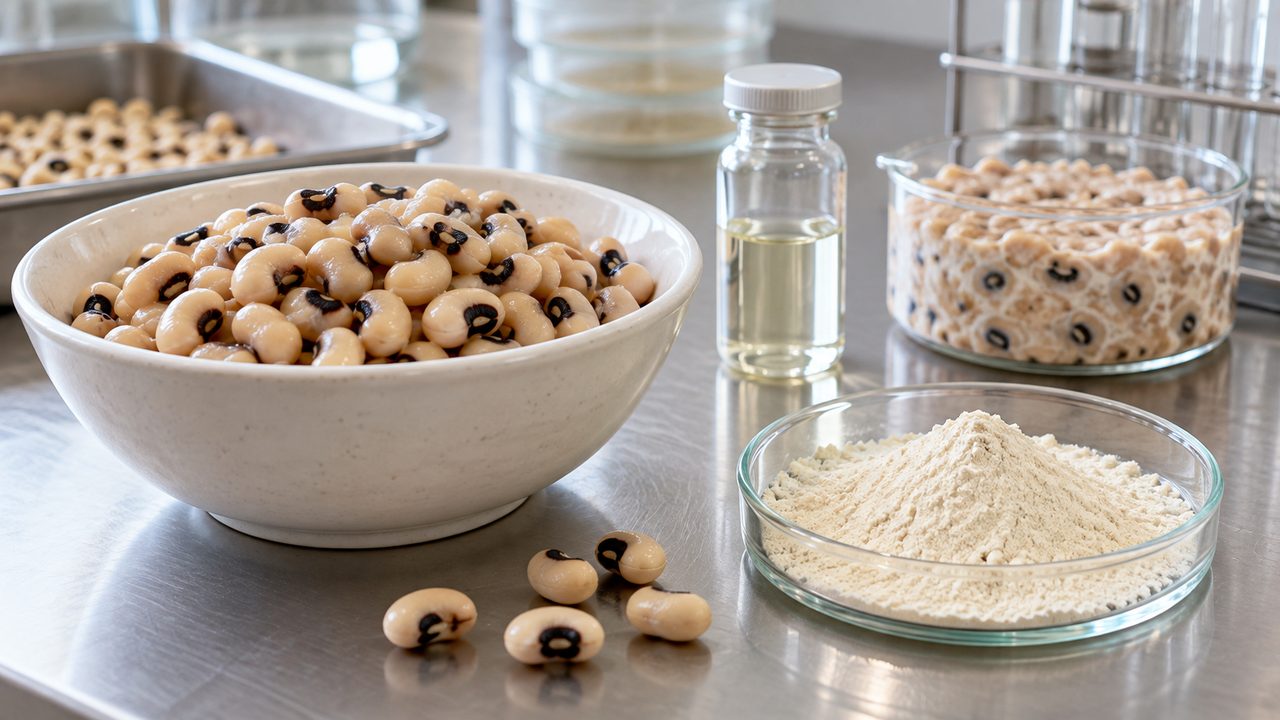
A study published on 12 October 2026 fermented cowpeas with Bacillus subtilis natto and then isolated polysaccharides. Fermentation increased polysaccharide yield by 35.60%. A purified glucan inhibited alpha-amylase and bound selected bile salts in test tubes. That makes the material interesting for further research, but demonstrates neither a blood-glucose or cholesterol effect nor the benefit of a finished food.
From food to a purified laboratory material
Cowpeas, also called black-eyed peas, are pulses. In the study, the seeds were treated with the fermentation microorganism Bacillus subtilis natto, then freeze-dried, milled and extracted with hot water. Protein removal, alcohol precipitation, ion-exchange chromatography and size-exclusion chromatography followed.
The resulting JDFE1-F is therefore not equivalent to a serving of fermented beans. It is a purified fraction with an average molecular mass of 5.175 kDa. Structural analysis described a branched alpha-glucan made up of 98.22% glucose building blocks.
Which measurements fermentation changed
Compared with unfermented cowpeas, polysaccharide yield rose by 35.60%. After purification, JDFE1-F contained 85.12 ± 3.09% total carbohydrate. These figures show that fermentation and subsequent separation can change the composition of the fraction recovered.
They do not show that the human body absorbs the same amount from an ordinary meal. Yield, purity and structure depend on the strain, fermentation time, extraction and purification. An industrial batch or kitchen product would require characterisation using its own methods.
Alpha-amylase test: a model, not a therapy
The purified glucan reached an IC50 of 2.668 ± 0.281 mg/ml in the alpha-amylase assay. IC50 is the concentration that inhibited half of the enzyme activity in the test-tube method used. The value was significantly lower than for the unfermented comparison fraction.
No human dose can be inferred from this. Digestion, other enzymes, the food matrix and metabolism are absent from the assay. Claims such as “lowers blood sugar” would be unsupported without suitable animal and, especially, human studies and would be misleading as a health promise.
Bile-salt binding with clear limits
At 4 mg/ml, JDFE1-F bound 58.09 ± 2.58% of sodium glycodeoxycholate and 60.79 ± 2.87% of sodium taurodeoxycholate in the laboratory. For the first compound, the purified fraction performed significantly better on another comparison measure; for the second, there was no significant difference among the 3 preparations.
This chemical binding assay likewise shows only an interaction under defined conditions. It measures neither cholesterol levels nor cardiovascular disease or adverse effects. Digestibility, dose, stability, tolerability, safety and performance in an actual food would all require assessment before use.
What consumers can do with this today
The study glucan is not a standard retail supplement and is no reason to buy cowpeas solely for a functional promise. In the kitchen, the whole pulses count, with their established nutrient profile, flavour, price and suitability for stews, salads or curries.
Dried cowpeas must be soaked and cooked fully according to the pack directions; raw pulses are unsuitable. Pre-cooked products save time. Practical dishes are available on Kochzauber under pulses and vegetarian dinners.
Conclusion: a new structure at an early research stage
Natto fermentation increased polysaccharide yield from cowpeas, and the isolated glucan displayed measurable in-vitro activities. Because the experiments used an extensively purified fraction, the result cannot be transferred to a serving of beans or a product. The next step is safety, digestion and efficacy research under realistic conditions.
Sources
- Food Science & Nutrition: glucan from fermented cowpeas, published 12 October 2026
- FAO AGRIS: review of the nutritional use of cowpeas
- German Federal Centre for Nutrition: buying and safely preparing pulses
Author: Kochzauber editorial team. Updated: 13 October 2026. The findings come from chemical and enzymatic in-vitro tests of a purified fraction and demonstrate no health effect in people.