EU raw milk price turns higher in August: what households can infer
The EU farm-gate raw milk price rose 2.3 percent in August but remained 19.7 percent below a year earlier. Here is why that is not a supermarket forecast and which shopping routine helps now.
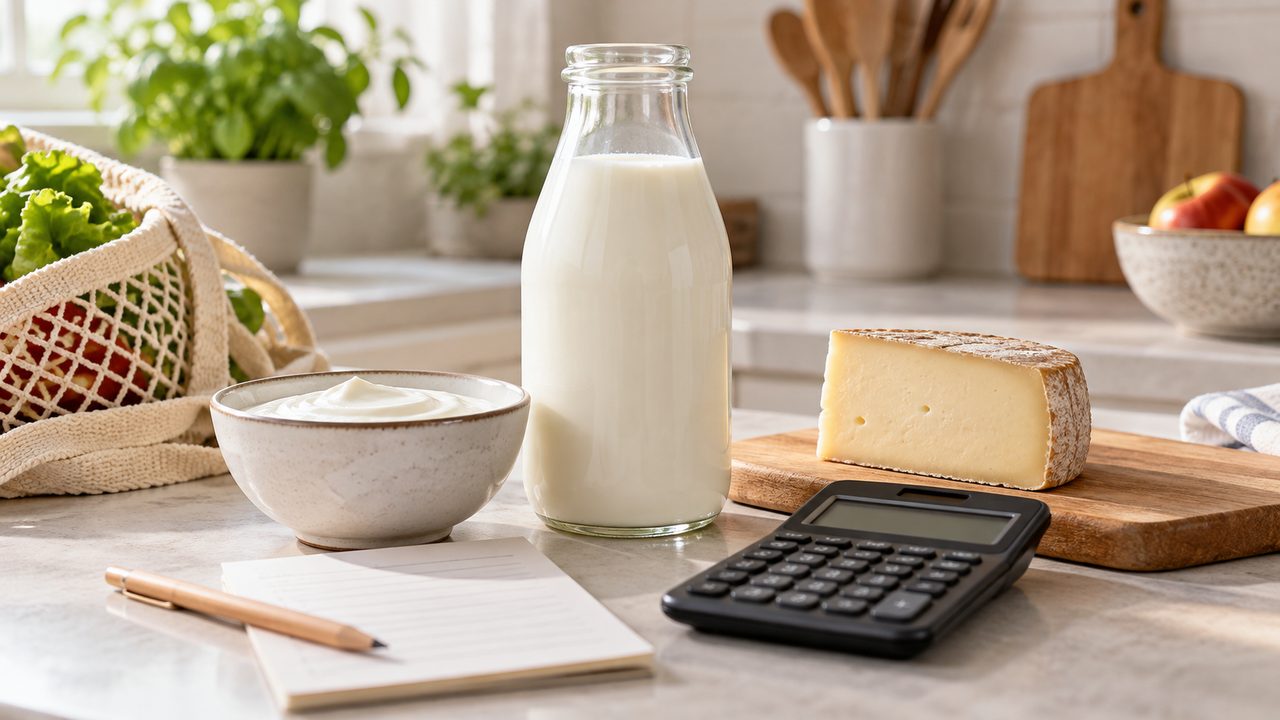
The European Commission published new raw milk price data on 9 October 2026. The weighted EU average stood at EUR 42.75 per 100 kg in August, 2.3 percent above July. Yet it was 19.7 percent lower than in August 2025. The apparently opposing signals mainly show that a monthly movement and an annual comparison answer different questions.
What the new table actually measures
The series records the price of cow's raw milk at actual fat and protein content paid by dairies to producers. It is neither the price of a litre of drinking milk nor a retail average for yoghurt, butter or cheese. Packaging, processing, energy, logistics, retail margins, contracts and taxes sit between the two stages.
The August figure of EUR 42.75 per 100 kg follows EUR 41.79 in July. For September, the table shows an estimated EU value of EUR 43.11 and an increase of 0.9 percent. The Commission explicitly marks that estimate as an indicator of price movement that should not be relied upon for forecasting.
Germany does not mirror the EU average exactly
For Germany, the dashboard reports EUR 41.15 per 100 kg in August. That was 2.5 percent more than in July but 24.2 percent less than in August 2025. This comparison alone shows why the EU average cannot be transferred to one country, let alone to a specific product in a chilled cabinet.
Reported August values also varied widely across the EU. Differences in milk composition, seasonality, contracts and market structure all matter. For consumers, the table is therefore an early indicator at producer level, not a future receipt. Destatis's consumer price index remains the more suitable source for retail prices actually observed in Germany.
A practical shopping routine without price prophecy
Households watching their budget can check three points regardless of the next market report:
- Compare unit prices: for milk, yoghurt and cheese, use the price per litre or kilogram, not only the prominent pack price.
- Plan consumption: large tubs or blocks of cheese are cheaper only if they are used before spoiling or portioned appropriately.
- Define the use: cooking may call for a different product from breakfast, reducing the number of speciality packs opened.
A weekly plan can connect breakfast, a sauce and a bake so opened products are used again. Kochzauber's breakfast and cheese sections offer ideas. Whether a private label, branded product or plant-based alternative costs less still depends on the current unit price for a comparable quantity and purpose.
Why a lower producer price is not automatically good news
A year-on-year decline may make households hope for relief. For dairy farms, however, a lower payout means less revenue while costs do not necessarily fall by the same amount. The data describe one market stage and do not judge which price would be appropriate for farms or households.
It would likewise be premature to turn the August rise into a new lasting inflation wave. That would require more months of evidence as well as data on processed products and consumer prices. The table is useful as context: it shows a short-term change of direction after a steep annual decline.
Conclusion: watch the market trend, compare the actual shop
The new EU data support two correct statements at once: raw milk became dearer in August than in July and remained substantially cheaper than a year earlier. They do not yield a reliable price for the next shop. Unit-price comparisons, suitable pack sizes and a plan for leftovers provide more immediate value.
Sources
- European Commission: EU prices of cow's raw milk, data completed 8 October 2026
- European Commission: milk and dairy price monitoring, published 9 October 2026
- Destatis: consumer price index and inflation rate for Germany
Author: Kochzauber editorial team. Updated: 11 October 2026. Producer prices are not forecasts for individual retail prices; every percentage comparison refers to the raw milk stage shown in the EU table.