EU Egg Price Rises: Why That Does Not Automatically Raise Your Grocery Bill
The latest EU market report shows a short-term rise in egg prices but a decline from a year earlier. What the figure measures and how to compare eggs fairly.
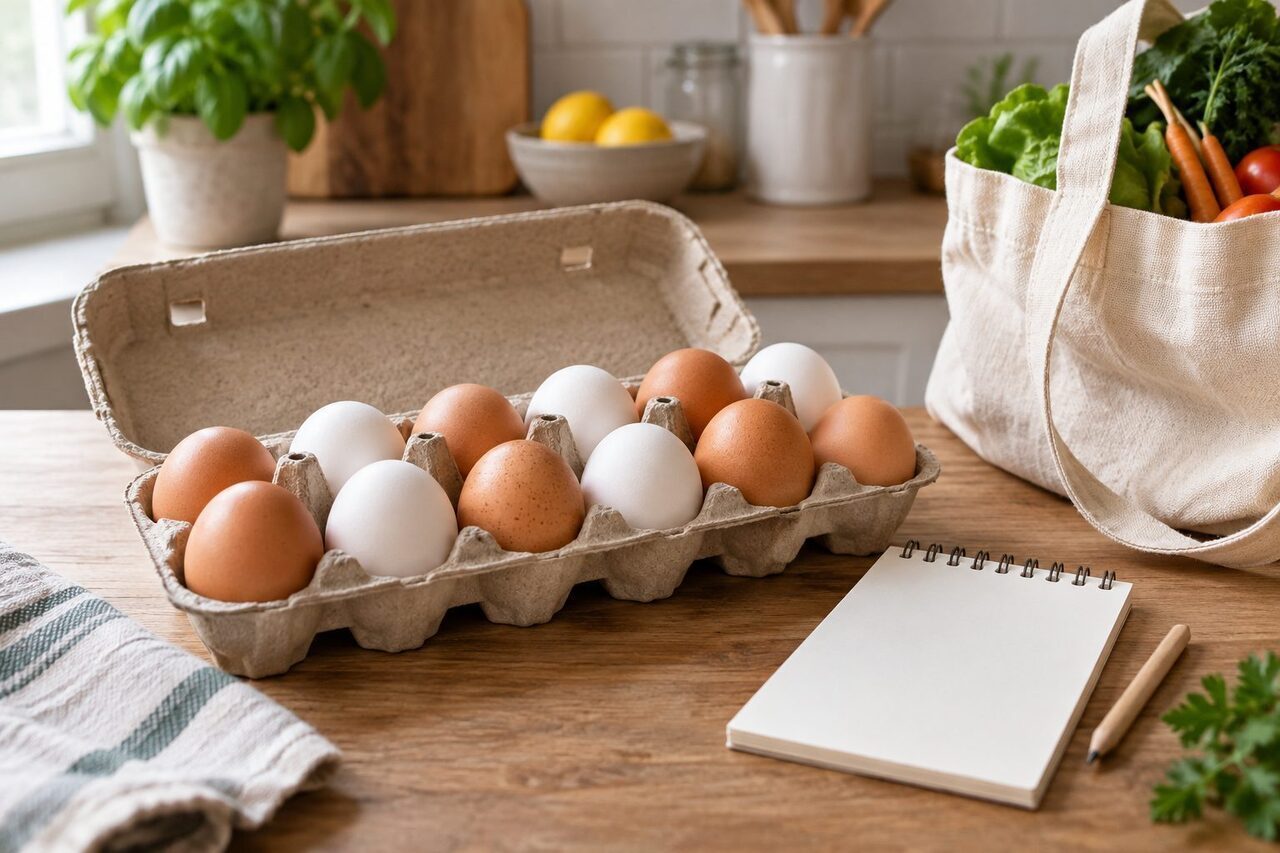
In short: The latest EU market report shows a short-term rise in egg prices but a decline from a year earlier. What the figure measures and how to compare eggs fairly.
For consumers, this separation is crucial. The EU value is collected at an earlier level of trade: Prices are reported from packing points for Class A eggs, usually as an average of sizes L and M. Up to the price of a six- or ten-box, there are also sorting, packaging, transport, trade costs, VAT, holding form and actions.
What the new EU figure actually measures
The EU Member States send the Commission a representative listing in Euro per 100 kilograms per week. The basis is eggs of grade A from packing sites. Where cage eggs are no longer representative, the listing can be reported for soil farming instead. The value is therefore suitable for monitoring the direction of the market, but not for direct conversion into a carton price.
The reference size also explains why a calculation attempt per egg goes wrong quickly. An egg of size M weighs less than one of the size L, packaging contains different quantities, and the EU series is a weighted average of several countries. If you want to know if your own standard product has become more expensive, you need the price of the same carton in the same business over several weeks.
Higher in the short term, lower year on year
Three comparative periods can tell different stories at the same time. Compared to the previous week, the EU quotation increased by 1.5 percent, compared to the previous month by 4.6 percent. Compared to the corresponding week of the previous year, it was still 6.2 percent lower. Therefore, the factually correct conclusion is that eggs were last more expensive at this market level, but remained below the level of one year ago.
The dashboard also shows that EU imports of eggs and egg products increased from January to May 2026 to 120,496 tonnes of egg equivalent. In the same 2025 period, it was 63,159 tonnes, an increase of 90,8 percent. This trade figure does not explain the price alone. It covers various egg products and countries of origin and cannot be equated with the number of imported egg cartons in German retail.
Why shop prices can react differently
- Farming: organic, open-air and soil farming have different cost structures. An EU average blurs these differences.
- Contracts and delays: Trade and suppliers do not necessarily buy at the price of the day. Changes can arrive later, weaker or not at all on the shelf.
- Pack and size: Six organic eggs of size L are not useful to compare with ten bottom keeping eggs of size M alone via the pack price.
- Actions and private brands: Discounts may temporarily cover the general market direction.
A headline like "Ears are 4.6 percent more expensive" would therefore be misleading. 4.6 percent refer to the EU packing point value compared to the previous month, not all products in German supermarkets.
How to compare eggs sensibly when shopping
Start with the product that you actually want to buy: keeping shape, origin, size and number of pieces should stay the same when comparing prices. The unit price can help if stated on the shelf; in the case of eggs, the unit price is also easy to calculate. More importantly, it is not only the large-printed promotional price of two packages of different sizes.
The producer code on the egg gives orientation. The first digit stands for the farming method: 0 for organic production, 1 for outdoor, 2 for soil and 3 for cage keeping. Then follow the country of origin and the farm number. The carton also contains, among other things, quality and weight class, packing point number, minimum durability date and storage instructions.
For scrambled eggs, omelet or frittata, a different amount counts than for a baking recipe. Ideas for use can be found in the Kochzauber categories breakfast, vegetarian dinner and recipes according to ingredients. (Vegetarian dinners; Recipes by ingredients)
Storing eggs correctly after purchase
The Federal Centre for Nutrition recommends storing eggs in the refrigerator, preferably in the egg box and separated from strongly smelling foods. An undamaged shell is important. The minimum shelf life is for the intended storage; older eggs should only be used completely heated.
A large pack is therefore not automatically cheaper. It is only worth it if the household consumes the eggs in time or concrete dishes are planned for it. The lower unit price does not help if a part remains unused.
Conclusion: Watch the market trend, compare the actual carton
The new EU report shows a differentiated picture: The packing point price increased in the week and month comparison, but was below the previous year's figure. Neither a flat-rate German price increase nor a reliable forecast for the next purchase can be derived from this.
For everyday life, the concrete comparison on the shelf remains more reliable: the same posture, the same size, the same quantity and the same product as possible. The EU data provide the background, the cash receipt shows the actual burden on the household.
Sources and status
- European Commission: Eggs – Market Situation Dashboard, updated on 16 September 2026.
- European Commission: Eggs: Marketing standards and market monitoring, weekly packing price methodology.
- Federal Center for Nutrition: Eggs: From purchasing to the kitchen, marking and storage. (Eggs: From shopping to the kitchen)
Author: Kochzauber editorial team. Information and update status: 18 September 2026. The article classifys EU market data and does not contain any price forecast. The title image is an editorial illustrative image.