Duckweed protein: higher recovery uses far more electricity
A new study compares four methods for extracting protein from duckweed. The highest laboratory recovery also required particularly high electricity use.
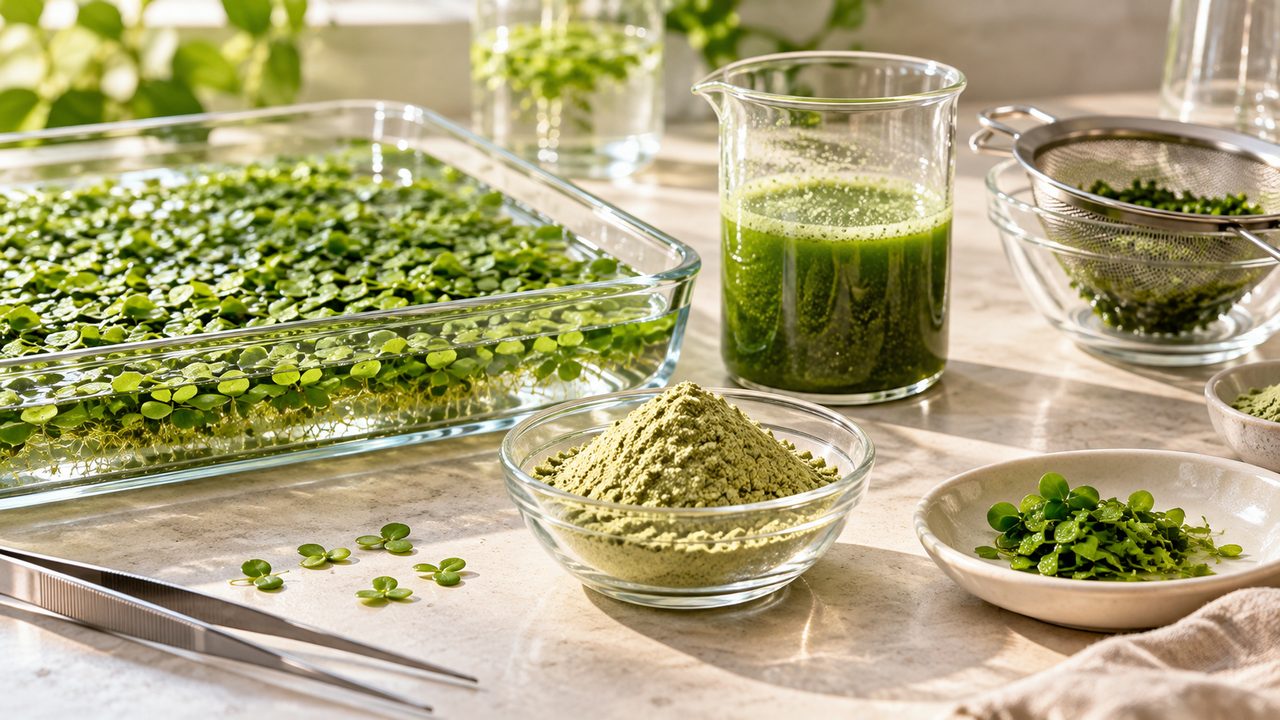
An open-access study published on 13 October 2026 compares methods for extracting protein from duckweed. With dried biomass, two more involved combinations recovered more protein than the simpler variants. The comparison also shows that the highest recovery was not the most economical in electricity. The findings come from fixed laboratory conditions and are not a buying recommendation for any product.
Four routes through the same biomass
The study used dried duckweed from Lemna minor and Lemna gibba. Researchers compared ultrasound-assisted enzymatic extraction (USE), orbital-shaker-assisted enzymatic extraction (OSE), sequential ultrasound and orbital-shaker extraction (USOSE), and ultrasound-assisted pH-shift extraction (USpH). For frozen-thawed Lemna minor biomass, they also compared ultrasound with magnetic stirring.
That distinction matters: the team compared specific protocols under fixed conditions. The result therefore does not mean that ultrasound, enzymes or pH shifting will perform identically across every formula and scale. It describes the performance of this experimental setup.
Two combined processes produced the highest values
With dried biomass, USOSE achieved the highest protein recovery at 88.6 ± 2.5%. USpH followed at 84.7 ± 0.2%. OSE reached 75.2 ± 1.2%, while USE reached 73.2 ± 0.4%. USpH also produced the concentrate with the highest measured protein content, 55.6 ± 0.7 g/100 g.
USpH also led for quantified amino acids at 39.0 ± 0.6 g/100 g. These figures are analytical properties of the concentrates. They do not automatically establish good digestibility, flavour, mouthfeel or suitability for a particular food.
The electricity comparison changes the picture
Per gram of recovered protein, USE required an average of 0.011 kWh, whereas USOSE required 0.291 kWh. The method with the highest recovery in this laboratory trial therefore also had the highest measured electricity input. With frozen-thawed biomass, magnetic stirring recorded slightly higher recovery; ultrasound required less treatment time and electricity.
The authors consequently identify no universal winner. Recovery, composition and processing intensity have to be considered together. An industrial environmental assessment would also need scale-up, water, processing aids, drying, heat, waste streams and the actual electricity mix.
EU authorisation: not all duckweed is the same
In the EU, heat-treated Lemna minor and Lemna gibba plants have been authorised as a novel food since 2025, but only within defined specifications. A particular protein concentrate from Lemna gibba and Lemna minor was also added to the Union list in 2024. The regulations cover aspects including production, composition and labelling.
That does not make every pond harvest or arbitrary extract lawful for sale. Duckweed can take up substances from its growing medium, so controlled cultivation and compliance with the relevant authorisation are central. The new laboratory protocols are not automatically identical to an already authorised manufacturing process.
What consumers can take from the study
- Check the product form: whole vegetable, powder and protein concentrate are not the same.
- Read the species: Lemna minor and Lemna gibba should not be equated with every duckweed.
- Put protein figures in context: a high concentrate value says nothing about the complete recipe.
- Do not infer sustainability from one measurement: high recovery and low electricity use did not coincide here.
Established protein sources remain easier to obtain for everyday cooking. Recipe ideas are available under pulses and vegetarian dinners. For now, duckweed protein is mainly relevant to ingredient development, product assessment and transparent labelling.
Conclusion: more protein is only part of the calculation
The study of 13 October 2026 makes a genuine trade-off visible: USOSE recovered the most protein but used the most electricity per gram in the laboratory. USpH produced the concentrate with the highest protein content. The sensible method therefore depends on product goal, scale, resources and authorisation. Functionality, digestibility, safety in a specific final food and consumer acceptance were not tested.
Sources
- Food and Bioprocess Technology: open-access original study, published 13 October 2026
- EUR-Lex: Regulation (EU) 2025/153 on heat-treated Lemna minor and Lemna gibba plants
- EUR-Lex: Regulation (EU) 2024/1048 on protein concentrate from Lemna gibba and Lemna minor
- EFSA: explanation and safety assessment of novel foods
Author: Kochzauber editorial team. Updated: 15 October 2026. The study assesses extraction performance at laboratory scale; it establishes neither health effects nor general sustainability superiority.