Clean label, plant protein and reuse: when innovation is truly ready
A new review maps safety gaps in clean-label foods, alternative proteins, side-stream ingredients and sustainable packaging. Five readiness areas are meant to prevent premature scale-up.
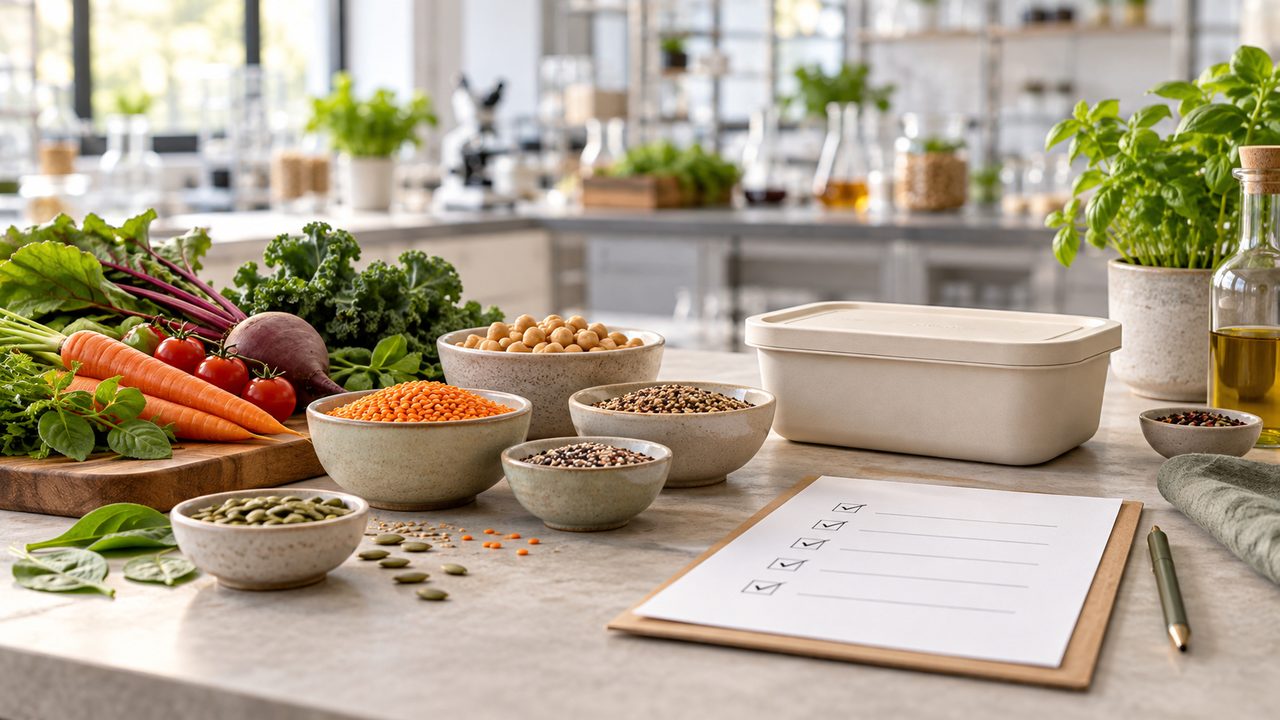
A review published online on 8 October 2026 asks when sustainable food innovations are safe enough to scale. It covers reformulated products, alternative proteins, side-stream ingredients and sustainable packaging, with digital assurance as a cross-cutting layer. Its central message is deliberately restrained: terms such as clean label, plant-based, reusable or plastic-free do not by themselves demonstrate either greater or lower safety.
Why a shorter ingredient list may change controls
Clean label is not a legally uniform safety standard. Removing preservatives, acidity regulators or other technical aids can alter several protective hurdles at once. Shelf life, pH, water activity, the cold chain and the manufacturing process must therefore be assessed as a system. A more familiar-sounding ingredient list alone does not show whether the new recipe remains equally robust under realistic storage conditions.
The review appraised 17 selected publications in a structured way and separated direct evidence from assumptions that might be transferred. The authors stress that reformulation can be safe when removed hurdles are replaced by validated controls. A sustainability goal is therefore not an argument against food safety, but neither is it a shortcut around process data, challenge testing and clearly assigned responsibility.
Alternative proteins and side streams need their own questions
For alternative proteins, possible risks depend on source and processing. Allergens, antinutritional factors, microbial loads and process residues cannot be generalised across all plants, fungi or fermentation products. Ingredients from side streams add questions about origin, previous use, transport and storage. A material that was previously feed or a residual stream does not automatically become a suitable food ingredient simply because it is upcycled.
In the European Union, novel foods require a safety assessment and authorisation before they are placed on the market. EFSA considers factors including composition, manufacturing, expected intake, toxicology and allergenicity. The new review adds an early development question to that legal framework: is the evidence mature enough for the next scale, or must a critical point first be closed with realistic data?
Reusable and bio-based are systems, not single attributes
The review also avoids blanket judgements about sustainable packaging. Reuse depends on material, cleaning, number of cycles, returns, transport and user behaviour. A bio-based or plastic-free surface says nothing by itself about barrier performance, migration or hygienic reprocessing. If packaging and formulation change together, both changes must be assessed jointly because moisture, oxygen and real-world use interact.
European hygiene rules apply to food businesses of every size and cover production, processing and distribution. Sustainable changes therefore do not replace good hygiene practice or procedures based on HACCP principles. Digital sensors and traceability may support controls; according to the review, however, evidence of improved real-world safety outcomes is less consistent than evidence that many of the technologies can function.
The five proposed readiness gates
- Safety evidence: have hazards, realistic use and critical process limits been studied with suitable data?
- Regulatory readiness: are classification, authorisation, labelling and responsibilities clear?
- Consumer understanding: are preparation, storage, reuse and disposal explained clearly?
- Food-chain responsibility: is it clear who controls raw material, process, package and deviations?
- Post-launch monitoring: are feedback, traceability and a plan for new signals in place?
The gates are deliberately non-compensatory. Strong climate data cannot offset an unresolved allergen question, for example. Conversely, an open detail does not make every innovation unusable; it identifies the test still needed before a pilot, larger production or broad marketing. The framework is conceptual and, as the authors state, requires prospective validation with relevant stakeholders.
Conclusion: separate marketing claims from safety evidence
A simple shopping principle remains useful: claims describe a selected property, not overall quality. Read specific ingredients, allergens, storage and preparation instructions, and handle reusable containers as directed by their maker. The review ranks no individual products; it offers a better question set for developers and regulators. Variety still matters in the kitchen, including meals rich in vegetables and a vegetarian dinner.
Sources
- Trends in Food Science and Technology: review of safety readiness for sustainable innovation
- EFSA: safety assessment of novel foods
- European Commission: food hygiene in the EU
Author: Kochzauber editorial team. Updated: 10 October 2026. The five-gate framework is conceptual and does not replace product-specific risk assessment or regulatory authorisation.