Brewer’s spent grain in PLA packaging: two sides of the life-cycle balance
A new life-cycle assessment compares PLA with 10% and 20% brewer’s spent grain against neat PLA, PET and polypropylene. Lower fossil demand comes with higher impacts elsewhere.
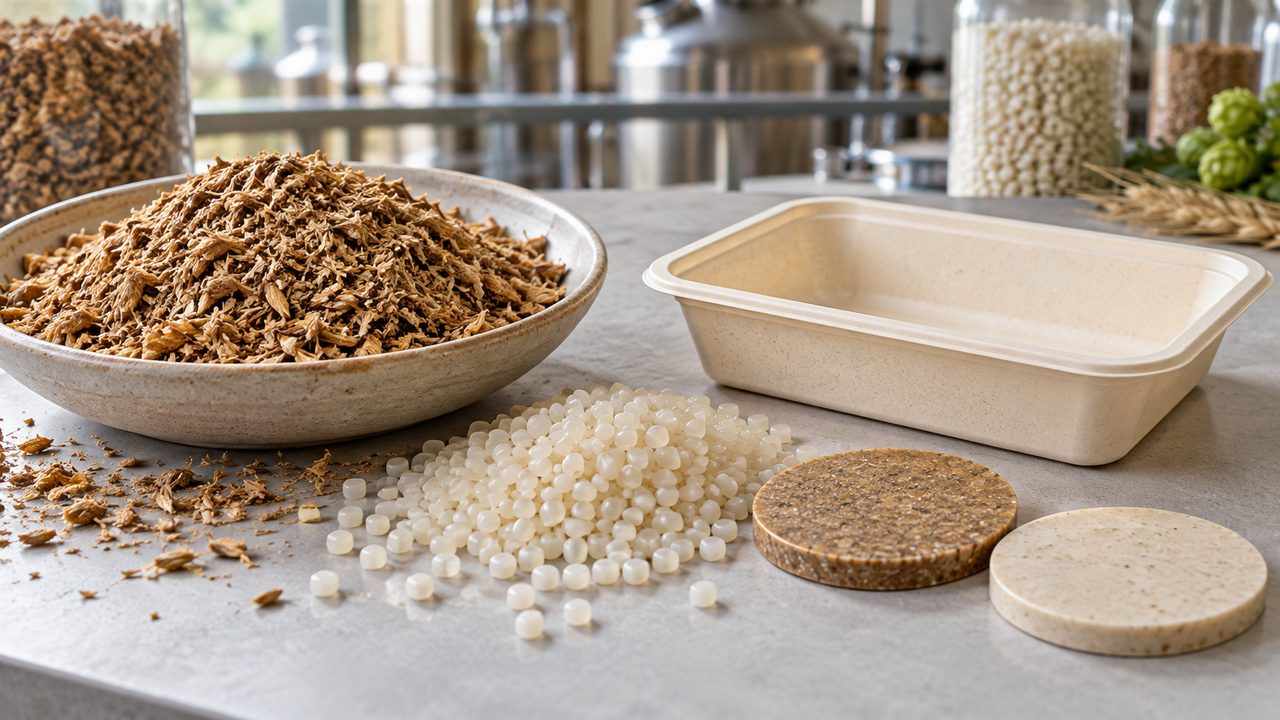
A life-cycle assessment published on 9 October 2026 examines PLA composites containing brewer’s spent grain for possible packaging applications. Neat polylactic acid, blends with 10% and 20% spent grain, polypropylene and PET were compared. The result is not a simple victory for bioplastic: the by-product lowers some impacts, while drying, milling and end-of-life routes shift others.
What was actually assessed
Brewer’s spent grain remains after mashing as a wet, fibre-rich side stream. The model treated it as a waste-derived feedstock using a cut-off approach; impacts assigned to it mainly came from preparation energy. The functional unit was 1 kg of material. The study therefore compares material quantities within defined system boundaries, not finished trays or films delivering identical protection and service life.
PLA is bio-based, but that property does not automatically mean biodegradability under every condition or a better overall footprint. The study first calculated production to the factory gate and then added end-of-life scenarios. Results of this kind depend on the electricity mix, data, material performance, collection and actual treatment. They are decision support, not a universal environmental label.
Where spent grain produced benefits
Compared with neat PLA, global warming potential fell by 4.10% with 10% spent grain and by 8.20% with 20%. The fossil-resource indicator declined by 5.40% and 10.70%, respectively. The explanation is straightforward: part of the newly produced polymer matrix is replaced by an existing lignocellulosic side stream.
Among the modelled materials, the composite containing 20% spent grain had a global warming potential of 2.98 kg CO2 equivalent per kilogram. Neat PLA reached 3.25 kg, PET was higher, but polypropylene was lower at 2.77 kg. For fossil-resource demand, the PLA systems performed substantially better than PET and polypropylene. The ranking therefore changes with the environmental objective.
The trade-off lies in drying and milling
Freshwater eutrophication rose from neat PLA by 16.1% with 10% spent grain and by 32.2% with 20%. The study identifies electricity for drying and milling as a major driver. The aggregated toxicity indicator also increased with more spent grain. Using a residual material therefore does not automatically save impacts in every category, particularly when a very wet feedstock needs energy-intensive preparation.
In the modelled end-of-life scenarios, composting and recycling performed better than incineration, but the authors identify data gaps. Industrial extrusion and moulding were not represented with measured efficiencies and energy use, and further recycling routes for the composites are missing. Mechanical performance, barriers, migration and food safety also require testing before an actual packaging application.
What bio-based, biodegradable and compostable mean
- Bio-based describes the feedstock source; a bio-based plastic is not automatically biodegradable or compostable.
- Biodegradable applies under defined conditions and does not mean a material quickly disappears in every environment.
- Compostable generally requires industrial conditions and suitable separate collection; local disposal instructions remain decisive.
- Food contact is a separate safety question: the material and any transfer of substances must suit the specific use.
The European Commission therefore calls for assessment across the full life cycle and warns against vague environmental claims. EFSA explains that chemicals in contact materials may transfer into food and are assessed using migration and toxicology data. The new LCA establishes neither food-contact approval nor PFAS-free status; it examines environmental impacts of modelled material systems.
Conclusion: less primary polymer, but no free pass
Brewer’s spent grain can partly replace neat PLA and, in this model, reduce climate impact and fossil-resource demand. Preparation energy and suitable waste infrastructure still help determine the result. For households, the waste hierarchy remains practical: avoid unnecessary packaging, use reuse systems sensibly and sort according to local rules. Ideas for basic ingredients are available with vegetables and a vegetarian dinner.
Sources
- Processes: life-cycle assessment of PLA and brewer’s spent grain composites
- European Commission: bio-based, biodegradable and compostable plastics
- EFSA: safety of food-contact materials
Author: Kochzauber editorial team. Updated: 10 October 2026. The study models material impacts; it demonstrates neither market readiness, food-contact suitability nor PFAS-free status for a product.