Finding new proteins with AI: what AlterProtX can really do
A new study presents AlterProtX, an AI system that compares whole proteomes to identify functionally promising protein sources earlier. Here is what it means for food – and what remains unknown.
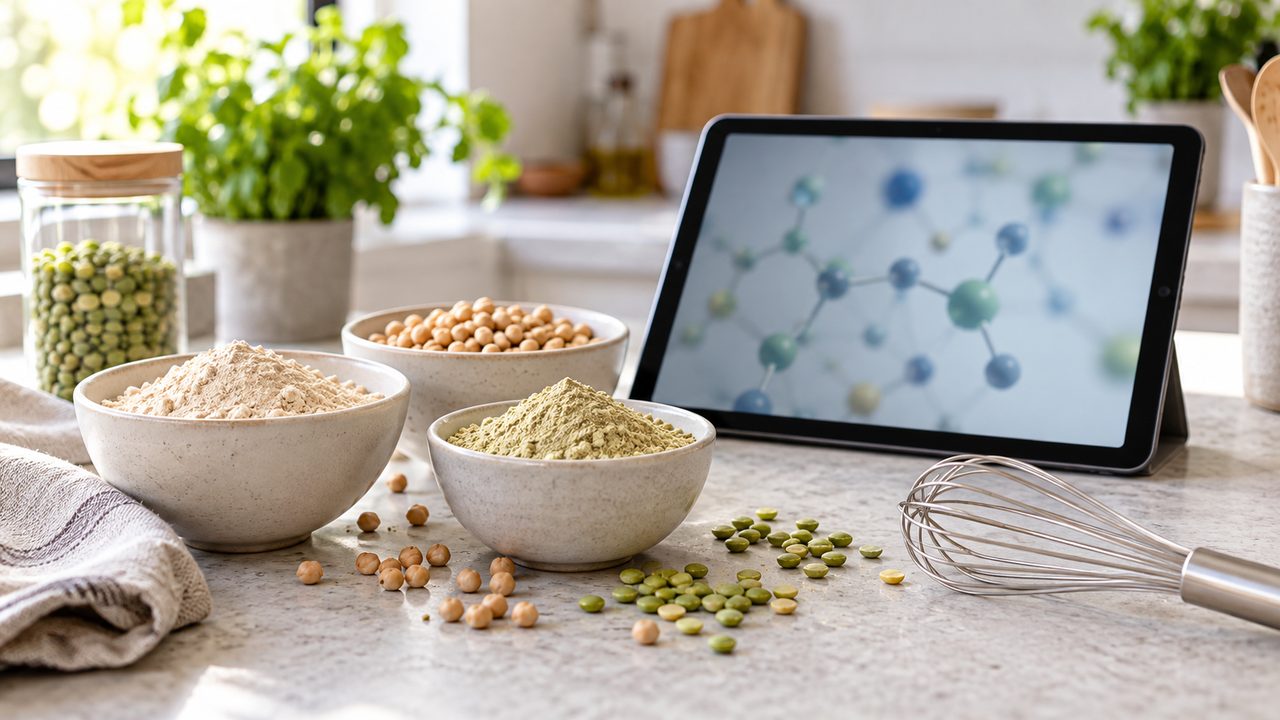
On 8 October 2026, npj Science of Food published a peer-reviewed early version of a study on AlterProtX. The AI-enabled method is designed to screen non-animal protein sources at proteome scale: it combines predicted thermal stability with six attributes of intermolecular interactions, plus information on nutritional adequacy and potential allergenicity. It is a research tool, not a finished food or a safety authorisation.
Why protein quantity alone is not enough
Proteins perform more jobs in food than a nutrition panel can show. They may bind water or oil, stabilise foams, form emulsions and create gels during heating. Whether a plant or another non-animal raw material can replace milk, egg or meat protein in a recipe therefore also depends on processing, flavour, texture and the collective behaviour of many individual proteins.
That is the problem addressed by the study. Many existing AI models examine individual protein sequences. AlterProtX instead summarises distributions across an entire proteome. This is intended to make sources comparable even when their protein mixtures are complex. The central question is which candidates may be functionally similar – not whether they already perform identically in a finished product.
What AlterProtX brings together
The system first predicts the thermal stability of individual proteins, a trait relevant to heating and processing. It then adds six properties describing intermolecular interactions. These data are turned into distribution profiles that allow animal and non-animal proteomes to be compared mechanistically.
The researchers complement this functional view with nutritional adequacy and potential allergenic risk. That widens early screening: a candidate should not only show technological similarity but also be prioritised from nutrition and safety perspectives. The study describes AlterProtX as an interpretable screening step; it does not replace chemical analysis, sensory testing, digestibility studies or clinical allergy assessment.
Why screening is not authorisation
A high ranking in a computational model does not prove safe intake levels, pleasant taste or stable manufacturing. Origin, cultivation, processing and formulation can also alter properties. Novel sources in particular require real data on composition, toxicology, allergenicity, absorption and the production process.
In the European Union, novel foods may be marketed only under authorised conditions. EFSA assesses potential risks, while the European Commission maintains the Union list of authorised novel foods with specifications, conditions of use and labelling requirements. Digital prioritisation may prepare that work, but it cannot shorten or replace the legal assessment.
What matters when shopping today
- Read the specific protein source in the ingredients; a broad word such as plant-based says little about composition or processing.
- Check allergen information, especially for pulses, nuts, cereals or blends containing several protein sources.
- Compare more than grams of protein: look at salt, saturated fat, fibre and the rest of the ingredient list as well.
- Use variety: beans, lentils, chickpeas, tofu, nuts and grains play different roles in a weekly menu.
The new approach may make research more efficient, but it does not give consumers a quality seal for a product. What matters is what has actually been authorised, labelled and included in a particular formulation.
Conclusion: a search engine for research, not a shopping list
AlterProtX expands alternative-protein discovery from single proteins to the proteome perspective and combines function, nutrition and potential allergenicity. Its main value is helping researchers select candidates for demanding experiments more deliberately. In the kitchen, proven variety and clear labelling still count – including meals rich in vegetables or a vegetarian dinner.
Sources
- npj Science of Food: AlterProtX study
- EFSA: novel foods and safety assessment
- European Commission: Union list of novel foods
Author: Kochzauber editorial team. Updated: 9 October 2026. The study describes early-stage prioritisation; it does not establish market readiness or authorisation of individual protein sources.