2026 Potato Harvest: Are Potatoes Becoming More Expensive?
Reduced acreage, heat and weak yields in some regions are limiting supply. There are signs of higher potato prices, but the retail price depends on more than harvest volume alone.
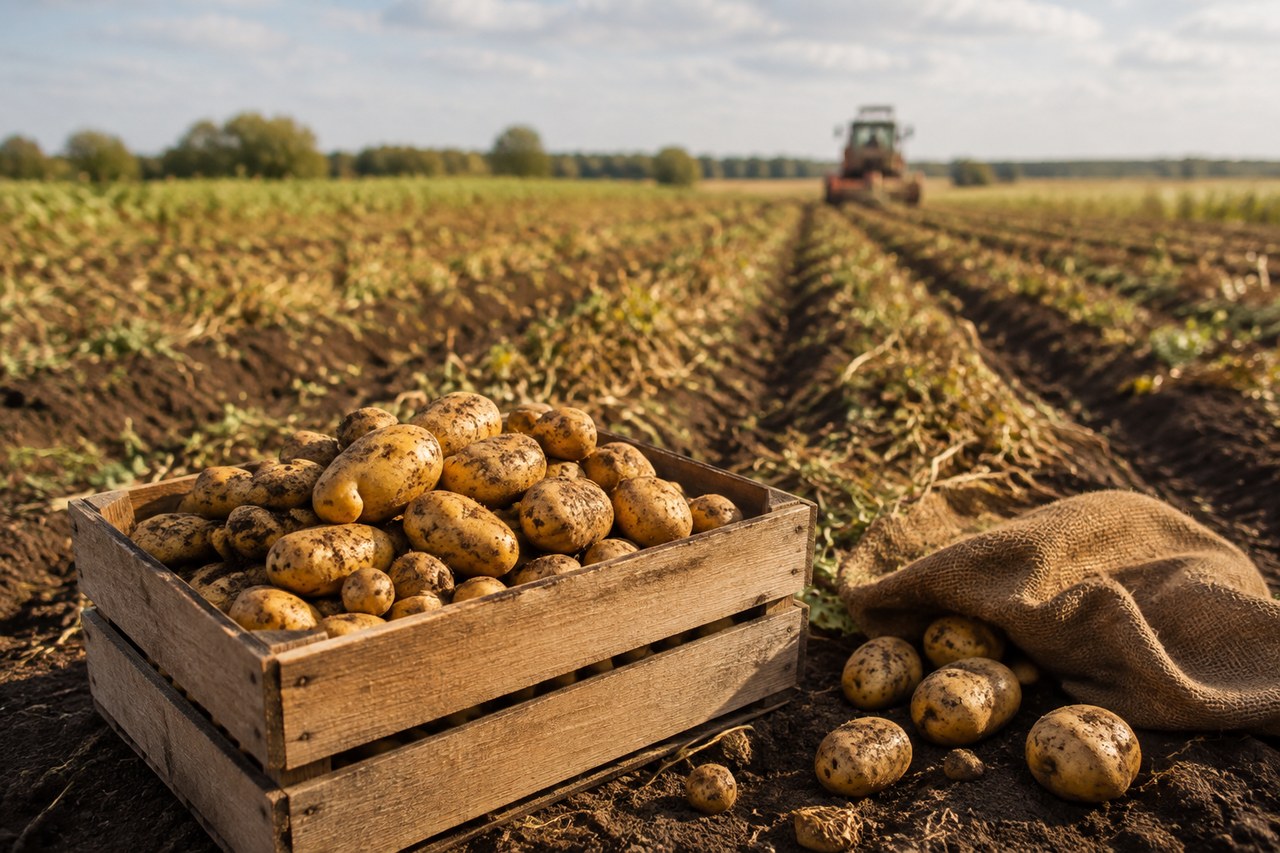
In short: Reduced acreage, heat and weak yields in some regions are limiting supply. There are signs of higher potato prices, but the retail price depends on more than harvest volume alone.
After the record harvest of 2025, the area shrinks significantly
The comparison with the previous year is particularly striking, because in 2025 an extraordinary amount of goods came onto the market. According to final figures of the Federal Statistical Office, about 13.9 million tonnes of potatoes were harvested on 301,800 hectares, which was nine percent more than 2024.
According to the AMI, the preliminary land use survey for 2026 shows only about 268,000 hectares. Thus, the potato area is a good eleven percent smaller than in 2025 and stronger than initially assumed in spring. Potatoes for the French fries processing are affected, but to a lesser extent also food potatoes.
Less land initially means less harvest potential. However, how many potatoes that can be sold are actually available in the end depends on yield per hectare, tuber size and quality, as well as losses in grubbing up and storage.
Heat and drought affect the regions differently
The harvest report 2026 of the Federal Ministry of Economic Affairs describes a particularly dry spring and a heat summer. Over several crops quantities and qualities were weaker than in many years of means; at the same time there were large regional differences. This range is also evident in potatoes.
According to the AMI estimate of 31 August, the German potato harvest in 2026 could be 10.6 million tonnes, which would be about 3.3 million tonnes less than in the record year 2025. The figure is not yet a final official harvest result: in individual parts of the country, crop failures are reported, while conditions in Lower Saxony were cheaper than in particularly dry southern and western regions.
For the week from 7 to 13 September, the Schleswig-Holstein Chamber of Agriculture reported regionally below-average to slightly above-average yields. After a rain break, only an estimated third of the harvest was introduced there. As long as a large part of the tubers are still in the soil, forecasts remain uncertain.
What the current market prices show
The market data already indicate a more stable situation, but not a uniform price picture. AMI reported at the end of August that the prices for food potatoes were barely falling. The smaller harvest volume began to support the market.
In Schleswig-Holstein, producer prices in the 37th calendar week were 26 to 29 euros per 100 kilograms for solid cooking and 25 to 28 euros for predominantly solid cooking loose goods. The consumer prices observed there also ranged from 1.69 to 2.89 euros per kilogram for loose goods; pack sizes and sales outlets showed a large range. The Chamber still described the regional market situation as balanced and the price level as relatively constant.
Hessen provides another regional signal: On 1 September, the state-owned agricultural company Hessen recorded an average of 37 euros per 100 kilograms for solid-cooking producer goods, after 20.25 euros in the corresponding week of the previous year. For mainly fixed-cooking goods, 35 euros were compared to 18.25 euros. At the same time, the Hessian wholesale tax prices for pallet-like sack goods were below the previous year's level. This initially works contradictoryly, but shows how strong market level, contractual situation, quality, packaging and region influence the comparison.
Why the farm price does not arrive one to one in the supermarket
Potatoes are sorted, stored, washed, packaged and transported between the field and the shelf. In addition, the costs and calculations of packing companies and trade as well as the VAT. If the price for loose producer goods rises significantly, this can push the shop price upwards. However, a doubling of the producer price does not automatically mean a doubling at the cash register.
Lots of potatoes, small bags, promotional products, organic potatoes and regional special varieties also have different costs. In the case of chips, chips or potato products, the raw material price is also distributed between processing, fat, energy, cooling, packaging and trade. The smaller area for processing potatoes is therefore a risk factor, but not yet a concrete forecast for the price of a single product.
Will potatoes become more expensive in the fall of 2026?
The most likely answer is: rather yes, but not everywhere and not necessarily jumpy. In 2026, the smaller area and the weaker harvest estimate speak against the very low raw material prices after an oversupply. Regional producer prices are partly already significantly higher than the previous year. At the same time, the current reports show that sufficient goods are on the market and consumer prices are strongly scattered.
For a reliable nationwide statement, the final harvest result and a longer series of current consumer prices are still missing at the beginning of September. It will be crucial how much stockable goods are actually available after the main harvest has been completed. Therefore, further changes are possible in winter and spring without a serious percentage for the supermarket being mentioned today.
How to buy potatoes in price-consciously
- Compare basic price: Pay attention to the price per kilogram, not only to the striking pack price. Thus, loose goods, 2.5-kilogram bags and larger bags can be fairly compared.
- Only suitable quantities are available: A large bag is only worth it if you consume the potatoes in time and can store them cool, dry, dark and airy. For smaller quantities, the Federal Centre for Nutrition recommends paper or jute bags instead of closed foil bags.
- Quality testing: Good tubers are solid, dry and free from green areas or germinations. Small shell defects are not automatically a quality deficiency.
- Choosing a cooking type suitable: Festcooking varieties are suitable, for example, for salads and fried potatoes, predominantly solid cooking for many everyday dishes and floury cooking for puree, soups or dumplings. This means that less is sorted out and the dish is more reliable.
Many cheap dishes can be planned around the tuber. Inspiration offers our potato recipes, the uncomplicated one-pot dishes and seasonal ideas under autumn recipes.
Conclusion: Fixed market, but no free letter for price alarm
According to current estimates, potato harvests in 2026 are significantly smaller than the record harvest of the previous year. This slows down the price decline and can increase the price of potatoes. However, how strong consumers feel in the store depends on the region, variety, pack size, stock flow and trade. The serious interim balance at the beginning of September is therefore: Price pressure is rather upward, but a substantial increase across the board has not yet been proven.
Sources and status
- Federal Statistical Office: Final results on potato harvest 2025, available on 7 September 2026. (Source)
- Agrarmarkt Information Society: Less potato cultivation than first estimated, 13 August 2026.
- Agrarmarkt Informations-Gesellschaft: Small potato harvest stops price decline, 31 August 2026.
- Federal Ministry of Agriculture, Food and Homeland: Harvest Report 2026, as of 2 September 2026.
- Chamber of Agriculture Schleswig-Holstein: Potato prices and market report for the 37th calendar week, 7 to 13 September 2026.
- Landesbetrieb Landwirtschaft Hessen: quotations for potatoes, 1 September 2026.
- Federal Center for Nutrition: Potatoes: From the purchase into the kitchen, accessed on September 7, 2026. (Source)
Author: Kochzauber Redaktion. Information and update status: September 7, 2026. The cover image is an AI-generated symbol image and does not document any concrete harvest or market region.