What Is Hojicha? Flavour, Caffeine and Preparation
Hojicha is roasted Japanese green tea with warm, nutty aromas. Discover how it differs from matcha and genmaicha, how much caffeine it contains and how to brew it.
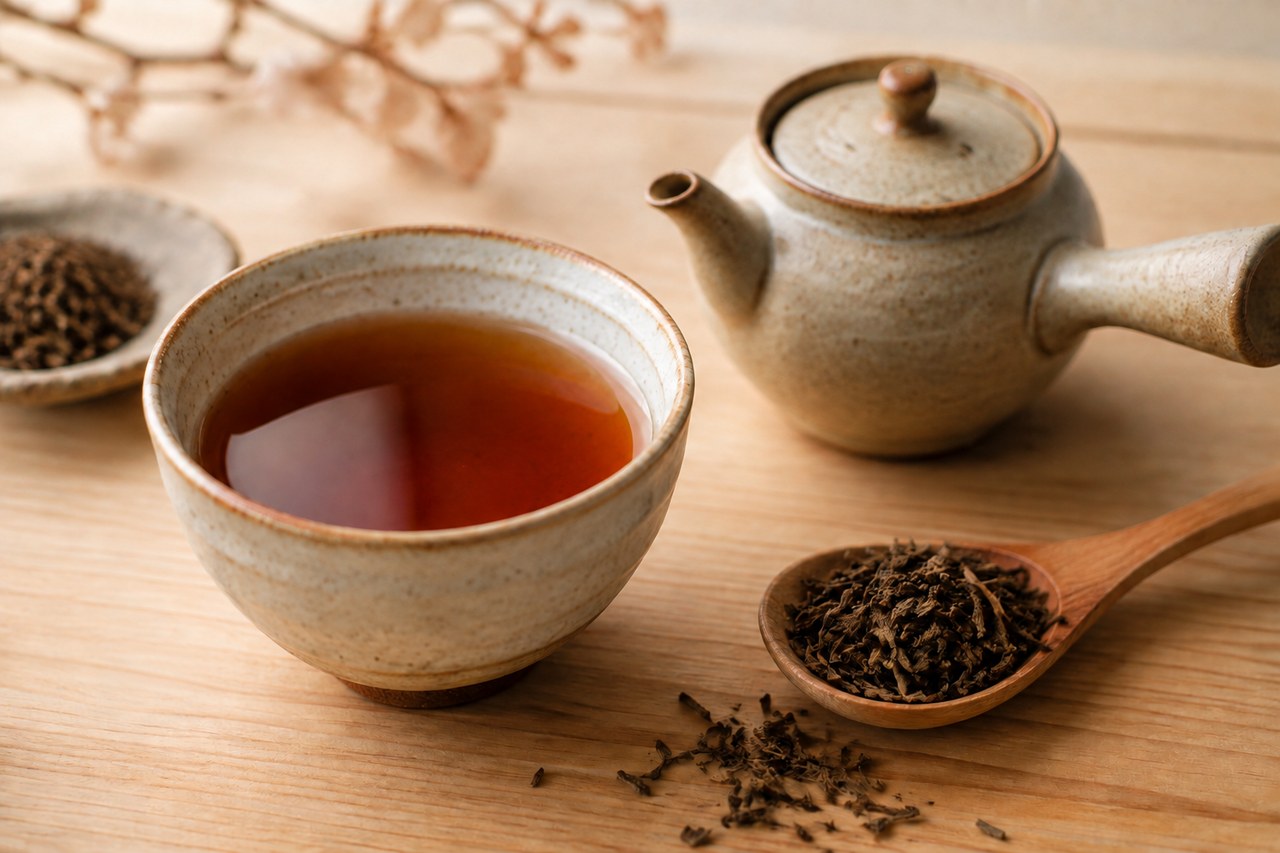
In short: Hojicha is roasted Japanese green tea with warm, nutty aromas. Discover how it differs from matcha and genmaicha, how much caffeine it contains and how to brew it.
What exactly is Hojicha?
The name is also written Hōjicha or Houjicha; in Japanese it stands for roasted tea. The Japanese Ministry of Agriculture describes Hojicha as tea, which is produced by roasting Sencha or other green teas already processed. Bancha, larger leaves and leaf stalks are often used for this purpose.
Hojicha thus remains a green tea, although dry leaves and finished drink do not look green. The decisive difference with black tea lies earlier in the processing: with Japanese green tea, the enzymes are usually inactivated after harvesting by steaming or heating. The later roasting gives Hojicha colour and fragrance, but does not make it oxidized black tea.
How does roasted green tea taste?
While Sencha often looks fresh, vegetable-like and distinctly tart, warm roasting aromas are in the foreground with Hojicha. Depending on the starting tea and the degree of roasting, it can taste nutty, woody, malty, smoky or slightly caramel. The infusion is usually clear and has a reddish-brown colour.
The heat does not only alter the aroma. Studies show that when roasting, catechins and amino acids, among other things, lose weight. This explains why Hojicha often tastes less bitter, less astringent and less umamial than high-quality unroasted green teas. "Mild" does not automatically mean weak: a dark roasted tea can be very fragrant and strong without much bitterness.
Hojicha, Matcha and Genmaicha: the differences
- Hojicha: Already made Japanese green tea is roasted. Loose leaves are poured up and then removed; ground Hojicha is completely drunk or used for cooking.
- Matcha: Shaded Tencha is ground to very fine green powder. The powder is beaten up with water and completely drunk. roasted flavours are not its typical characteristic.
- Genmaicha: Green tea is mixed with roasted rice. The roast note here comes mainly from rice, while at Hojicha the tea leaves themselves are roasted.
A brown tea powder with the inscription Hojicha is therefore not a "brown matcha". Both powders can be used similarly, but come from differently processed tea and taste different.
How much caffeine does Hojicha contain?
Hojicha is often referred to as deaffeinated. This can be true in comparison with some high-quality green teas, but is not a guarantee for each variety and cup. The starting material plays a major role: later harvested, larger leaves and stems often contain less caffeine than young leaves. Dosage, water temperature and drawing time also influence the infusion.
Roasting can additionally reduce the caffeine content, but not uniformly. A report from the Japanese tea association examined samples before and after roasting. On average, the measured content decreased by 17 percent; for individual samples the change was between zero and 50 percent. The Japanese food database continues to show caffeine for a Hojicha infusion prepared under precisely defined conditions.
The practical classification is therefore: Hojicha is not caffeine-free. If you have to avoid caffeine or are very sensitive to it, do not treat it like a herbal tea and do not rely on the word "redeemed".
So you prepare loose Hojicha
Hojicha tolerates hotter water than many fine Japanese green teas. The Japanese Ministry of Agriculture recommends 90 to 100 degrees hot water for roast teas and about 30 seconds to one minute rest time. The high temperature quickly brings the characteristic fragrance into the cup.
- Boil up water and preheat teapot and cup.
- As a starting point, dose about 4 to 5 grams of loose Hojicha to 250 millilitres of water or use the package specification.
- Pour in 90 to 100 degrees of hot water and let it rest for 30 to 60 seconds.
- Drain the tea completely. For a second infusion, allow to rest slightly shorter and adjust to taste.
If the tea tastes too thin, it usually helps a little more leaf instead of a very long drawing time. If it becomes too strong or dry, shorten the time or reduce the dosage. Hojicha can also be drunk cold; for a quick cold tea, the hot poured tea can be given over ice.
Leaf tea or Hojicha powder?
Loser Hojicha is the classic choice for a clear infusion. The roasted leaves and stems remain in the sieve. Hojicha powder consists of finely ground roasted tea. It does not really dissolve, but is distributed in water or milk and is fully used.
The powder is particularly suitable for a Hojicha latte, ice cream and baked goods. Because it clumps quickly, it should first be sifted and stirred with little warm liquid to form a smooth paste. For desserts, our recipes for Hojicha Tiramisu and Hojicha ice cream offer concrete amounts and working steps.
What you can pay attention to when buying
- Choose shape: Leaf tea is intended for infusion, fine powder especially for latte, ice cream and pastries.
- Check ingredients: Pure Hojicha is made of tea. Finished latte mixtures may also contain sugar, milk powder, flavourings or other ingredients.
- Note the degree of roasting: Bright roasts can taste finer and tea-like, darker strong, smoky and strongly roasting.
- Buy small quantities: The characteristic aroma fades after opening. Keep the tea well closed, dry, cool and light-proof and far from strongly smelling foods.
More basics and hearty dishes can be found in our collection of Japanese recipes. Hojicha is not just a sweet one: the Japanese Ministry of Agriculture also calls combinations with onigiri and spicy sauces.
Conclusion: not a matcha substitute, but a tea of your own
Hojicha is roasted Japanese green tea with brown leaves, warm scent and usually milder taste. It can be poured hot or cold and used as powder in milk drinks and desserts. Its roasted aromas clearly distinguish it from Matcha and Genmaicha. The sober formulation is worthwhile for caffeine: often less, but by no means zero.
Sources and status
- Japanese Ministry of Agriculture, Forestry and Fisheries: Uji Tea – species and processing of Japanese teas, retrieved on September 7, 2026. (Source)
- Japanese Ministry of Agriculture, Forestry and Fisheries: Japanese tea types, combinations and infusion temperatures, retrieved on September 7, 2026.
- Japanese Ministry of Education, Culture, Sports, Science and Technology: Food Database – Hojicha infusion, Japanese Standard Food Composition.
- Japanese tea association: report on the caffeine content of Hojicha and the influence of roasting, investigation report.
- Fujisaki et al.: Stress-Relieving Effects of Japanese Green Tea, Foods 2025; background to processing and ingredients of various Japanese green teas.
Author: Kochzauber Redaktion. Information and updating status: September 7, 2026. General food and preparation information, no individual medical advice. The cover image is an AI-generated symbol image.