Tomatoes in the Heat: What a New Microbiome Study Shows
A deliberately assembled community of root bacteria strengthened tomato plants in initial experiments. We explain what is new and which conclusions home gardeners should not draw yet.
In short: A deliberately assembled community of root bacteria strengthened tomato plants in initial experiments. We explain what is new and which conclusions home gardeners should not draw yet.
Why Individual Useful Bacteria Often Don't Sufficient
Complex communities of micro-organisms live around plant roots. Some can support nutrient uptake or influence the reaction of a plant to stress. However, a single strain, which is promising in the laboratory, must first assert itself under changing conditions in the soil. Temperature, competition from other microbes and substances produced by the plant change the interaction.
The team of Kyoto University, Tohoku University and RIKEN therefore did not investigate any supposed miracle bacteria, but defined microbial communities. For this purpose, nine bacterial types isolated from tomato roots and two plant metabolites were brought together in different combinations. The plants also grew at different temperatures.
The current event is a research report published by the University of Kyoto on 8 September 2026. The underlying study was published in the journal The ISME Journal on 26 August. (Source)
How the model selected from 102 combinations
The quality-tested data set included 301 tomato plants and 102 compositions of microbial communities. Among other things, the surface fresh mass was measured. A so-called Elastic-Net regression model first linked these measured values to the respective composition. According to the expert article, information from the genomes of the bacteria improved the prediction.
The model should not simply "name the best bacterium". It prioritized combinations, whose common functional potential seemed particularly interesting for further testing. Subsequently, the researchers tested the predicted candidates again on real plants. This step is important: the calculation was a selection tool, not a substitute for laboratory and outdoor experiments.
Six bacteria plus tomato were the candidate G2
The community known as G2 consisted of six bacteria and tomato, a substance naturally produced by tomato plants. In the laboratory, G2 promoted plant growth and improved tolerance to high temperature. In outdoor experiments, the surface fresh mass increased significantly. Genetic analyses also showed a changed activity of stress-related plant genes. The specialist publication highlights inter alia interactions with a bacterium of the genus Sphingobium.
These results suggest that the effect does not depend solely on a micro-organism. It could be crucial how several bacteria, plant substances and environmental conditions interact. Precisely this heavy-to-manage mesh is to make the model-based approach more searchable.
What the study has not yet answered
From more plant mass does not automatically follow a larger or more aromatic tomato harvest. The publicly accessible summary does not report a consumer test of fruit number, taste, nutritional value, durability or economic efficiency. The long-term stability of the community in different soils, climate zones and tomato varieties must also be further investigated.
A specifically defined community was tested under concrete test conditions. Other bacteria or a randomly mixed soil preparation are not to be equated with this. The article in the ISME Journal is currently available as an accepted manuscript, i.e. after evaluation, but before the final editorial text. The DOI remains in place; details of the final version may still change.
The university sees potential to transfer the process later to other crops, which is a research perspective, not an already proven effect on cucumbers, peppers or other species.
Why it doesn't make a recipe for bacterial fertilizer
The six organisms and tomato were selected and applied under scientifically controlled conditions. Neither the press release nor the study provide guidance for private mixtures. Composts, purchased microbes or home remedies do not automatically reproduce G2.
The Federal Environment Agency distinguishes plant reinforcement products and plant protection products: tonics can also contain microorganisms, but do not undergo the same strict approval procedure as plant protection products. A scientific label is therefore not yet a proof that a product achieves the results of this tomato study. (Source)
If you buy a preparation, you should carefully check the purpose, ingredients and application instructions and do not require any unidentified effects. Even mixed plant protection products are not a safe abbreviation in the hobby garden; the UBA expressly warns against supposedly harmless home products.
Four robust measures for tomatoes on hot days
- Watering in the morning and on the ground: The Federal Information Centre on Agriculture recommends regular watering on hot days, preferably early in the morning and directly in the root area. Thus, the water reaches the soil, while the leaves remain as dry as possible. (Source)
- Protect against extreme irradiation: In the case of announced strong heat, balcony plants can sometimes stand under an awning. In the bed, a light shading fabric or a white cloth help without packing the plant airtight.
- Keep the soil covered: A mulch layer slows the drying process and supports a living soil. Do not press material directly on the stem and check when casting whether the moisture actually reaches the root zone.
- Location and variety to think about: Tomatoes like sun, but variety, pot size, wind protection and water supply influence their resilience. The Federal Environment Agency recommends basically resistant varieties, suitable location conditions and a healthy soil.
Brown black, sunken areas compared to the stem can indicate an end rot. It is often favored by a disturbed calcium supply in case of drought and is not automatically an infectious fungal disease. Even water supply is therefore more helpful than spontaneous treatment on suspicion.
From the plant to the plate: use harvest instead of waiting
In the long term, the new research aims at more resilient production. For the household, the direct benefit of a successful harvest remains: processing ripe tomatoes promptly, sorting out damaged fruit and pooling surpluses in dishes. Our vegetable recipes and summer recipes – for example for sauce, soup, salad or oven vegetables – provide ideas.
This does not change the limits of the study, but combines heat protection with food value estimation. A plant does not have to be maximum size to be valuable in everyday life; the decisive factor is that its fruits are safely harvested and actually eaten.
Conclusion: A new research path, not yet a garden product
The study shows above all a new method: Microbial communities can be selected more specifically with plant experiments, genome data and a comprehensible calculation model. The candidate G2 improved growth and heat tolerance of tomatoes in the described tests. Whether this results in a robust, affordable and widely applicable product is open.
For hobby gardeners, the practical message is not "buying bacteria," but: detecting plant stress early, watering evenly on the ground, shading in extreme sun and maintaining the soil. These are now feasible measures; G2 remains research for the time being.
Sources and status
- Kyoto University: Optimizing tomato plans growth with microbes, research message of 8 September 2026. (Source)
- Yamazaki et al.: Model-guided design of defined microbial community reveals interactions underpinning plant growth and stress tolerance, The ISME Journal, published on August 26, 2026, DOI 10.1093/ismejo/wrag219.
- Bundesinformationszentrum Agriculture: Sunburn and heat damage to fruit and vegetable plants, updated on 31 March 2026.
- Umweltbundesamt: Difference between plant protection products and plant reinforcement products, background source; and plant protection in the vegetable garden, updated on 26 February 2026.
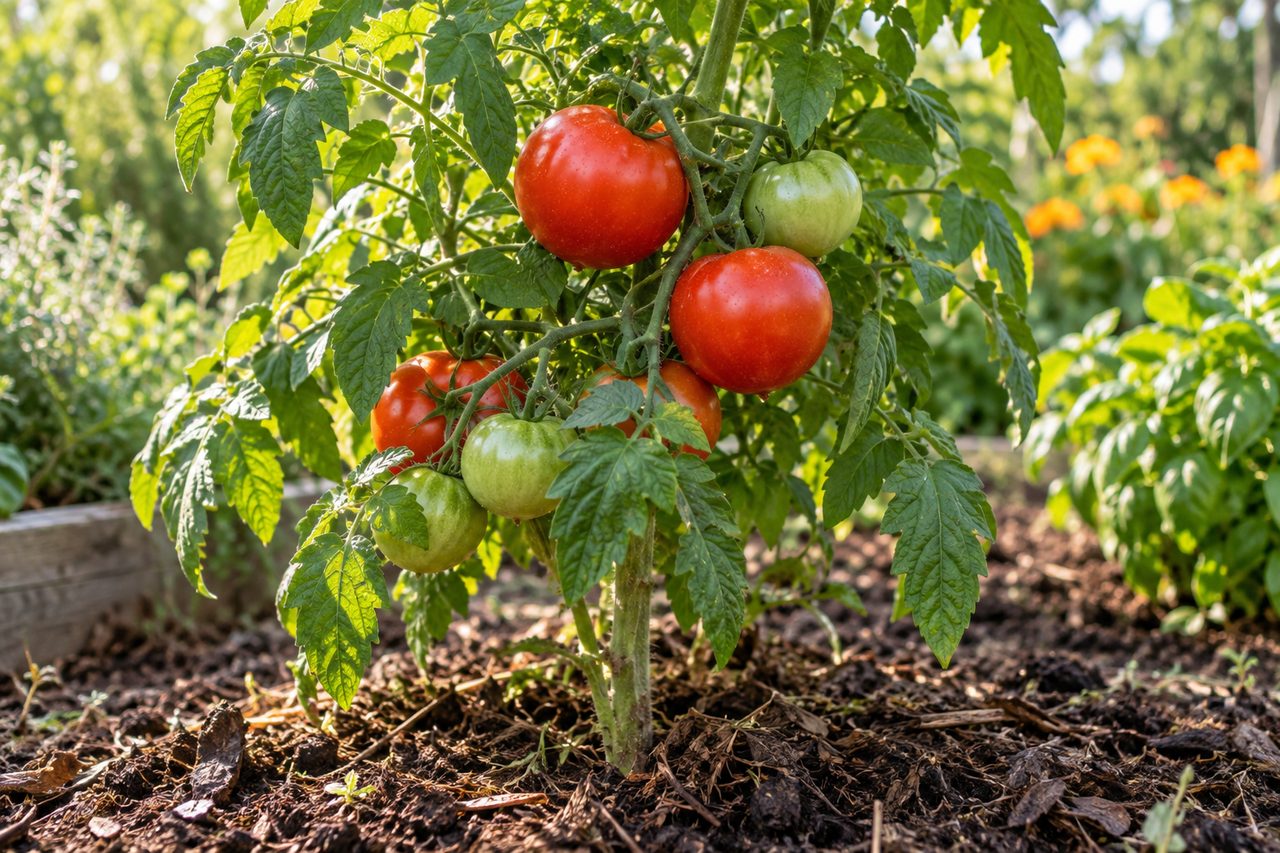
Author: Kochzauber Redaktion. Information and update status: 9 September 2026. The article classifys early research results and is not a product or application consultation. The title image is an AI-generated symbol image.