Sunflower receptacle pectin: cultivars stabilise yogurt differently
A new study extracts pectin from sunflower receptacles. Four cultivars produced very different gels, and only one clearly improved the model yogurt.
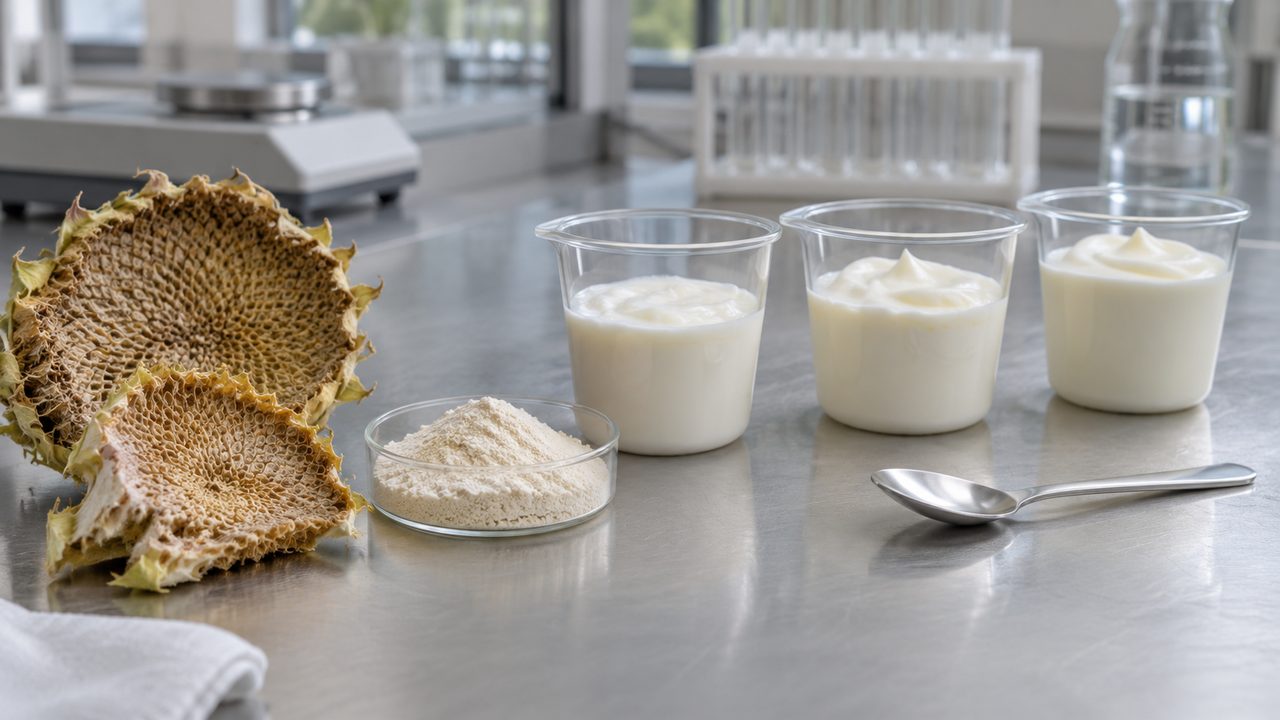
A study published on 18 November 2026 examines sunflower receptacles as a new pectin source. Pectins from four cultivars were added to plain yogurt at 0.1%. The results show that the same plant side stream can deliver very different gelling and stabilising functions depending on cultivar.
From harvest side stream to pectin powder
Sunflower receptacles remain after the seeds are removed and form a substantial plant side stream. The team studied two oilseed and two confectionery sunflower cultivars from Inner Mongolia. Fresh receptacles were dried, milled, acid-extracted with sodium citrate and the pectin was precipitated with ethanol.
Yields from one production batch ranged from 20.06% to 25.12%, depending on cultivar. For comparison, the paper cites 10–22% as a common industrial range for pectin from conventional apple and citrus raw materials. High yield alone, however, does not show whether an extract will work well in food.
Structure matters more than the plant name
The four pectins differed in galacturonic acid, degree of esterification, molecular order and gel behaviour. Pectin from the Neikuiza No.3 cultivar combined 61.65 ± 0.81% galacturonic acid with a degree of esterification of 35.31 ± 0.39%. It formed the most ordered and strongest gel in the comparison.
Another pectin had higher individual composition values but was more sensitive to pH changes and formed a weaker gel. The practical message is that a shared side-stream origin does not guarantee identical functionality. Cultivar and structure would need control during scale-up.
Only the right structure helped the yogurt
All four pectins were tested at 0.1% in full-fat yogurt. With the best-performing pectin, centrifuge-measured whey separation fell from 8.57 ± 0.40% in the control to 4.03 ± 1.65%. Firmness was 20.47 ± 0.4 g, similar to the control at 19.57 ± 2.78 g.
The other three pectins increased whey separation or softened the yogurt. Even so, no sample showed visible separated whey after 7 days at 4 °C. These were laboratory measurements, not a tasting trial, industrial filling test or long shelf-life study.
Natural does not mean additive-free
- Pectin is a plant polysaccharide known as E 440 in the EU.
- A nature-derived material can still be used technologically as an additive.
- Clean label is not a single legal category for an ingredient list.
- A new origin requires defined purity, specifications and legal assessment.
EU rules require an authorised use and appropriate labelling for additives, while EFSA assesses safety. Shoppers should therefore read the full recipe. Our breakfast ideas and recipes by ingredient offer choices without judging yogurt by one additive alone.
Conclusion: a useful side stream needs cultivar control
Sunflower receptacles delivered interesting pectin yields in this experiment. Cultivar was decisive: only the structurally suitable pectin clearly stabilised the model yogurt, while others worsened individual measurements. Commercial use still requires repeated batches, sensory work, storage, process trials and a suitable regulatory specification.
Sources and context
- Foods: study of pectin from four sunflower cultivars in yogurt, published 18 November 2026
- EFSA: food additives and pectin E 440
- European Commission: EU rules on food additives
Author: Kochzauber editorial team. Updated: 19 November 2026. The results come from a model yogurt and are not instructions for home extraction.