Softer whole-wheat steamed buns: what a new fermentation study shows
A new study examines whole-wheat dough fermented with Bacillus subtilis. The steamed buns became softer and airier. Here is what the laboratory work means and which established methods help with wholegrain baking.
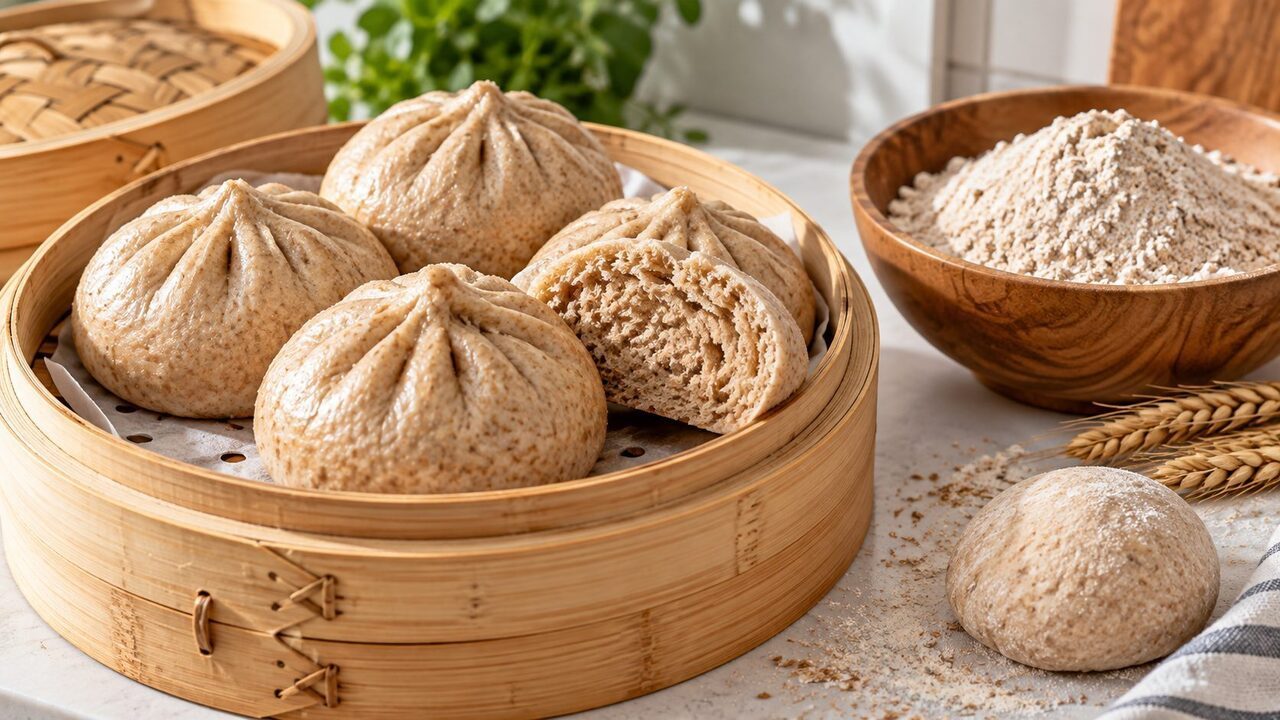
A study published in npj Science of Food on 28 September 2026 investigates how Bacillus subtilis changes whole-wheat dough. The fermented steamed buns had higher specific volume, greater porosity and lower hardness. The work offers an approach for product development; at home, water, flour and suitable resting remain the immediately useful variables.
Why wholegrain dough can be challenging
Bran in whole-wheat flour can disrupt the gluten network that gives dough its structure. The new work addresses this technological problem. It asks whether controlled fermentation changes the interaction of starch and protein, improving the texture of steamed buns.
This also helps explain why simply swapping the flour in a white-bread recipe does not guarantee a good wholegrain recipe. The German Federal Centre for Nutrition stresses sufficient water, suitable resting times and flour quality. These established points apply independently of the new experiment.
What the researchers compared
The team used 4 Bacillus subtilis strains and examined flow behaviour, molecular interactions, microstructure, texture and volatile compounds, among other properties. Fermentation reduced apparent viscosity and increased recovery after deformation. This is consistent with dough that deforms more readily.
Spectroscopic and microscopic findings were consistent with altered hydrogen bonding, greater short-range starch order and a more continuous protein phase. Such measurements help explain structural changes; they do not represent a taste assessment by every potential future buyer.
How the steamed buns changed
The fermented samples showed more volume per unit mass, greater porosity and a softer crumb. In the comparative analysis, strain SH was the most effective. These findings apply to the whole-wheat systems and conditions studied.
Steamed buns and oven-baked bread undergo different processes. The experiment therefore supplies no fixed water quantity, proofing time or culture dose for your bread. A directly usable kitchen recipe cannot be derived from the published summaries.
Aroma measurements and liking are different questions
Analysis of volatiles found lower relative odour activity values for certain off-odour compounds associated with lipid oxidation and lignin, alongside higher levels of aromatic alcohols. This describes chemical and instrumental changes. It establishes neither a universal taste judgement nor a proven health benefit.
The publisher is initially providing a peer-reviewed early version that may still undergo editorial changes. This article relies on the publicly accessible abstract and bibliographic details; unavailable numerical results are not supplied.
Why the culture needs specific assessment
The name of a microorganism alone does not guarantee safe use in any recipe. EFSA explains that its QPS process is a safety pre-assessment conducted separately from the assessment of a specific regulated product. QPS status therefore does not automatically lead to that product’s market authorisation.
For this kitchen guide, the tested cultures are not a recommendation to stir any Bacillus product into bread dough. At home, use established recipes with baking ingredients and starter cultures intended for that purpose.
What you can use in wholegrain baking today
- Choose a recipe specifically designed for wholegrain flour and follow its water quantity.
- Use a scald or preferment when the recipe calls for one; ingredients need enough time to bind water.
- Judge dough development rather than watching only the clock. Temperature and flour change how quickly dough matures.
- When trying again, change just one variable where possible so you can identify water, flour or resting as the cause.
The German Federal Centre for Nutrition and the University of Hohenheim’s free wholegrain baking book provide background and tested instructions. Find suitable accompaniments in our recipes by ingredient and breakfast recipes.
Conclusion: a technological approach with clear limits
The study shows how targeted fermentation can influence whole-wheat dough and steamed-bun structure. The particular strains and test conditions matter. At home, the useful starting point is established wholegrain recipes: enough water, appropriate dough management and a deliberate comparison of baking attempts.
Sources and update
- Fan et al., npj Science of Food: study of Bacillus subtilis, whole-wheat dough and steamed buns, published on 28 September 2026; peer-reviewed early version.
- EFSA: Qualified presumption of safety (QPS); background on microorganism safety pre-assessment.
- German Federal Centre for Nutrition: baking with wholegrain flour; background on water, flour and dough management.
- University of Hohenheim, Wheat Working Group: baking healthy and tasty bread; freely available wholegrain baking book.
Author: Kochzauber editorial team. Information updated on 30 September 2026. The kitchen advice is not an instruction to use the bacterial strains studied. The cover is an editorial symbolic image.