Roasting peanuts: new study tracks when their characteristic aroma forms
A multi-omics study follows colour, cell structure and aroma precursors as peanuts roast. Its 160 °C model explains stages, but is not a universal recipe.
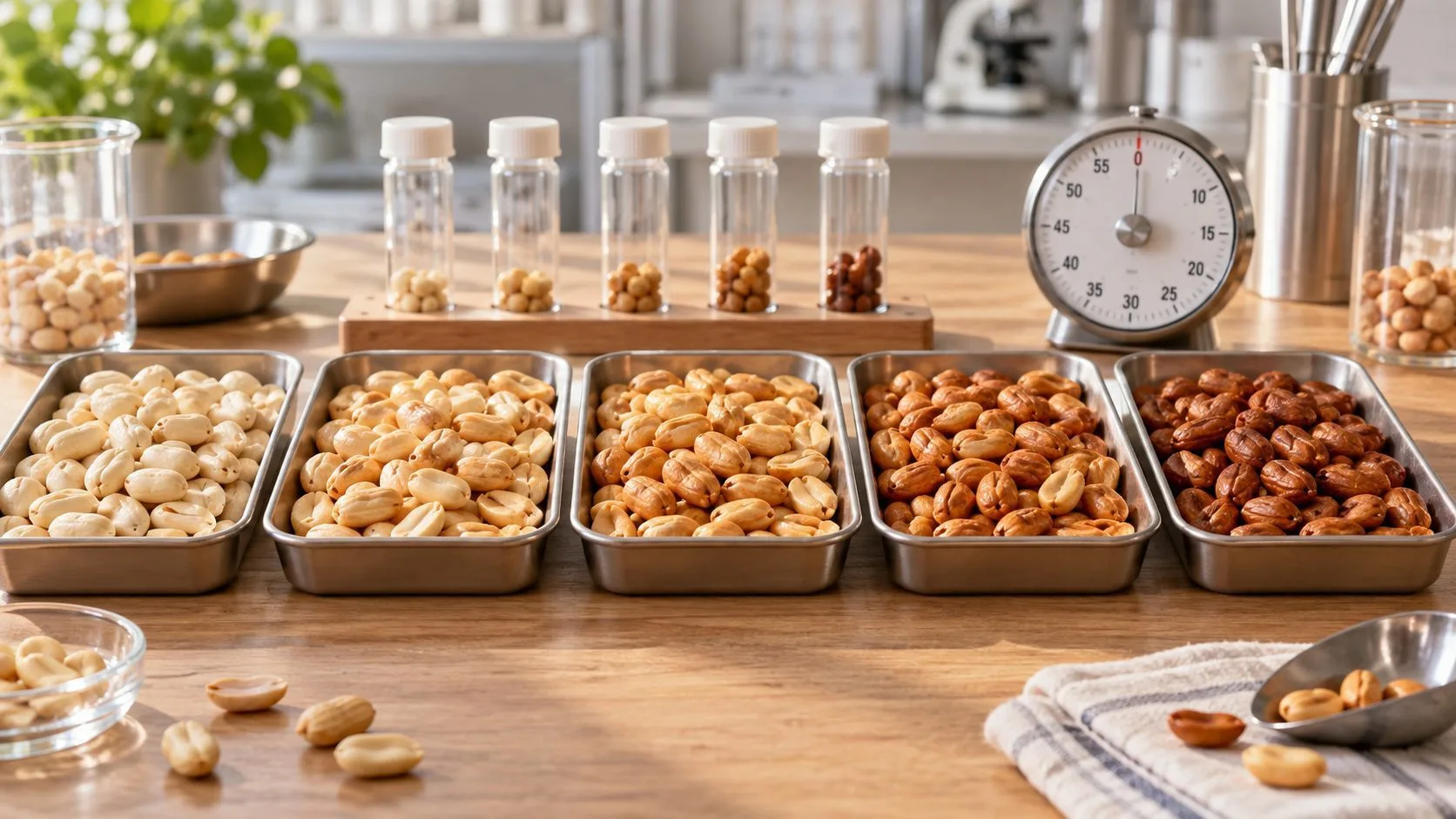
In short: A study published on 26 September 2026 followed how peanuts change when roasted at about 160 °C. The team combined colour measurement, microscopy and several omics techniques. It described stages at 5 min, 5–10 min and 15 min and linked precursors to characteristic pyrazines. This is a research model of aroma formation, not a minute-by-minute guarantee for every oven, variety or batch size.
Why roasted peanuts smell different
Heat brings sugars, amino acids and other constituents into reactions that create new aroma compounds. Pyrazines often contribute roasted and nutty notes. Colour, cell structure and fat distribution change at the same time. The new work examines these layers together instead of measuring only a few volatile compounds at the end of the process.
The 3 stages in the experiment
The researchers described the state around 160 °C after 5 min as a heat-induced mass-transfer stage. An activation stage followed between 5–10 min, while a heat-responsive reaction stage dominated around 15 min. These boundaries describe the chosen laboratory system. A domestic oven may differ in preheating, airflow and actual product temperature. Peanut size, moisture and starting condition also affect the outcome.
What colour and microscopy added
The paper reports 12 quadratic fitting models for colour-spectrum changes; every R² value exceeded 0.88 and the highest reached 0.98. Under the microscope, the team proposed a model in which lipid droplets collide and fat diffuses outward. Such models summarise measured patterns, but they are not a visual rule with which a cook can identify molecules in the kitchen.
The precursors in focus
The multi-omics analysis highlighted 7 lipid molecules, 6 amino-acid molecules and 7 oligosaccharide molecules associated with flavour formation. The team used them to propose a network of relationships with characteristic aroma compounds. Correlations and a mechanism model are useful for new hypotheses; they do not prove that only these compounds determine flavour.
What can reasonably transfer to the kitchen
- Spread evenly: one layer supports more even browning than a deep pile.
- Watch colour and aroma: times are guidance because appliances and peanuts differ.
- Stop in time: residual heat continues to act; darker is not automatically more aromatic.
- Allow to cool: texture and final roast level are easier to judge after cooling.
Why a darker roast is not automatically better
Roasted aromas form alongside unwanted reaction products. For home heating of starchy foods, Germany’s Federal Institute for Risk Assessment recommends the general rule “golden rather than charred” to minimise acrylamide. The new peanut study did not identify an optimal health-related roast. It examined aroma mechanisms, not an individual risk balance or a household limit.
The allergen warning does not change
Roasting does not make peanuts allergen-free. Peanuts are among the major allergens that require labelling. When cooking for others, avoid cross-contact through trays, bowls and equipment and communicate clearly. For households without peanut allergy, find ideas in Kochzauber’s recipes by ingredient and breakfast recipes.
Conclusion: understand stages, do not worship the timer
The study combines structure, composition and volatile aroma compounds into a detailed picture of roasting. The distinction between early transfer, activation and reaction stages is particularly useful. At home, however, time is only a starting point: even spreading, observation and stopping in time matter more than blindly copying 15 min at 160 °C.
Sources and update
- npj Science of Food: Elucidating flavor formation molecular mechanisms in peanut roasting through multi-omics analysis, original study, published 26 September 2026.
- German Federal Institute for Risk Assessment: questions and answers on acrylamide in food, general context on browning reactions and home preparation.
- EUR-Lex: Regulation (EU) No 1169/2011, labelling duties and Annex II on substances causing allergies or intolerances.
Author: Kochzauber editorial team. Information updated on 28 September 2026. The experimental design is not a validated household recipe; appliances, peanuts and quantities differ. The cover is an editorial symbolic image.