Pumpkin enzyme breaks down peanut proteins—but does not make an allergen-free food
A figleaf-gourd enzyme reduced antibody binding to peanut proteins in laboratory tests. It has not yet produced a safe food for people with peanut allergy.
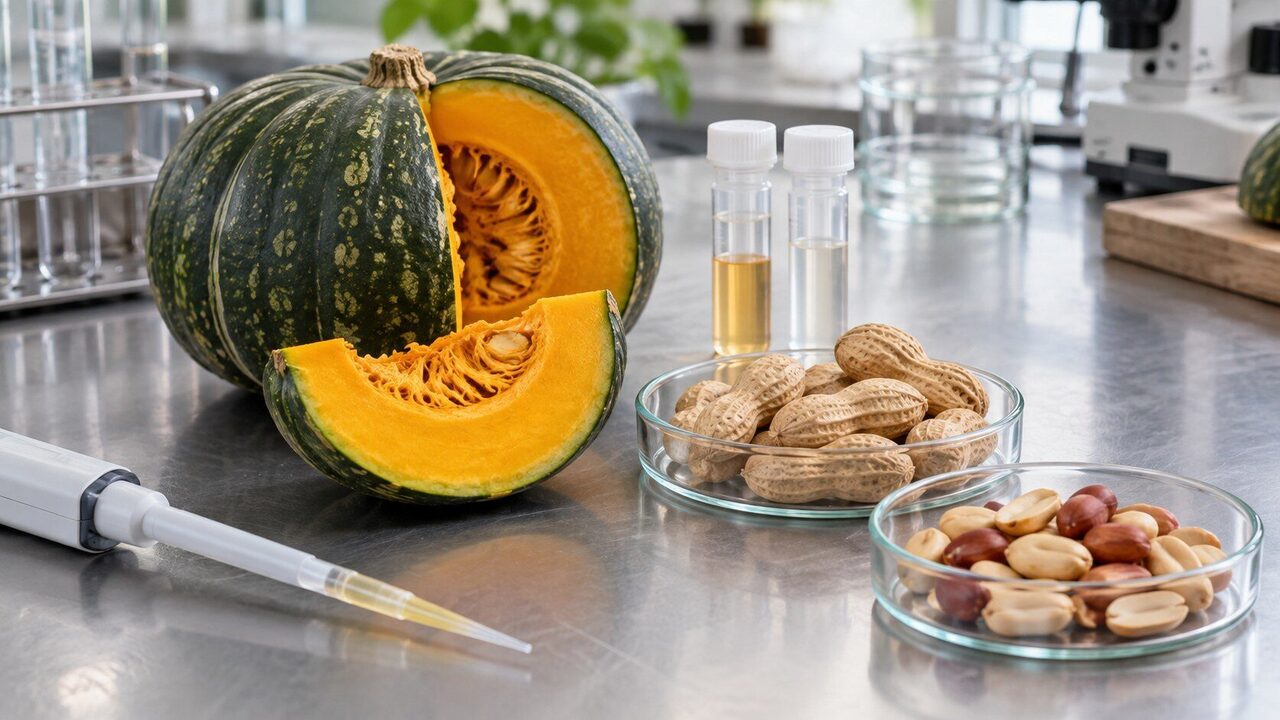
In short: A research release issued on 24 September 2026 describes how a serine protease from figleaf gourd broke down peanut proteins in the laboratory. Antibody binding was lowest at 42 °C after 24 hours, but it did not disappear completely. The work offers a route for food-technology research, not proof of an allergen-free product and not an invitation for people with peanut allergy to try treated peanuts.
What the laboratory study tested
The team treated peanut proteins with a serine protease obtained from Cucurbita ficifolia. It compared enzyme activities of 150, 300 and 600 U/mg, temperatures of 37 and 42 °C, and reaction times of 0, 1, 5 and 24 hours. The researchers then measured how strongly antibodies from the blood of people with peanut allergy bound to the resulting protein components.
The result that stood out
The most intensive treatment at 42 °C for 24 hours produced the lowest antibody binding in the tests. This suggests that the enzyme changes certain structures in peanut proteins or breaks them into smaller peptides. The finding shows a measurable effect under controlled laboratory conditions. It does not yet show how a resulting food would be processed, stored, digested or tolerated by a person.
Why reduced binding does not mean allergen-free
Small peptides created by the breakdown could still bind to IgE antibodies. The researchers therefore report that complete removal of immunoreactivity was not achieved under the tested conditions. A laboratory antibody-binding test is also different from showing that allergy-related cells are not activated or that no reaction occurs in a controlled clinical test.
Not yet a product for people with allergy
The study describes a processing step, not a market-ready food. It provides neither a safe serving size nor reassurance about traces, cross-contact or severe reactions. Anyone with peanut allergy should continue to follow medical advice and allergen labelling. The new method must not prompt private experiments with treated or heated peanuts.
Four limits of the study
- Laboratory, not daily life: The work examined protein samples, not complete meals or market-ready foods.
- Binding, not reaction: Less antibody binding does not automatically prove a milder clinical reaction.
- Residual reactivity: IgE-binding components remained detectable after breakdown.
- No consumption trial: Safety, dose and effects were not tested in people.
What shoppers should do in practice
Peanut is one of the 14 allergens that must be declared in the EU. A new processing step does not automatically remove that obligation. The actual recipe, legal assessment and label of the specific product remain decisive. For anyone who must cook without peanuts, reading every ingredient list carefully matters more than a broad research headline.
Why food technologists may find the approach useful
Enzymes can break proteins down selectively under mild conditions, changing texture, solubility or immunoreactivity. That makes the pumpkin protease interesting for further study. Its benefit must still be confirmed in real food matrices. Our recipes by ingredient help with raw-material choices, while the breakfast ideas offer places to look for suitable alternatives.
Which checks need to come next
The authors identify tests of allergy-related cell activation as a next step. Standardised food processes, analyses after storage and digestion, and robust safety assessments would then be needed. Only that chain of evidence can show whether the biochemical effect can become a useful application with a credible safety assessment.
Conclusion: an interesting process with a clear safety boundary
The pumpkin enzyme reduced antibody binding to peanut proteins under selected conditions, but did not eliminate it. The study therefore supplies a promising element for future processes, not a solution to peanut allergy. Until a tested product with unambiguous labelling exists, the practical conclusion does not change: people with diagnosed allergy should handle peanuts only in line with medical advice and should not infer safety from an early laboratory study.
Sources and update
- EurekAlert: Pumpkin enzyme may help reduce peanut allergenicity, research release dated 24 September 2026.
- Food Chemistry: Pumpkin power: The influence of serine protease isolated from Cucurbita ficifolia on peanut proteins, issue date 1 October 2026.
- European Commission: Food allergies, EU allergen-labelling overview.
- German Federal Institute for Risk Assessment: Allergies: key questions and answers, technical background.
Author: Kochzauber editorial team. Information updated on 26 September 2026. This article describes laboratory research and does not replace medical advice. The cover is an editorial symbolic image.