Plastic tea bags tested: putting particles and BPA in context
A new study compares 14 bagged teas with 14 loose teas. Plastic bags released more particles, but that alone does not provide a robust health forecast.
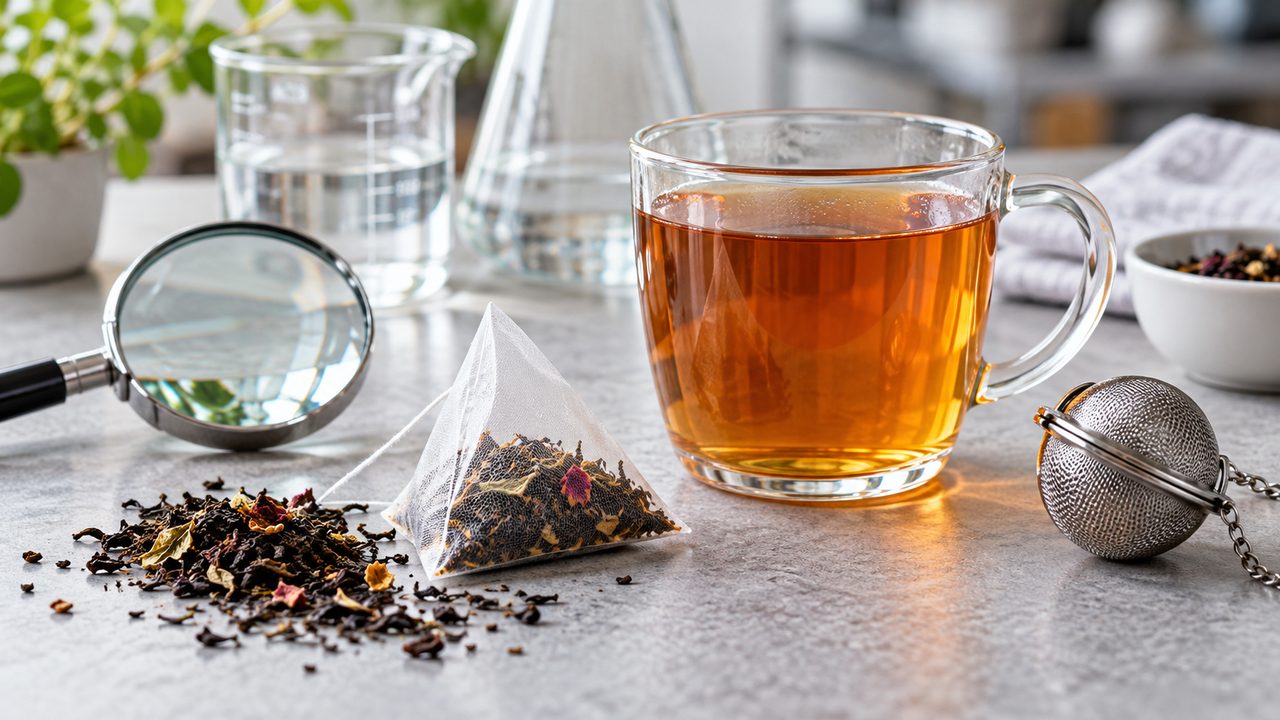
A study published in npj Science of Food on 13 October 2026 examined infusions from 14 bagged and 14 loose-tea brands. Under standard preparation with water at 95°C for 3 min, the researchers found substantially more microplastic particles in infusions from plastic bags, along with measurable migration of bisphenol A and phthalate esters. It is a laboratory comparison, not a final assessment of the health risk from every tea bag on the market.
What the laboratory comparison covered
Each product group included 14 brands. Infusions were made under the same conditions. The team characterised particles by ATR-FTIR and measured bisphenol A and phthalate esters by GC-MS/MS. Polymer type and selected chemical substances could therefore be considered separately.
The study describes the tested bags as polymer-based. Results for them cannot simply be transferred to paper, cellulose or materials marketed as compostable. Manufacturing, surfaces and quality may also differ within one material group.
The particle counts
Infusions from plastic bags contained 555 to 2498 particles per cup. Loose tea produced 0.3 to 2.4 particles per cup. Debris above 100 µm from the bags consisted exclusively of polyamide fibres; loose tea contained several polymers and predominantly fragments.
That is a clear difference under the experimental conditions. It does not automatically prove that every particle was newly generated during brewing. In reviewing an earlier tea-bag study, Germany’s Federal Institute for Risk Assessment noted that particles may already sit on surfaces before infusion and be washed off during brewing. Measurement and sample preparation strongly affect counts.
Do not confuse the BPA figure with the risk model
In the new paper, estimated BPA intake from bagged tea reached up to 21.7% of EFSA’s tolerable daily intake. The cumulative hazard index for the chemicals studied remained below 1. Both are modelled figures within the study and should be read neither as an all-clear nor as proof of disease risk.
EFSA set the tolerable daily intake for BPA at 0.2 ng per kg of body weight per day. A percentage of that value therefore depends on assumptions about body weight, volume and frequency. The index also covers only the substances studied and the uncertainties in the model.
What authorities currently say
The BfR considers health effects from microplastics in food unlikely on current knowledge, while also saying that data remain insufficient for an overall assessment. That is precisely why particle measurement and health effects need to be kept separate.
EU rules require food-contact materials not to transfer constituents in quantities that endanger health, unacceptably change food composition or impair taste and smell. The new study is not a regulatory compliance test of any specific retail product.
Four practical choices without alarmism
- Check the material: if the bag type is unclear, consult the pack or ask the manufacturer.
- Use a loose alternative: loose tea in stainless steel or a suitable reusable infuser avoids the disposable bag, but not every background particle source.
- Follow brewing directions: use the maker’s temperature and time; the study tested 95°C and 3 min.
- Do not rely on appearance: bag material, BPA migration and particle counts cannot be identified reliably by sight.
Anyone who already enjoys loose tea can switch easily with a reusable infuser. Ideas for warm drinks and accompanying food are available under breakfast and recipes by ingredient. Switching is a precaution and waste choice, not medical treatment.
Conclusion: relevant material comparison, open risk question
The study of 13 October 2026 finds far higher particle counts under standard conditions in infusions from plastic tea bags than loose tea and detects selected chemical migration. Methodological and toxicological uncertainties mean that the health significance remains open. Transparent material information and robust testing standards are more useful than blanket alarm.
Sources
- npj Science of Food: original plastic tea-bag study, published 13 October 2026
- German Federal Institute for Risk Assessment: review of an earlier tea-bag microplastic study
- European Food Safety Authority: re-evaluation of BPA intake
- European Commission: safety requirements for food packaging
Author: Kochzauber editorial team. Updated: 15 October 2026. Particle and migration measurements do not by themselves establish a health effect.