PFAS in food packaging: what a new laboratory test can reveal
A new direct-desorption test found signs of volatile PFAS and fluorinated polymers in selected food-contact materials. Here is what the screen can and cannot establish.
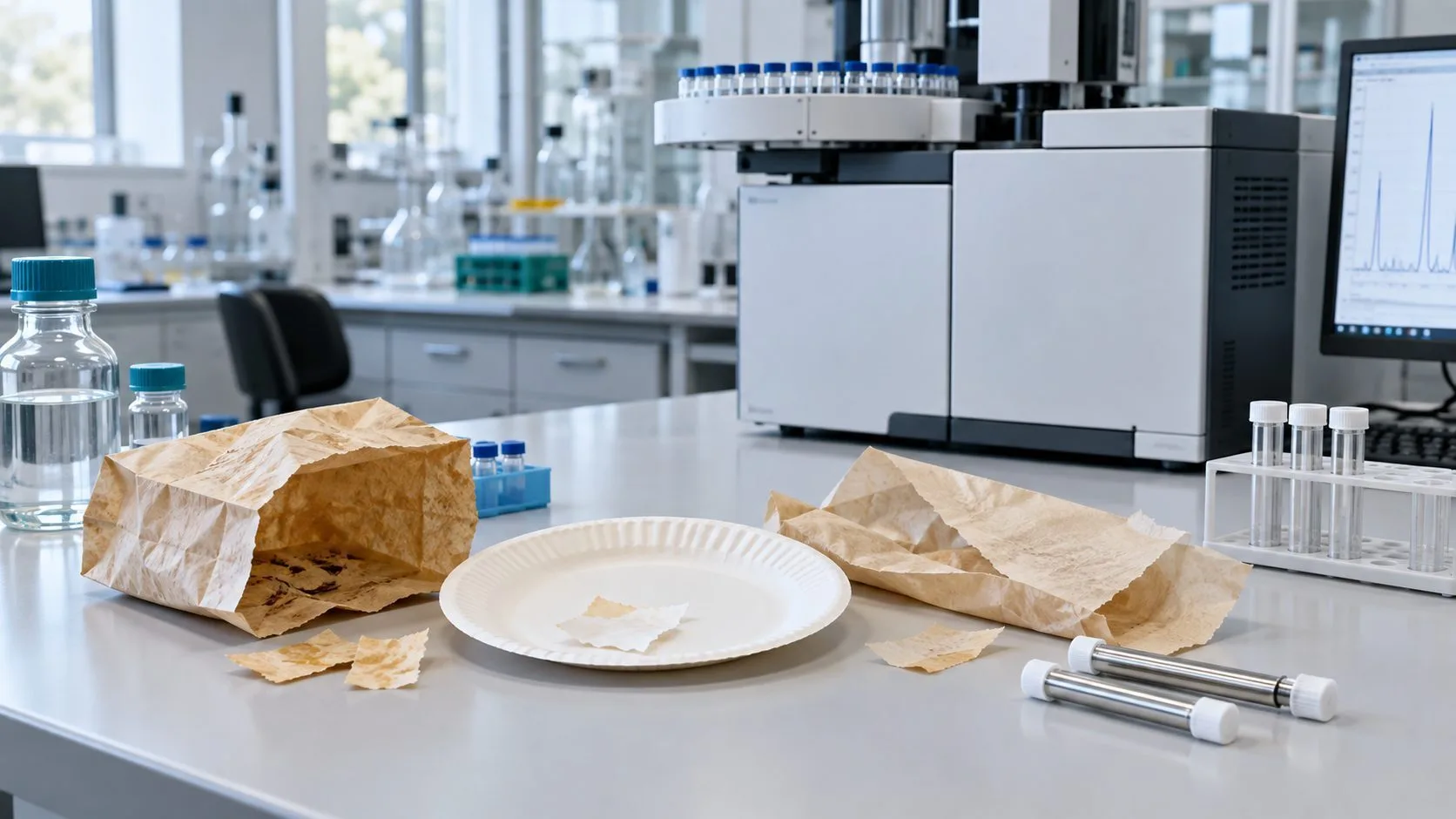
In short: A study published on 27 September 2026 describes direct thermal desorption coupled with gas chromatography–mass spectrometry, or DTD–GC–MS. The team examined 13 food-contact materials for volatile PFAS and indicators of side-chain fluorinated polymers. It is a rapid laboratory screen. It neither measures every PFAS nor proves on its own that a package is wholly PFAS-free or safe for every use.
What the experiment examined
The researchers optimised the method for 5 n:2 fluorotelomer alcohols and then expanded the target range to additional volatile compounds. Small pieces of material were heated directly in a tube; released substances entered the GC–MS without prior liquid extraction. The main screen used 200 °C and a 20 min desorption. Mean recovery was 114 %, while detection limits for the fluorotelomer alcohols were 20–53 pg.
Which samples produced notable signals
At 200 °C, 3 popcorn bags and 1 paper plate marketed as ecofriendly released 6:2 fluorotelomer alcohol and 6:2 fluorotelomer olefin above the quantifiable range. The researchers attribute this to thermal degradation of a side-chain fluorinated polymer. Repeated desorption continued to release the compounds, although at declining levels. A separate test at 115 °C for 2 min was designed to approximate microwave heating of one popcorn bag.
Why this is not a home experiment
The procedure requires specialist equipment, controlled temperatures and very small samples. Packaging should not be heated empty or burned at home. The findings also concern the selected materials, bought between 2020 and 2026; they do not describe every popcorn bag, paper plate or current product. The article image is therefore symbolic and does not show an original sample.
What the screen can and cannot do
- Strength: DTD–GC–MS shortens sample preparation and can indicate volatile PFAS and degradation products from certain fluorinated polymer side chains.
- Limit: it covers a defined group of volatile substances, not the full PFAS family.
- Not a migration balance: release during heating is not identical to the amount that transfers into a particular food.
- Not proof of PFAS-free status: that claim needs a defined testing strategy, further analyses and robust product documentation.
How the new EU rule fits in
Since 12 August 2026, food-contact packaging may not newly be placed on the EU market when it reaches or exceeds the PFAS limits in the packaging regulation. The thresholds include 25 ppb for each PFAS measured by targeted analysis, 250 ppb for the sum of targeted PFAS and 50 ppm for PFAS including polymeric PFAS. Commission guidance recommends a stepwise analytical approach. One DTD–GC–MS screen does not reproduce that entire compliance assessment.
Practical steps for shoppers
Appearance, colour or the word “paper” cannot reliably reveal chemical composition. Specific manufacturer instructions on intended use, temperature and disposal are more useful. Heat packaging only as directed and do not repurpose damaged single-use materials. Where suitable, reusable containers can reduce unnecessary single-use contacts; suitability, cleaning and correct use still matter.
Everyday cooking without alarmism
The study is mainly relevant to laboratories, surveillance and packaging development. It is not a reason to avoid packaged foods as a category. People preparing meals can browse Kochzauber’s recipes by ingredient and breakfast recipes. For purchased products, read the packaging instructions, do not exceed the intended temperature and look for traceable evidence behind specific PFAS-free claims.
Conclusion: a new searchlight, not a clean bill of health
The paper shows that direct thermal desorption can reveal volatile PFAS and signals from fluorinated side-chain polymers in food-contact materials. A rapid screen is particularly relevant under the new EU thresholds. Whether packaging is compliant, low-migration or fully PFAS-free must still be answered with the testing strategy designed for that question.
Sources and update
- PubMed: Direct thermal desorption–gas chromatography–mass spectrometry for screening volatile PFAS and side-chain fluoropolymers in food contact materials, bibliographic record and abstract, publication date 27 September 2026.
- Journal of Chromatography A: original paper with methods and results.
- EUR-Lex: Regulation (EU) 2025/40 on packaging and packaging waste, Article 5(5).
- European Commission: guidance for Regulation (EU) 2025/40, stepwise PFAS testing approach.
Author: Kochzauber editorial team. Information updated on 28 September 2026. This article explains a laboratory screen and replaces neither product testing nor legal advice. The cover is an editorial symbolic image.