Pequi kernel protein from a by-product: cold plasma improves lab functions
A new study upgrades defatted pequi kernels as a plant protein source. Brief cold-plasma treatment improved solubility and emulsification, but this is not yet a food product.
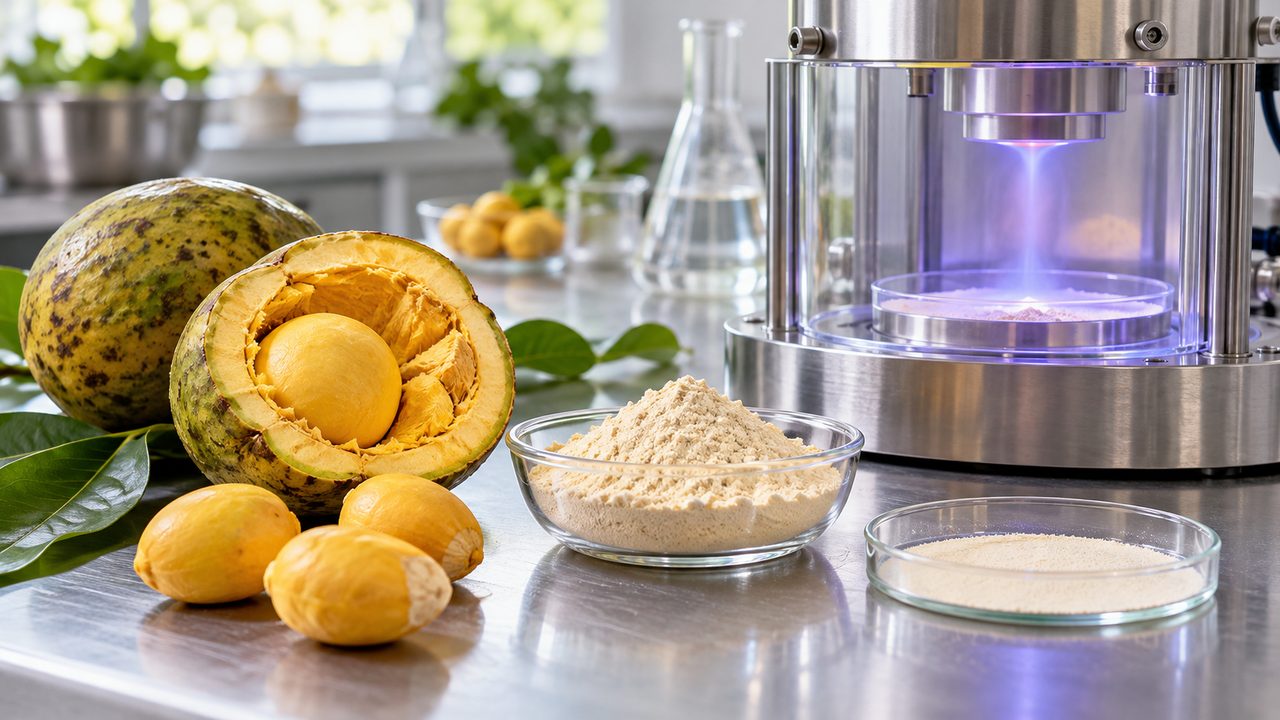
A study published on 10 October 2026 examines protein from pequi kernels, a side stream of oil production from the Brazilian Cerrado fruit. Brief treatment with cold atmospheric plasma improved several technological properties of the isolate. That is interesting for new plant-based ingredients, but it remains basic research without a finished food, consumption trial or market authorisation.
Why the pequi kernel was investigated
Pequi, botanically Caryocar brasiliense, is a fruit native to Brazil's Cerrado. Its kernels are traditionally eaten and used for oil. After defatting, biomass remains that, according to the new paper, contains about 27% protein on a dry basis. This side stream could potentially gain more value instead of being treated merely as a residue.
For the experiments, the team extracted protein under alkaline conditions, precipitated it at its isoelectric point and freeze-dried it. The powder contained 87.93% protein on a dry basis. It was therefore a purified laboratory isolate, not ground pequi kernel of the kind that might be handled in a kitchen.
What cold plasma did to the protein
The researchers treated thinly spread powder for 2–10 minutes with a dielectric barrier discharge in ambient air. Despite the word plasma, the sample remained mildly tempered and did not exceed 25 °C. Reactive oxygen and nitrogen species can unfold, reorganise or oxidise proteins in this process.
Short exposures of 2–4 minutes performed best. Solubility rose to about 2.6 times the control, emulsifying activity to almost 7 times and emulsion stability to about 2.7 times. Water- and oil-holding capacities reached roughly 2.0 times the untreated values. Such functions matter technically in beverages, sauces or structured foods.
More treatment was not automatically better
With longer exposure, particle size, dispersion and viscosity increased. The researchers also found more carbonyl groups and fewer free sulfhydryl groups, signs of oxidative change and aggregation. This reveals a central limit: the same process that helps briefly can promote undesirable structures when applied for longer.
The figures therefore apply only to the isolate, equipment and conditions studied. Transfer to another protein batch, a larger production line or a finished formulation would need fresh testing. “Chemical-free” would also be misleading: no chemical modification reagent was added, but reactive species still produced chemical changes in the protein.
What is still missing for a food product
The paper assessed solubility, emulsification, holding capacity and rheology, not the taste, colour, storage stability or acceptance of a finished product. Digestibility, amino-acid quality, potential allergens and process by-products were also not examined as a complete safety assessment in this study.
A producer would also have to address raw-material origin, sustainable harvesting, consistent composition and legal marketability in the target market. Brazil has established a national policy for the sustainable management, harvesting and processing of pequi, but that does not replace product-specific assessment in Europe.
Everyday value: reading the technology trend correctly
Consumers are unlikely to find pequi protein isolate as a standard ingredient soon. If it appears, the ingredient list, protein amount, allergen information and nutrition table will say more than terms such as “circular”, “clean label” or “plasma-treated”. A new protein source is not automatically nutritionally superior.
Established plant variety is already available among vegetarian dinners and recipes by ingredient. Pulses, grains, nuts and seeds remain more accessible choices while new isolates still have to demonstrate quality in the actual food.
Conclusion: promising function at an early stage
Brief cold-plasma treatment made pequi kernel protein markedly more soluble and emulsifying in the laboratory system; longer treatment increased oxidation and aggregation. The study shows a possible route for using a side stream. It demonstrates neither health benefits nor the market readiness of a food.
Sources
- Food and Bioprocess Technology: cold plasma and pequi kernel protein, published 10 October 2026
- Embrapa: technical fact sheet on pequi and its components
- Brazilian Presidency: law on sustainable pequi use
Author: Kochzauber editorial team. Updated: 12 October 2026. The findings come from laboratory tests of a protein isolate and are not a safety, authorisation or health assessment of a finished food.