Onion peel and chitosan nanoparticles show laboratory potential
A new laboratory study combines red-onion peel extract with chitosan. The results may inform future preservation research, but this is not a finished food package.
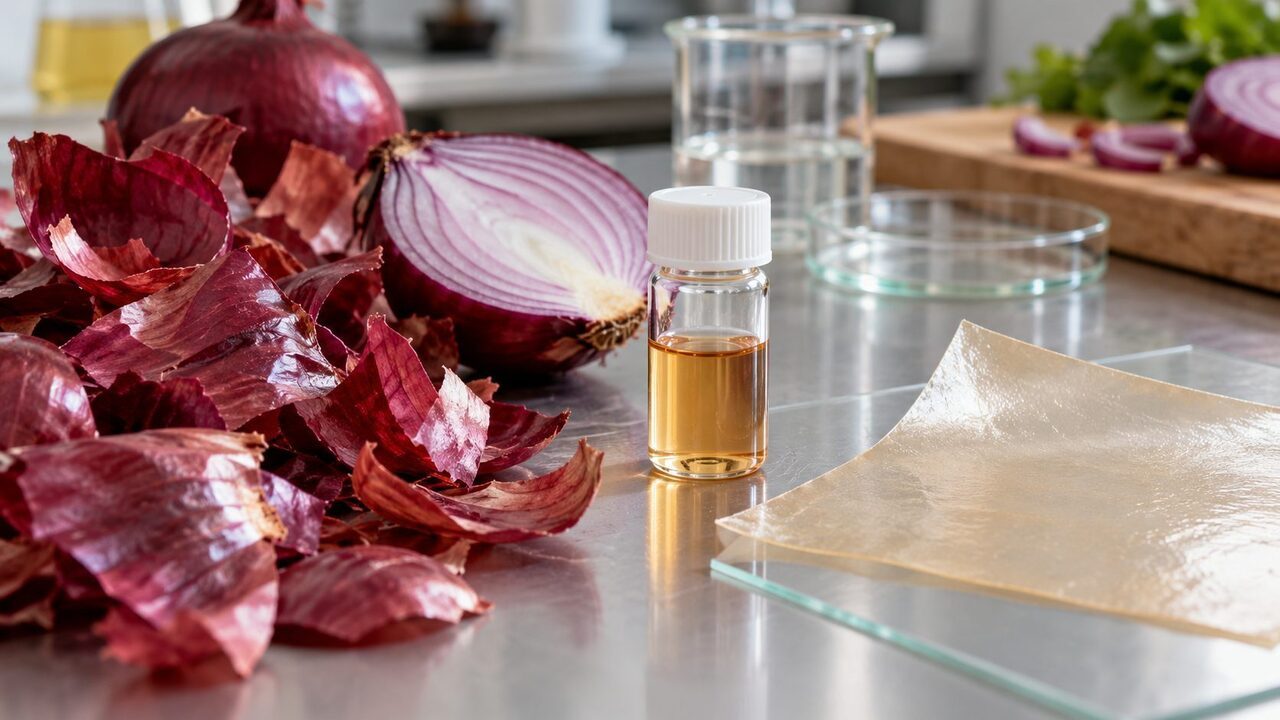
A study published on 3 October 2026 embedded red-onion peel extract in chitosan nanoparticles. Antioxidant activity was preserved in the laboratory and activity against several bacterial strains sometimes increased. That makes the approach interesting for further research into preservation systems, but it demonstrates neither food safety nor market readiness.
How the formulation was developed
The researchers used a Box–Behnken design with 15 runs. They varied the concentrations of chitosan, onion-peel extract and tripolyphosphate. Outcomes included particle size, size distribution, surface charge, loading and antioxidant activity. The optimized particles averaged 237.6 nm in size.
Chitosan is a biopolymer commonly obtained from chitin; in practice its source may, for example, be crustacean shells. The study characterized the material with several laboratory methods. It did not, however, make a retail-ready film or test packaged foods, industrial manufacture or actual migration into food.
What the laboratory values mean
The loaded nanoparticles achieved 89.58% antioxidant activity in the assay used. Their IC50 was 0.49 mg/ml, compared with 0.54 mg/ml for free extract. After 72 hours, roughly 46 to 60% of the extract was released, depending on pH.
In bacterial assays, the formulation was markedly more active against Escherichia coli and Staphylococcus aureus than free extract; against MRSA, by contrast, free extract was stronger. Such in-vitro findings show activity under controlled conditions. They do not yet show that packaging would make food safer or extend shelf life.
Why this is not a finished clean-label solution
The paper describes the combination as a possible platform for further investigation, including food-preservation systems. Stability data, tests in real foods, sensory assessment, migration measurements, dose evaluation, scale-up and an appropriate regulatory assessment are still missing.
The term clean label is also inappropriate here: it is not proof of safety, and a naturally derived starting material does not automatically make a nanoformulation simple or risk-free. The study did not investigate PFAS either, so it does not establish that the material can replace a PFAS-free packaging alternative.
What matters for nano applications in the EU
The European Commission notes that nanomaterials may have different properties and risk profiles from their larger forms. EFSA guidance therefore calls for case-specific characterization and risk assessment, including for food-contact materials.
Packaging must generally not transfer constituents to food at levels that endanger health, unacceptably alter composition or impair taste and smell. Publication in a scientific journal replaces neither that assessment nor authorization for a specific use.
Conclusion: a smart by-product idea that remains basic research
Using onion peel as a source of functional substances could add value to residual streams. The new work provides interesting laboratory results while illustrating how many steps still separate research from safe use. Consumers should not infer shelf-life or health promises. Find related kitchen ideas among our vegetable recipes and recipes by ingredient.
Sources and update
- Husien et al., Scientific Reports: onion-peel extract in chitosan nanoparticles, published on 3 October 2026.
- European Commission: nanomaterials in food and requirements for risk assessment.
- European Commission: safety principles for food packaging and contact materials.
Author: Kochzauber editorial team. Information updated on 5 October 2026. This article explains a laboratory study; the formulation was not tested as market-ready food packaging. The cover is an editorial symbolic image.