Microplastics in food: why a high index is not a health verdict
A new review explains five widely used microplastic indices. They compare contamination, but cannot yet classify a food as safe or unsafe.
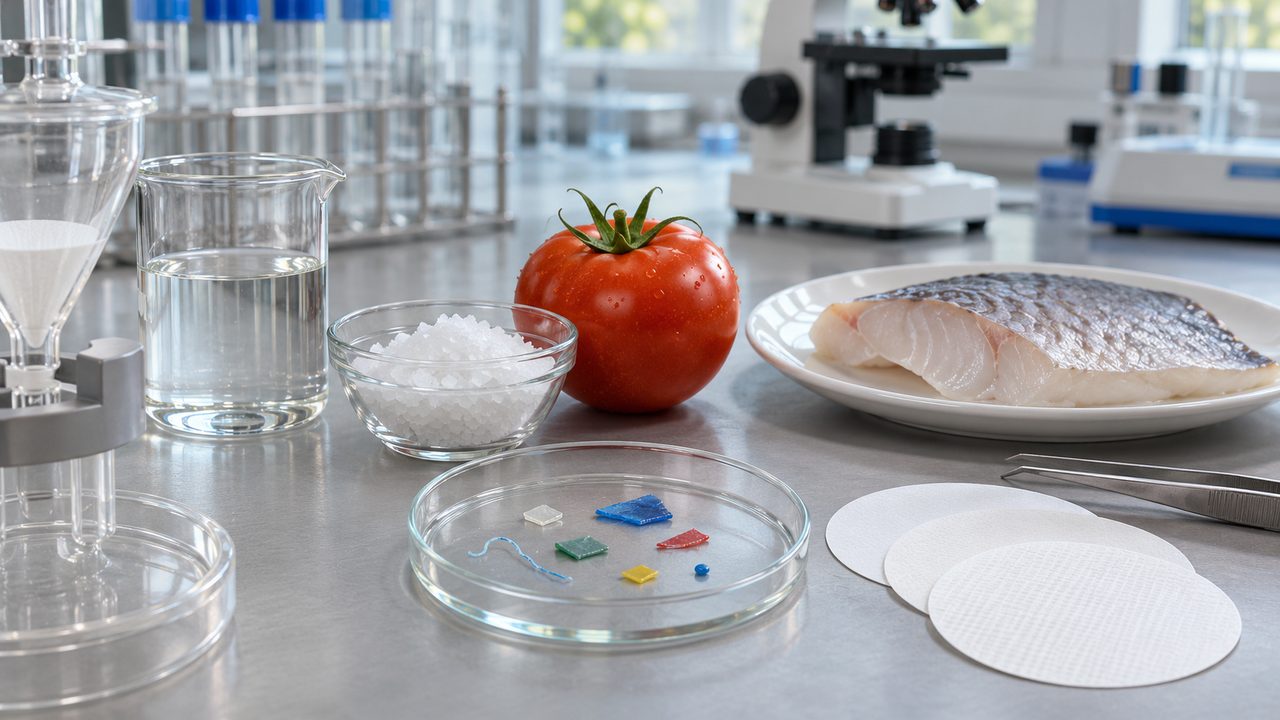
A review published on 18 November 2026 shows why figures on microplastics in food can promise too much. Five common indices describe intake, contamination or polymer composition. None is currently a validated human-health threshold.
Five indices answer different questions
Estimated Daily Intake, or EDI, combines measured particle abundance with food consumption and body weight. The Polymer Hazard Index, PHI, weights the proportions of identified plastics using existing hazard scores. The Contamination Factor, CF, and Pollution Load Index, PLI, compare measurements with a selected background value. The Pollution Risk Index, PRI, combines contamination and polymer weighting.
These metrics are not interchangeable. EDI estimates how many particles might be ingested, but it does not account for uptake by the body or dose-response relationships. PHI describes a relative chemical-hazard component of the polymer mixture, not the effect of a specific food. CF, PLI and PRI are mainly useful for comparing samples or locations when the same method is used.
A high index is not an unsafe-food label
There are no internationally accepted health-based guidance values for ingested microplastics. Labels such as low, medium or high have partly been adapted from environmental assessment. They must not be read as toxicologically derived food limits. A high PHI or PRI can prioritise a sample for further investigation, but it proves no illness and defines no safe portion.
A low value is not a complete all-clear either. Many indices omit or only partly address particle size, shape, surface, weathering, additives, attached contaminants and bioavailability. Some newer polymers are also absent from older hazard tables. A missing score therefore does not automatically mean a low hazard.
Why studies remain difficult to compare
Results depend on the particle sizes a laboratory can detect, sample preparation, blank correction and polymer confirmation. A study with a smaller detection limit will usually find more particles than one counting only larger fragments. Differences among food matrices make direct comparisons harder still.
The review therefore calls for harmonised size ranges, updated polymer scores and minimum reporting on sampling, recovery, contamination control and spectral evaluation. EFSA is working on a comprehensive assessment of micro- and nanoplastics in food. Until that is available, indices should be treated as screening and prioritisation tools.
What readers can check in a headline
- Check whether the figure is a particle count, mass or polymer index.
- Look for particle size, detection method and the food portion analysed.
- Accept comparisons only when samples and methods are genuinely similar.
- Do not infer disease or a safe portion from an index category.
Germany's BfR likewise says the evidence is not yet sufficient for an overall health assessment. For everyday cooking, our fish recipes and recipes by ingredient provide choices; the new review does not justify avoiding entire food groups.
Conclusion: better comparisons, no health threshold yet
The five indices organise different parts of a complex problem. Their value lies in comparison, quality control and research prioritisation. They cannot currently determine whether a specific intake matters for health. Reliable analytical methods, exposure data and toxicological dose-response evidence remain essential.
Sources and context
- Foods: review of risk indices for microplastics in food, published 18 November 2026
- EFSA: microplastics and nanoplastics in food and the ongoing risk assessment
- German Federal Institute for Risk Assessment: facts, research and open questions on microplastics
Author: Kochzauber editorial team. Updated: 19 November 2026. This article explains assessment methods and is not individual medical advice.