Honey in the lab: what the new machine-learning classifier reveals about origin
A new study combines measurements and machine learning to distinguish monofloral from multifloral honey. It may support screening but does not replace fraud testing or label checks.
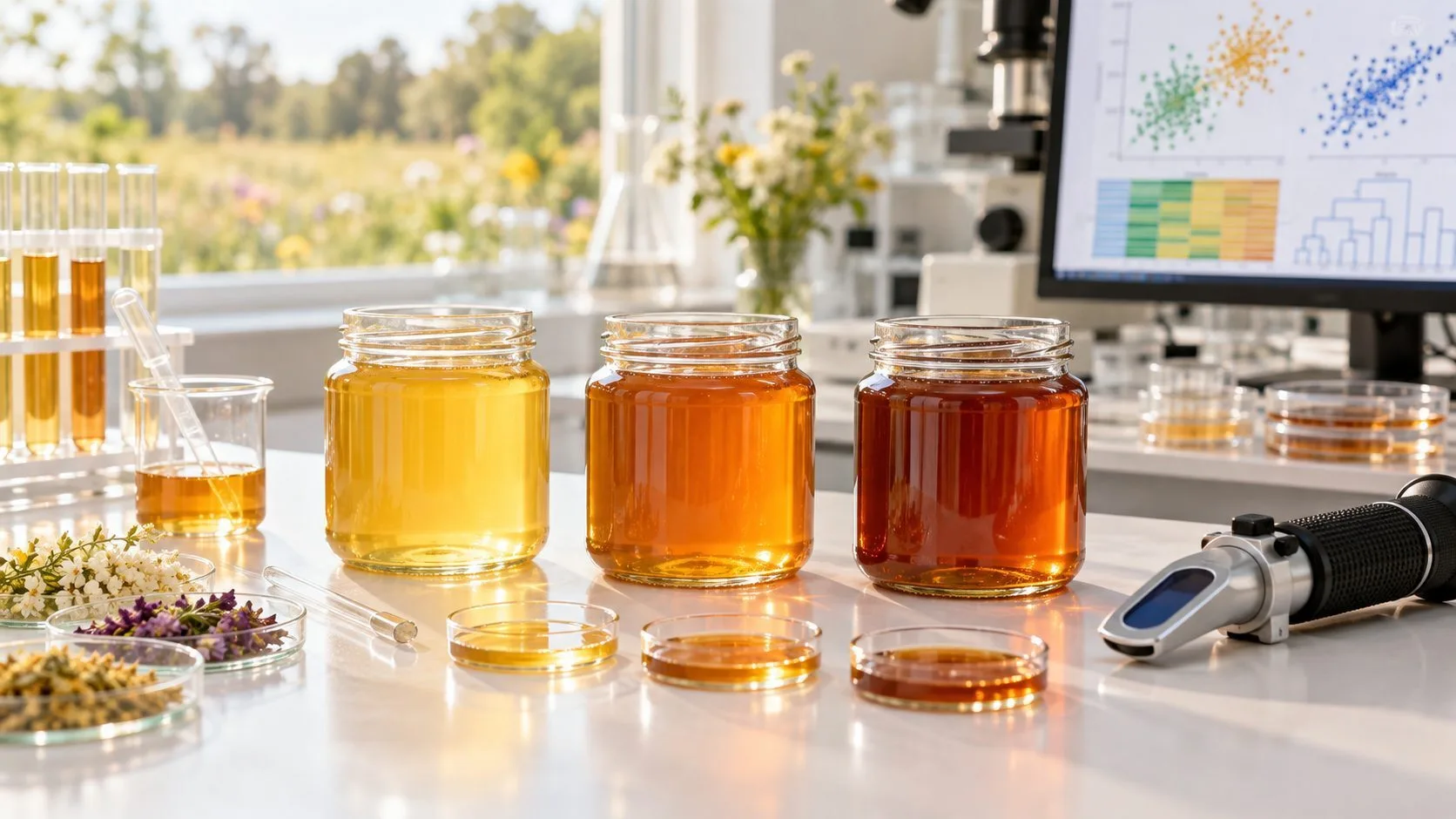
In short: A study published on 26 September 2026 combines physicochemical honey data with machine learning to distinguish multifloral and monofloral honey. Electrical conductivity, sugar variables and stable carbon isotopes were among the most informative features. The method is a potential laboratory screen for botanical classification. It does not automatically detect added syrup or reliably determine the country, region or overall quality of any jar.
The question answered by the model
Monofloral honey comes wholly or mainly from a named plant source and should show its sensory, physicochemical and microscopic characteristics. Multifloral honey combines several forage sources. The researchers trained models on measurements from known samples so that they could separate these two classes. This task is narrower than a complete authenticity assessment.
Data used in the analysis
The inputs included electrical conductivity, moisture, colour intensity, glucose, combined fructose and glucose values, other sugars and isotope parameters. Feature selection aimed to retain information with high relevance and low redundancy. The team then compared Random Forest, neural networks, deep-learning approaches and a genetically optimised ensemble. SHAP analysis showed which variables most strongly influenced the classifications.
What the result means
The hybrid model delivered balanced classification performance on the available dataset, according to the paper, and performed similarly to Random Forest while exceeding other baselines. The phrase “on the available dataset” matters: an algorithm learns patterns from the samples used to develop and test it. New harvests, regions, plant species and laboratory procedures can shift the distribution of measurements.
Limits that must remain visible
The samples were supplied by a company with which several co-authors are affiliated; the paper also declares no competing interests. Broad official use would require independent datasets, interlaboratory trials and predetermined decision thresholds. The target variable is only monofloral versus multifloral. A falsely labelled country of origin or added sugar syrup is not automatically identified.
Why several methods are needed
Honey is a variable natural matrix. Plant source, weather, harvest time and processing affect colour, water, sugars and conductivity. Depending on the question, controls therefore combine document checks, pollen analysis, isotope methods, chemical profiles and other techniques. Machine learning can combine patterns, but it cannot turn one measurement into a universal authenticity test.
What changed on EU labels
Since 14 June 2026, honey blends generally have to list the countries of harvest in descending order with their share by weight. Products lawfully labelled before that date may remain on sale until stocks are exhausted. The European Commission must set harmonised analytical methods for detecting adulterated honey by 14 June 2028. Origin labelling and laboratory testing therefore address different parts of transparency.
Why control matters
In the EU “From the Hives” action, 320 imported consignments were tested in 2021–2022; 147 samples, or 46 %, were suspected of adulteration. “Suspected” is not the same as a final legal finding of fraud. The Joint Research Centre stressed that no single test is sufficient and that analytical findings require traceability work and further investigation.
Four shopping pointers
- Read origin information: countries and shares on new blends are more useful than the former broad EU/non-EU wording.
- Understand floral names: acacia, rapeseed or lime describes botanical origin, not a health promise.
- Do not treat price as proof: a high or low price alone confirms neither authenticity nor adulteration.
- Use honey as a measured sweetener: find ideas in breakfast recipes and recipes by ingredient.
Conclusion: a useful screen, not a truth machine
The study shows that conventional measurements and interpretable machine learning can support broad botanical classification. Its value lies in screening and prioritising further checks. For shoppers, the new origin label is the more immediate tool. A model output alone replaces neither official control nor traceability.
Sources and update
- Scientific Reports: Binary classification of multifloral honeys using hybrid ensemble optimization, published 26 September 2026.
- EUR-Lex: Directive (EU) 2024/1438, origin labelling and analytical mandate.
- EU Joint Research Centre: Food fraud: How genuine is your honey?, results and limits of the EU action.
- European Commission: Honey 2021–2022, documentation of the coordinated action.
Author: Kochzauber editorial team. Information updated on 27 September 2026. This article distinguishes botanical classification, origin labelling and fraud detection. The cover is an editorial symbolic image.