More grape-seed oil from the press: why longer is not automatically better
A new study tests acid and enzyme pretreatments for cold-pressed grape-seed oil. Maximum yield did not provide the best balance of phenolics and oil quality.
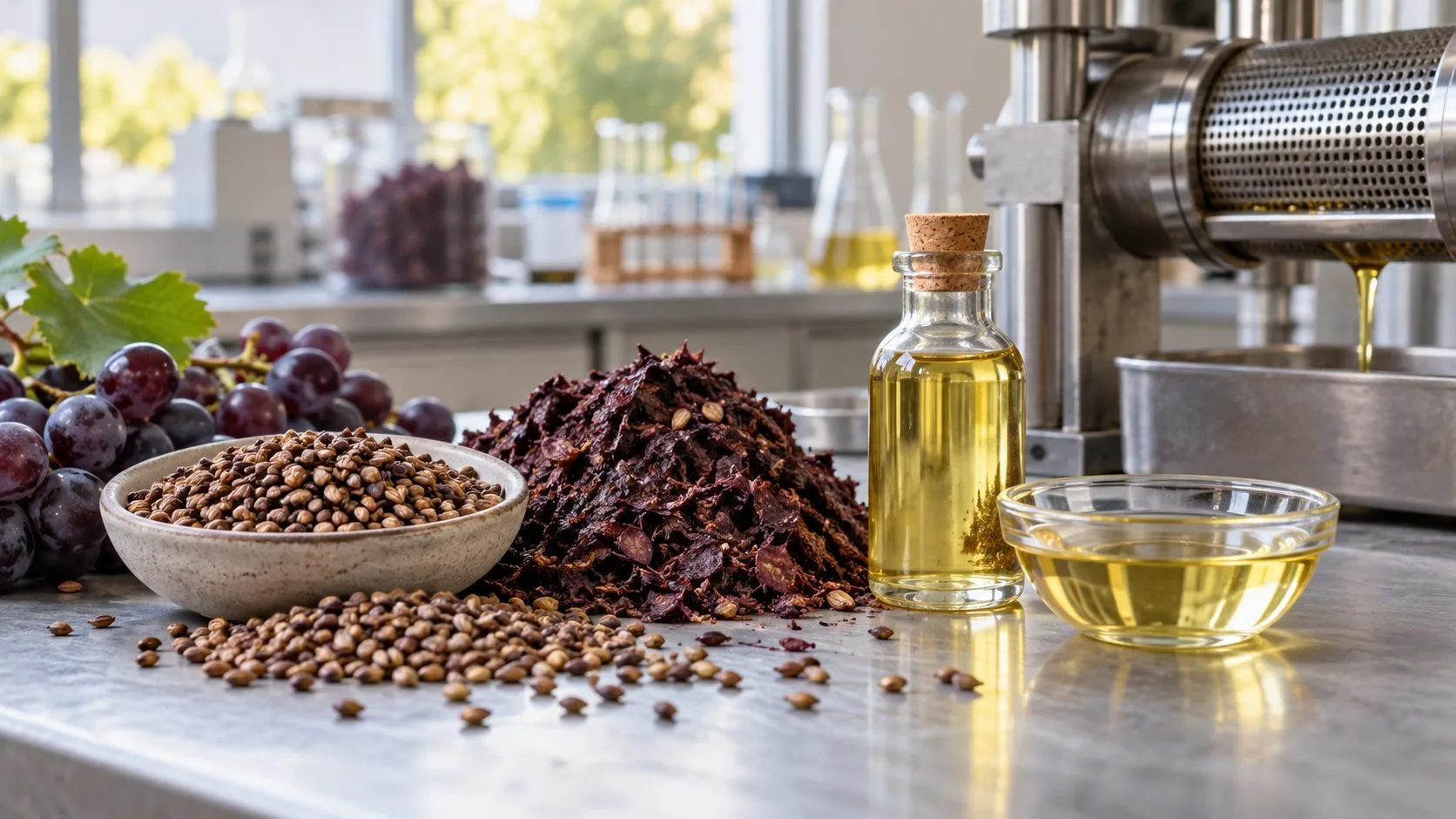
In short: A study published on 25 September 2026 examines how acid, enzymes and their combination alter cold pressing of grape seeds. The highest measured oil yield rose from 8.13 % in the untreated control to 9.68 %. At the same time, phenolic content, free fatty acids and oxidation measures showed that the longest and strongest treatment did not automatically provide the best overall quality. This is process research for producers, not instructions for treating seeds in a home kitchen.
Why grape seeds are an interesting by-product
Pressing grapes leaves skins, seeds and other solids as pomace. Oil can be recovered from separated seeds; the International Organisation of Vine and Wine identifies grape-seed oil as a traditional use of these by-products. Cold pressing avoids conventional extraction solvents but, depending on the raw material, leaves some oil in the solid matrix. The new work addresses this limitation.
How the experiment was designed
The researchers compared acid, enzyme and combined acid-enzyme pretreatments. They tested concentrations of 1, 2.5 and 4 % and incubation times of 12, 24 and 36 hours. The seeds were then cold pressed. Measurements covered yield, total phenolics, DPPH radical-scavenging activity, free fatty acids, peroxide and p-anisidine values, oxidative stability and colour.
The highest yield came with trade-offs
The control produced 8.13 % oil. The maximum of 9.68 % followed 4 % acid for 36 hours. Pretreatment can open cell structures and facilitate release. Yield alone is insufficient for industrial evaluation, however: extra process time, processing aids, neutralisation, energy, safety and the quality of the resulting oil all belong in the calculation.
Phenolics and a laboratory assay are not health proof
The highest total phenolic content was 97.8 mg GAE/kg oil and the highest DPPH activity was 90.18 %. These maxima occurred under more moderate conditions. DPPH measures in a chemical assay how strongly a sample scavenges radicals. It proves neither a clinical effect in humans nor that the oil with the highest laboratory value is automatically the best everyday choice.
Free fatty acids reveal the trade-offs
Free fatty acids ranged from 0.24 to 3.42 %, with enzyme treatments exerting the strongest effect. Primary and secondary oxidation markers and stability also changed. The authors therefore identify a more favourable balance at shorter 12–24 hours and moderate 2.5 % acid or combined treatments. The optimum depends on the desired quality profile.
What “cold pressed” says—and does not say
Cold pressing primarily describes a production method. It does not automatically guarantee more of every desirable compound, a longer shelf life or a special health effect. Raw material, oxygen, light, filtration and storage shape the finished oil. The study likewise shows that a gentle-sounding process can produce very different analytical results depending on the preceding conditions.
Practical points for consumers
As a rough rule, the German consumer advice centre recommends aromatic cold-pressed oils mainly for cold dishes and neutral refined oils for higher heat; oils should not be heated above 200 °C. The directions on the actual bottle remain decisive. Store oil cool, dark and tightly closed, buy an amount that fits your use, and stop using it if it smells rancid.
Four measured shopping questions
- Which process? Cold-pressed and refined oils differ in flavour and suitable uses.
- What is the oil for? Salad, dip and high-heat cooking require different properties.
- Which bottle size fits? A small bottle may be wiser when the oil is used only occasionally.
- What alternatives are available? Browse recipes by ingredient and vegetarian dinners.
Conclusion: optimisation requires more than yield
The study makes the trade-off clear: an aggressive long pretreatment can release more oil, while moderate conditions better balance phenolics, the radical-scavenging assay and other quality measures. This is a concrete research step for using wine-sector by-products. It does not yet establish an industrial standard or a superior consumer product.
Sources and update
- Scientific Reports: Enzyme-acid pretreatment conditions for enhancing yield and phenolic content in cold pressed grape seed oil, published 25 September 2026.
- German consumer advice centre: Speiseöle – welche eignen sich für was?, updated 5 August 2026.
- International Organisation of Vine and Wine: By-products: Types, Uses and Recommendations, overview of grape-pomace and seed uses.
Author: Kochzauber editorial team. Information updated on 27 September 2026. This article explains a laboratory and process study and makes no health claim. The cover is an editorial symbolic image.