Genetically modified crops against climate stress? What the new US analysis shows
A new Nature analysis links genetically modified US maize and soybean varieties with higher, more stable yields. Why this is a statistical association—not an assessment of prices or food safety.
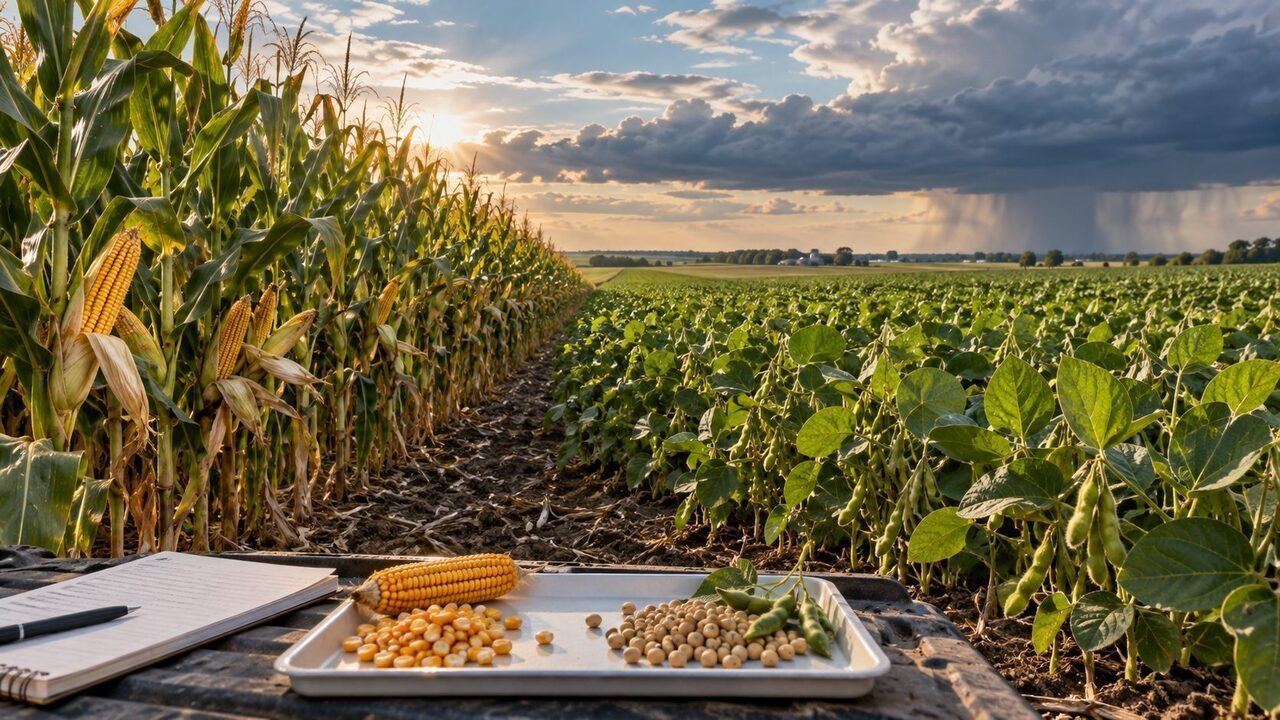
In short: a research paper published in Nature Climate Change on September 18, 2026, summarizes a long-term US analysis of corn, soybeans and cotton, and then shows that the spread of genetically modified varieties in corn and soybeans was associated with higher average yields, lower annual fluctuations, and a partially weakened effect of climate change. The study is relevant to the debate about resilient agriculture, but it does not prove that any genetically modified variety is automatically climate resilient or makes food more favorable in the supermarket.
What data have been evaluated
The research team combined publicly available U. S. data from 1978 to 2020, including county-level yields and cultivated areas, the distribution of genetically modified varieties, historical weather data, soil properties, elevation, and market information.
The long term is important because the commercial spread of genetically modified varieties has only increased significantly over time. Researchers have modeled how yields, fluctuations and geographical shifts in cultivation could have evolved with and without this use of technology. Such counterfactual models are useful, but they remain calculated comparison scenarios and not a second observed reality.
What the Analysis Reports
For maize and soybeans, the researchers found a positive link between the introduction of genetically modified varieties and average yields, while yield fluctuations were less year-over-year.
The modelling also suggests that the technology has slowed down part of the climate-related shift of crops northward, so that, in simple terms, existing crop regions have been able to sustain their production better than in the calculated scenario without GM varieties.
The authors are aware of the link between the introduction of varieties and the associated forces, which may include not only individual characteristics but also altered seed management, pest control, consulting and investment.
Why is there no universal causality?
The study is a spatial and econometric evaluation of historical data, not a controlled field experiment with identical farms. Farmers do not decide by chance which varieties they use. Farms, regions and years differ in weather, soil, market conditions, irrigation and management.
The models take into account many of these sizes, but cannot completely exclude unknown or incompletely measured influences. Furthermore, the results relate to three major US cultures and the characteristics prevalent there. They cannot be automatically transmitted to wheat in Germany, rice in Asia or new genomic techniques in Europe.
- No statements about any kind: climate resilience depends on the specific characteristic and the cultivation system.
- No safety study.: The work evaluates yields and crop distribution, not toxicology, allergens or environmental risks of a single product.
- No store price forecast: raw material income is only a fraction of processing, trade, energy, logistics and sales prices.
- No EU authorisation: A research result does not replace a statutory test and approval procedure.
What applies to food in the EU
GM foods and feed are subject to authorisation in the EU under Regulation (EC) No 1829/2003, whereby EFSA assesses potential risks to human health, animal health and the environment, taking into account the organism specifically requested and its intended uses.
The labelling shall also be subject to strict rules. Prepackaged food must be indicated in the list of ingredients if it consists of, contains or is produced from genetically modified organisms. For accidental or technically unavoidable traces, a threshold of not more than 0,9% per ingredient shall apply under certain conditions. Food of animals fed genetically modified food is not subject to this labelling requirement under the applicable rules.
For consumers, this means that the study does not change labels and does not introduce new products. Those who prefer a particular method of production when shopping should pay attention to the legal labelling and voluntary indications, rather than relying on general research reports on a specific food. (Recipes for ingredients; Vegetarian dinner)
What the results for food prices could mean
More stable yields can in principle help to mitigate extreme supply fluctuations, but this observation is not sufficient for a specific cash crop. Corn and soybeans flow into feed, starch, oils, biofuels and many industrial products.
A higher U. S. return can also be overlaid in Germany by exchange rates, energy prices, harvest failures elsewhere or trade rules.
Conclusion: a relevant signal with clear boundaries
The US analysis suggests that genetically modified varieties of corn and soybeans in the past decades may have not only supported yields but also its stability. This is an important contribution to the question of what tools agriculture can adapt to changing climate conditions.
The results, however, are neither a license for each technology nor a replacement for type-specific safety, environmental and authorisation checks, so for the public debate it is worth separating three questions: what does a variety do in the field, is a particular product safe and authorized, and what does that actually mean for price and on the plate?
Sources and status
- Nature Climate Change: Genetically engineered crops increase climate resilience of US fields, research briefing dated September 18, 2026.
- Dong et al.: Genetically engineered crop adoption support yields and cultivation under climate change, primary study, published on 8 September 2026.
- Zenodo: Data and evaluation code for the study, version dated 8 August 2026.
- European Commission: GMO legislation, overview of authorisation, risk assessment and traceability.
- consumer advice centre: Genetic engineering: What the labelling reveals, consumer information on labelling, thresholds and animal products.
Author: Kochzauber editorial team. Information and update status: 19 September 2026. The article lists a statistical agricultural study and does not include a price forecast or a passive safety assessment.