First World Packaging Day: Five Checks for Food Packaging
The first World Packaging Day took place on 6 September. Five practical checks help put food protection, PFAS limits, reusable systems and recycling into perspective.
In short: The first World Packaging Day took place on 6 September. Five practical checks help put food protection, PFAS limits, reusable systems and recycling into perspective.
A day of action, but no new seal of quality
The WPO describes the World Packaging Day as an annual international initiative. The first official issue took place on 6 September 2026. Among the four topics are food protection and less food waste as well as circular economy, innovation and responsible consumption. (Source)
Important for the classification: The World Packaging Day is an awareness-raising campaign coordinated by an international industry association. It is neither a new state seal nor proof that a concrete packaging is pollution-free, climate-friendly or actually recycled. Such properties must be substantiated with appropriate information, tests or legal requirements.
Check 1: Does the packaging protect the concrete food?
A packaging is not just waste. It can protect bread from moisture, sensitive goods from pressure and cooled food from contamination. Therefore, it is not only the material, but whether shape, closure and quantity fit to the contents. A damaged, leaky or for the intended temperature unsuitable packaging does not fulfil its task.
When purchasing, check first whether the product is intact and whether you can consume the quantity offered in time. A smaller package can be more useful despite a higher basic price if a portion of the large package regularly spoils. For prepared meals, suitable containers and clear planning help; ideas can be found in our lunch dishes and one-pot recipes.
Check 2: Can packaging be avoided or reduced?
Before comparing material types, the simplest question is worth it: Is this packaging necessary? Lots of goods, refill offers or a suitable container can avoid waste. In the case of packaged products, unnecessary cavities, additional boxes and individually packaged portions are indications of avoidable material use.
This does not necessarily mean rejecting any repackaging. Hygiene, transport and durability can make it necessary. The practical comparison is therefore: Does a more simple alternative fulfil the same purpose, does its quantity match your needs and can it be stored safely?
Check 3: PFAS arm after limit is not automatically PFAS-free
Since 12 August 2026, food contact packaging in the EU must not be re-marketed if it reaches or exceeds the PFAS limits set out in Article 5(5) of the EU Packaging Regulation. The EU Commission mentions take-away shells, fast-food paper, microwave popcorn bags, baking paper and pizza cartons as applications in which PFAS has been used because of its water or grease repellent effect. (Source)
The rule works with several analytical limit values. Therefore, it is not a universal promise of absolutely zero PFAS in every packaging. Also the appearance does not reveal whether a coating contains PFAS. Anyone who advertises with "PFAS-freie", should be able to explain what the statement is based on. In case of uncertainty, concrete manufacturer specifications or comprehensible test reports are more meaningful than terms such as "natural", "green" or "paper optics".
EU Regulation 2025/40 and the Commission's interpretation aid also clarify the transitional period: packaging already placed on the market before 12 August 2026 does not have to be recalled from the shelves because of this new rule alone. More about the classification of coated take-away packaging is included in our article about Monaco's new one-way rules. (Source)
Check 4: Reusable counts only by returning and refilling
A real reusable system is intended for repeated use and needs a return or circulation solution. The Umweltbundesamt recommends that deposit containers not be stored at home for long, so that they can be cleaned and refilled. (Source)
For everyday use, a fixed return routine helps: Place empty containers to the shopping bag after rinsing and bring them back at the next suitable opportunity. A newly purchased reusable box is not automatically the best solution if already suitable, food-safe containers are available. Note in own boxes the manufacturer's instructions on hot food, microwave, freezer and cleaning.
Check 5: Recycling begins with the right separation
"Recyclable" first describes a possible recycling, not the guaranteed way of each individual piece. For this, the packaging must end up in the appropriate collection and be technically sorted and used. According to the information of the Umweltbundesamt, packaging from paper belongs to the waste paper collection, glass according to colours separately into the waste glass and other restribed sales packaging into the yellow ton, the yellow bag or the local recyclable ton. Regional specifications may differ.
Detachable components should be detached from each other without having to rinse them with effort. Highly polluted paper can lose its recyclability. Also "biobased" or "biodegradable" does not automatically mean biotonnes: the Federal Environment Agency points out that packaging made of biodegradable plastic must not be disposed of via biowaste; for a few applications there are narrowly limited exceptions.
The five-minute routine before the purchase
- Need: Does the filling amount match your menu?
- Protection: Is the packaging undamaged and suitable for storage and use?
- Material: Is there an equivalent solution with less effort or a functioning reusable system?
- Statement: Is an environmental or pollutant promise concretely substantiated?
- After that: Do you already know when buying, how return or disposal work?
Conclusion: Not the word material, but the whole system counts
The first World Packaging Day makes a often overlooked field of tension visible: packaging protects food and at the same time becomes waste very quickly. A general ranking "paper good, plastic bad" helps little. More meaningful are five concrete questions about protection, prevention, pollutants, reusable and disposal route. Anyone who checks these points makes more robust decisions in everyday life than with a single green keyword on the front.
Sources and status
- World Packaging Organisation: World Packaging Day – concept and start on September 6, 2026, accessed on September 7, 2026. (Source)
- European Commission: New EU rules on packaging enter into application, 11 August 2026.
- EUR-Lex: Regulation (EU) 2025/40, and in particular Article 5(5) thereof.
- European Commission: Interpretation aid for Regulation (EU) 2025/40, published on 10 June 2026. (Source)
- Umweltbundesamt: Questions and answers on packaging and packaging waste, updated on 28 August 2026.
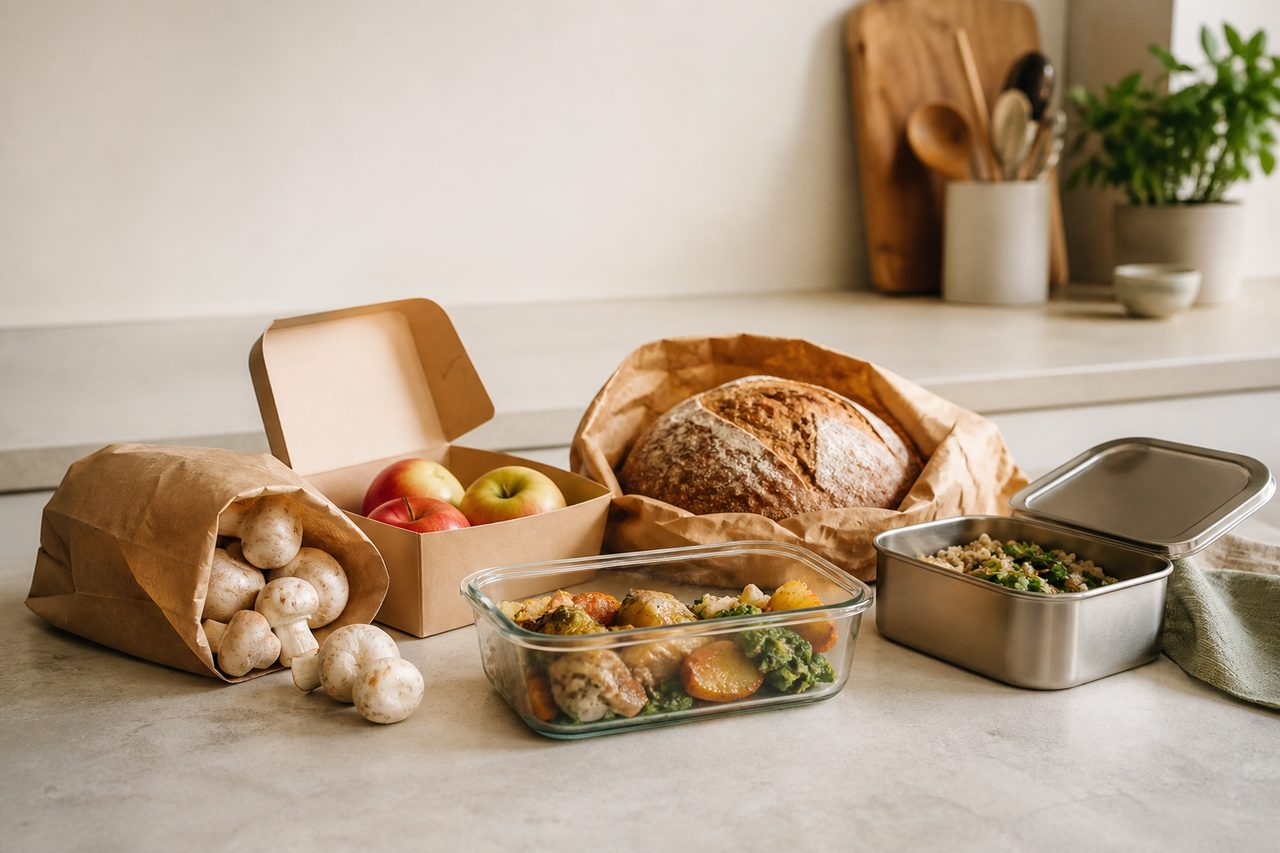
Author: Kochzauber Redaktion. Information and updating status: September 7, 2026. The title image is a symbolic illustration and no proof of material properties or certifications.