FAO Food Prices Rise: Why Cooking Oils Are Not All the Same
The global food price index rose in August, but individual vegetable oils moved in different directions. We explain what the figures show and what matters when choosing an oil for cooking.
In short: The global food price index rose in August, but individual vegetable oils moved in different directions. We explain what the figures show and what matters when choosing an oil for cooking.
Plant oils do not develop uniformly
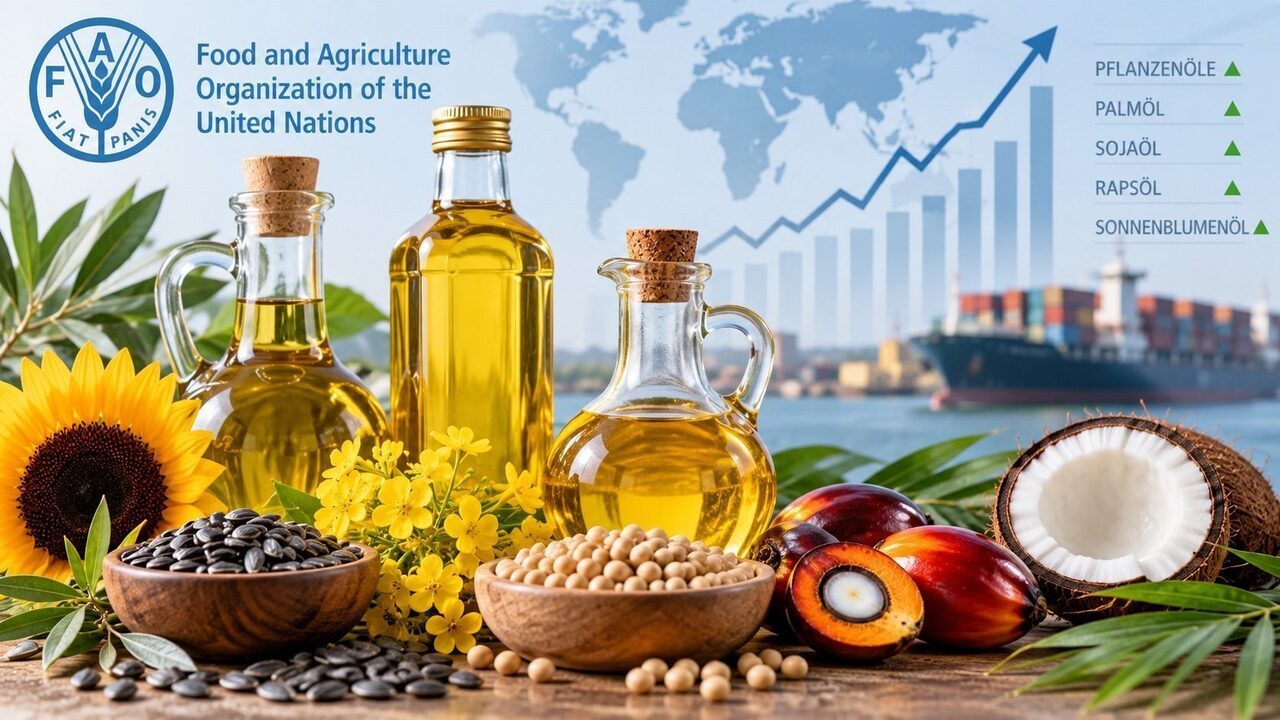
According to FAO, the sub-index for vegetable oils increased by 1.1 percent compared to July. Palm and soya oil became more expensive on the world market, while the quotations for rapeseed and sunflower oil slightly decreased. In these two oils, the organization refers to expectations of a plentiful supply next year. It is a market expectation, not an already secured harvest. (Source)
From this development no uniform price surcharge can be calculated for a bottle of oil in the German supermarket. An international comparison of the raw materials answers a different question than a comparison of finished products in the shop.
The index is not a German shopping list
The FAO Food Price Index presents international prices for a basket of traded agricultural commodities. It combines five product groups whose weighting is based on export shares. A German consumer price statistics pursues a different question. Neither the composition nor the level of trade are the same.
Our classification: A monthly decline in raw material price is not a promise for a directly cheaper trade product. If you want to compare two bottles, you need their actual basic price, filling quantity and intended use. An invoice like "The world market falls by one percent, so my oil has to be one percent cheaper next week" would not be greenable from these data.
When exchanging first think of the preparation
A cheaper oil is only a suitable alternative if it fits the food. The Federal Centre for Nutrition distinguishes between cold-pressed and refined varieties of sunflower oil: cold-pressed oil is particularly suitable for cold food. Refined is more taste-neutral and heat-stable; suitable high-oleic oils are suitable for high requirements such as frying. The instructions for use of the respective product remain decisive.
For everyday kitchens, we therefore propose a small two-step approach: First, determine whether you want to stir a dressing, sauté vegetables or fry a little. Then, compare within the suitable oils. A speciality for the salad does not have to be the oil for each hot pan at the same time.
A manageable supply instead of spontaneous large purchases
Check before an offer, which opened bottles are already available and how quickly you consume them. To buy an additional large package only because of a world market announcement, cannot be justified from the FAO figures. For suitable use ideas you can browse in our vegetable recipes and the Mediterranean cuisine. The recipes provide the culinary framework; the concrete product comparison is provided by the shelf.
Sources and status
- FAO: Supply concerns drive FAO Food Price Index higher in August, September 4, 2026.
- FAO: Food Price Index – definition and methodology, background source; figures of this article are from the September news date.
- BZfE: Food oils in the kitchen: sunflower oil, background for use.
Information stand: 6 September 2026. The kitchen tips are editorial suggestions, no price forecast.