EU butter prices far below last year: Why the weekly rise is still no retail forecast
The European butter price was about one-third lower year on year in mid-September, yet it rose within a week. What the market data show—and how to respond sensibly when shopping and baking.
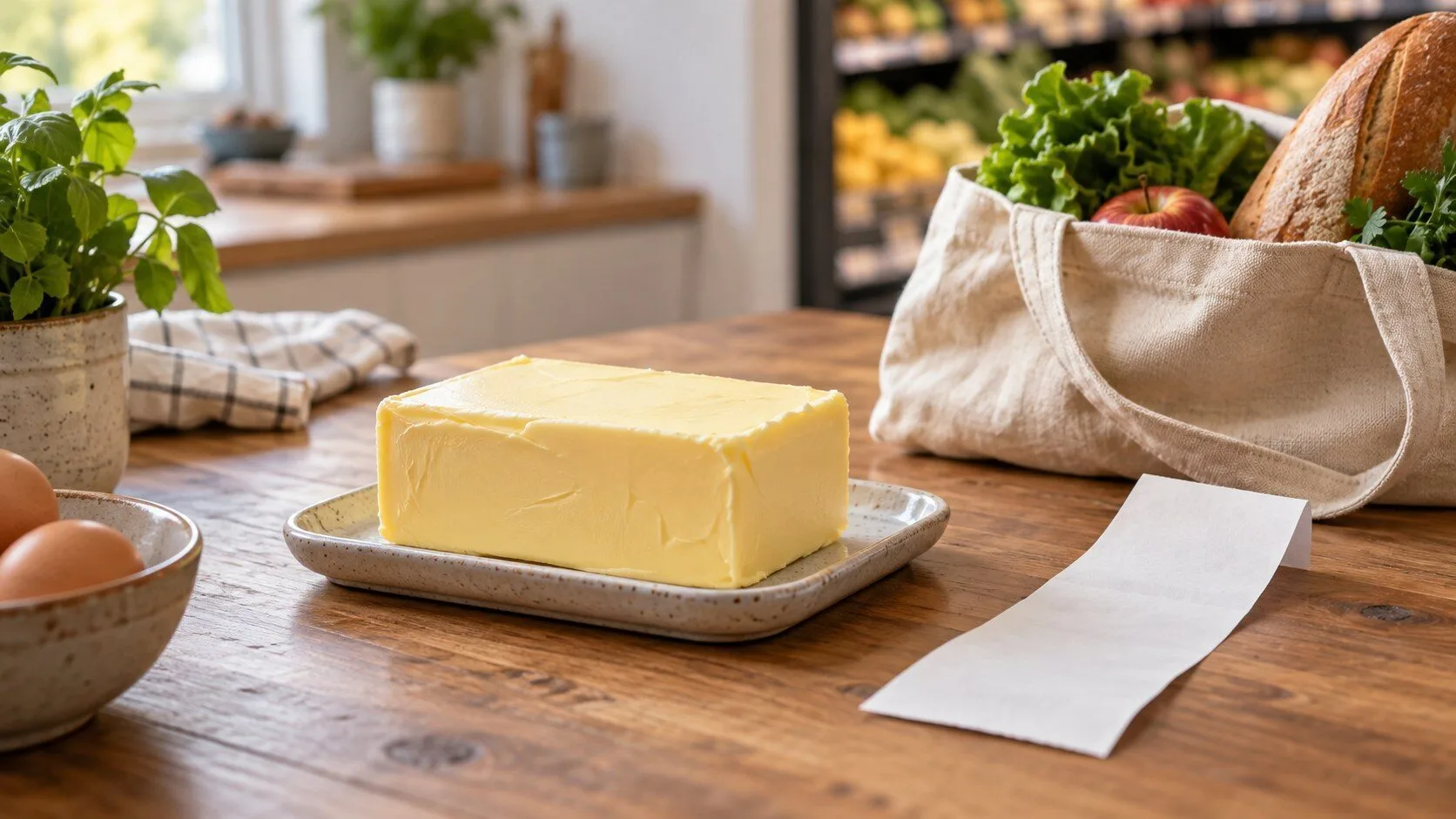
In short: on 17 September 2026 the European Commission published new weekly values for dairy products. For the reporting week of 7 to 13 September, the EU average for butter was 4.201 euros per tonne. This was 2,3 per cent higher than the previous week but 34,2 per cent lower than a year earlier. This listing describes reports from the wholesale or processing market. It is neither a German supermarket price nor a promise that butter at the box office will be immediately cheaper.
Two movements at once
The new figures are contradictory: short-term upwards, year-on-year downwards, both of which are likely to be true. According to the evaluation of Get Fair Dairy, which specialises in EU Commission data, the average value increased from around EUR 4.108 to EUR 4.201 per tonne, but remained 34,2% lower than the same calendar week of the previous year.
National figures also differed. Germany reported 4.500 euros per tonne and a weekly increase of 7,1 percent; France 4.141 euros with no weekly change; and Belgium 4.161 euros, down 3,2 percent. Such differences show why a single EU figure cannot be transferred directly to a particular shop. This week’s EU butter value also included reports from seven of 13 reporting markets.
What the Butter Value Measures
The EU Member States report weekly to the Commission market prices for important dairy products. The published value is given per tonne and is used for market monitoring. It is several steps ahead of the shelf: the raw material is packaged, transported, stored and sold through various trade channels.
In addition, retailers do not necessarily buy into the published weekly means. A falling annual comparison can reduce cost pressure but does not automatically or simultaneously lead to a specific final price.
Why a week's plus should not be overestimated
A 2,3 per cent rise in one week is a current market signal, but not yet a stable trend. In the previous weeks, the EU value fluctuated: at the end of August it was around 4.138 euros, at the beginning of September it was around 4.108 euros per tonne.
Also, the timetable market values are not reliable predictions for the shop. The Hessen State Farm has daily invoice prices for European butter contracts, reflecting expectations and contracts actually negotiated. For households, the actual unit price in the shop is more reliable than trying to derive the best time to buy from a commodity chart.
That's how you compare butter fair
- Read the unit price: Compare euro per kilogram instead of just the price of the large printed packaging.
- Keep the product type the same: sweet, sour and mildly acidified butter and mixtures capable of adhesion are not automatically interchangeable.
- Need to buy instead of stock: A multipack only saves if it is consumed or frozen in time.
- Monitoring price movements locally: Weekly offers and trademarks can change faster than regular brand prices.
For recipes, it is also worth looking at the function. When baking, butter provides fat, water and aroma; an exchange changes the consistency and flavour of the dough. In stir-frying, a suitable alternative can work, while for leaf tea, mustard dough or butter cream, the replacement is more demanding. You can find recipes for ingredients and breakfast.
Stock up but right
Butter can be cooled in the unopened original packaging according to the manufacturer's specifications. For longer storage it can be partially airtightly frozen. This makes it possible to use affordable offers without overlapping several packages in the refrigerator. After thawing it is particularly suitable for cooking and baking.
Smell, taste and packaging condition remain important criteria. The minimum shelf life date is not an automatic discard date for properly stored unopened products. However, if butter is rancid, unusually discolored or the packaging is damaged, it should not be reused.
What the new data does not prove
- No store price forecast: From EUR 4.201 per tonne, there is no specific price for a 250-gram packaging.
- No consistent development: country values, products and contract models differ.
- There is no quality statement.: The rating does not assess the taste, texture or manufacture of a particular product.
- No reason to buy hamsters.: a week's worth of movement does not justify an unnecessary supply.
Conclusion: annual comparison is relieved, the cashier decides
The EU butter price was well below the previous year's level in mid-September, although it was up from the previous week.
In everyday life, basic prices, comparable product types, and realistic demand help more than just a single stock market or wholesale number.
Sources and status
- European Commission: Milk and dairy products weekly prices, new data package of 17 September 2026.
- European Commission: EU prices of dairy commodities, reporting week 7 to 13 September 2026.
- Get Fair Dairy: European price overview of butter, preparation of Commission reports by Member State.
- consumer advice centre: Rising food prices: facts, causes, tips, information on basic prices and comparison of supply.
Author: Kochzauber editorial team. Information and update status: 20 September 2026. The article lists wholesale data and does not include a price forecast.