House-cricket powder: why EFSA could not confirm this application’s safety
EFSA could not establish the safety of a new spray-dried house-cricket powder. The decisive issues concerned processing, contaminants and microbiology—not insects as a food category.
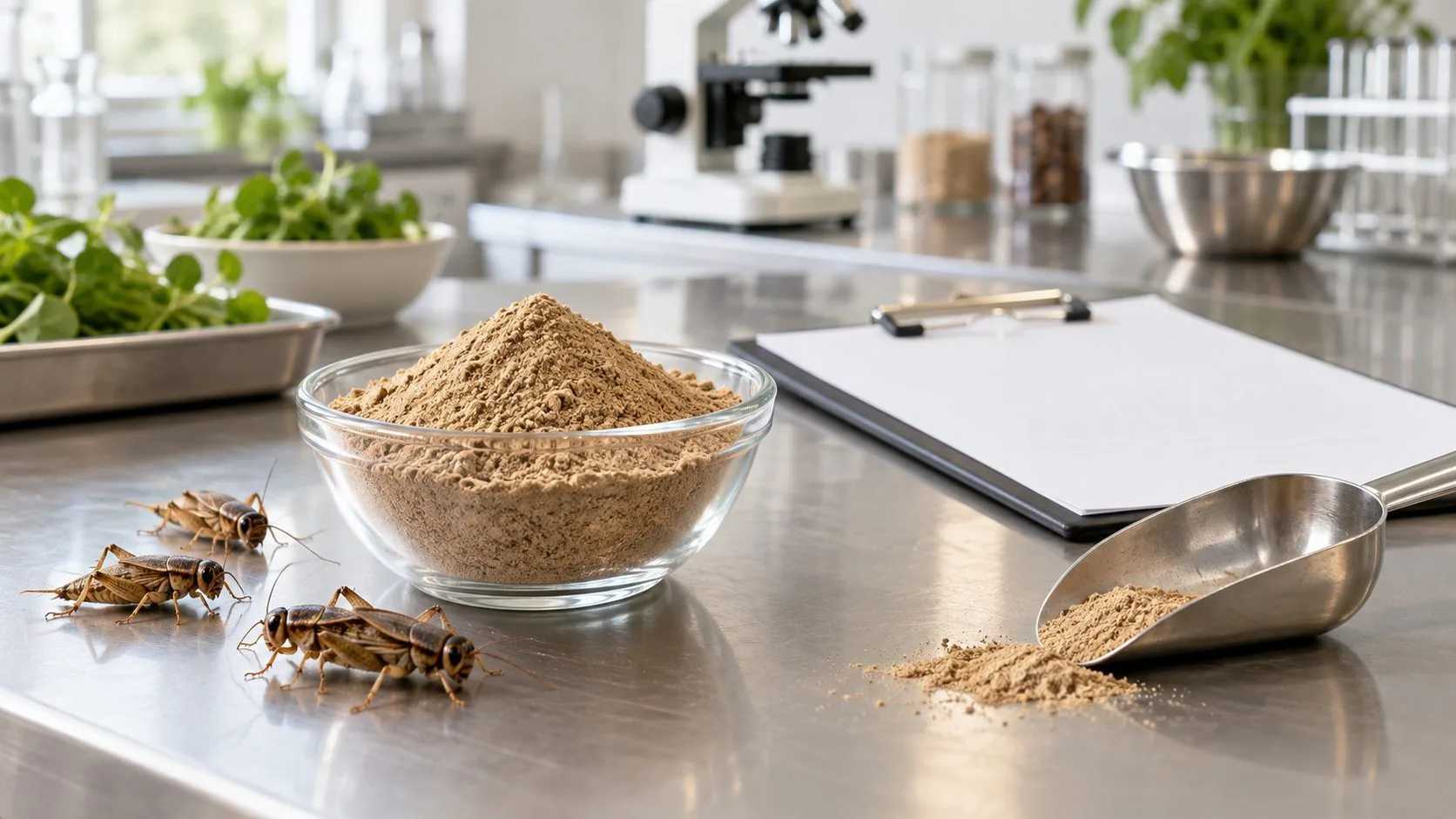
In short: On 25 September 2026, the European Food Safety Authority published its assessment of a specific spray-dried powder made from house crickets. The panel could not establish safety at the proposed uses and use levels. Gaps and findings related to production, chemical contaminants and microbiological quality were decisive. This is not a general conclusion that all insect foods are unsafe, and it is not yet a market decision by the European Commission.
What was assessed
The application of 5 April 2023 concerns a powder from Acheta domesticus made by grinding, pasteurisation and spray-drying. It was proposed as a whole food and as an ingredient in various products for the general population. EFSA’s task is limited to judging whether this specific material is safe under the proposed conditions. Marketing, sustainability, taste and possible benefits were outside the assessment.
Why the process left open questions
In the pilot process, the insects were fasted for at least 24 hours, killed at about -20 °C and first pasteurised at 70 °C for 5 minutes. Spray-drying used 180–200 °C for less than 5 seconds. Despite these stages, the panel considered it insufficiently demonstrated that the heat treatment reliably controlled microbiological hazards. Evidence of compliance with relevant EU requirements was also missing for some contact materials.
Which findings mattered most
EFSA reports marked variation in total microbial counts and, in some batches, elevated presumptive Bacillus cereus, yeasts and moulds. Reported mineral oil aromatic hydrocarbons also raised concerns. Phthalates were detected as well; incomplete information on contact materials meant that their source could not be determined. In the panel’s view, the proposed specification limits did not adequately capture the observed variability.
Allergy is a separate issue
House-cricket proteins may cause primary sensitisation. Cross-reactions may occur in people allergic to crustaceans, mites or molluscs. Allergens from feed can also remain in the finished powder. These points do not mean that everyone will react. They do explain why the ingredient name and any specific allergy warning would be central if an authorisation were later granted.
Why this is not a general ban
EFSA issued positive assessments for other forms of Acheta domesticus in 2021, 2022 and 2024, and the EU authorised several products under defined conditions. The new opinion concerns a different application, a particular pilot process and its evidence. Earlier authorisations cannot simply be transferred to this powder, but the new result cannot be turned into a ban on all house-cricket products either.
What happens in the regulatory process
An EFSA opinion is a scientific risk assessment. The European Commission and Member States decide whether a food enters the Union list and set its conditions of use and labelling. “Safety could not be established” means that the submitted evidence was insufficient for a positive conclusion. That is more precise than claiming that every product has been proven to cause harm.
What consumers can do
- Check the specific product: the ingredient list, allergy information and a valid authorisation matter more than the phrase insect protein.
- Take allergies seriously: pack warnings are especially relevant for people allergic to crustaceans, mites or molluscs.
- Do not recreate the powder: the assessed process is industrial food production, not a home-kitchen method.
- Compare protein sources: familiar options appear in our pulse recipes and recipes by ingredient.
Conclusion: one specific dossier falls short
The opinion illustrates how product-specific novel-food procedures are. An edible raw material does not replace robust evidence on process control, contaminants, microbes and allergens. Too many questions remained for this spray-dried house-cricket powder. For shoppers, the measured response is neither panic nor a blanket reassurance, but attention to the exact authorised ingredient and its label.
Sources and update
- EFSA Journal: Safety of Acheta domesticus spray-dried powder as a Novel food, published 25 September 2026.
- EFSA: Novel food, procedure, responsibilities and allergy information.
- European Commission: Union list of novel foods, the authoritative list of authorised novel foods.
Author: Kochzauber editorial team. Information updated on 27 September 2026. This article explains a product-specific risk assessment and is not individual allergy advice. The cover is an editorial symbolic image.