Too Much Rain Threatens Cocoa: What the New Study Means for Chocolate
A new PNAS study shows that not only drought but also heavy rain at the wrong time can weaken cocoa harvests. What this means for prices, shopping and pantry planning.
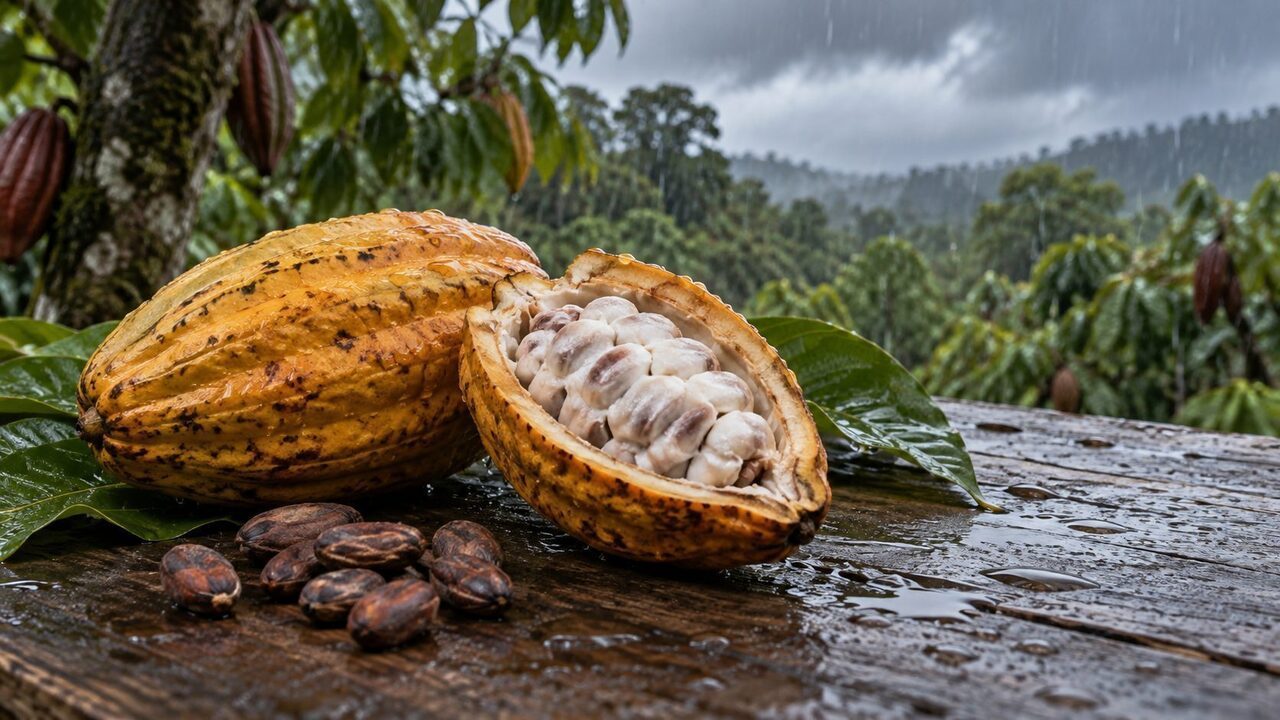
In short: A new PNAS study shows that not only drought but also heavy rain at the wrong time can weaken cocoa harvests. What this means for prices, shopping and pantry planning.
In the case of cocoa, the climate debate often revolves around heat and drought. The new paper published in the Proceedings of the National Academy of Sciences expands on this picture: too much rain can also cause harm if it falls in a sensitive stage of development. For consumers, classification is important above all. A weather-related crop fluctuation can affect the commodity market, but between cocoa beans and store prices lie processing, contracts, stocks, energy, packaging, transport and trade.
What the research team investigated
The scientists used newly available data from the Ghana Cocoa Board at district level. As production also grew over the years due to additional cultivation areas, they separated this long-term trend from the fluctuations in individual harvest years. Subsequently, they compared the adjusted yields with daily data on precipitation, dry periods, soil moisture and temperature.
During the rainy season from April to June, heavy rainfall can mechanically strain flowers and favour conditions in which fungal diseases spread. From November to February, however, the fruits that continue to grow need sufficient water; severe drought can also cost the crop.
The comparison with Ecuador and Indonesia is important because it shows that the pattern did not only appear in a single country. Nevertheless, cultivation areas, varieties, soils and management differ. The study therefore does not provide a fixed limit, since the rain causes the same crop loss everywhere.
Why extreme rainfall is more than a wet season
A monthly average can obscure how the water actually falls. The same amount of rain can be distributed over many moderate days or fall into a few very strong buds. For flowers, young shoots, soil, and disease pressure, that makes a difference. That's why the team looked at daily weather data and sensitive growth phases instead of just annual averages.
Researchers see a potential benefit in longer-term warnings. Certain large-scale patterns in the Pacific and Atlantic affect regional precipitation. If risky phases are better detected months in advance, farms could plan more targeted care, disease control or protective shading. This is a research and adaptation approach, not an early warning system that is already widely available.
What the study does not say about chocolate prices
The work examines yield and weather relationships. It calculates neither German final consumer prices nor the price of a particular brand. Even a smaller harvest does not automatically result in the same proportion of a higher shelf price. Manufacturers can buy raw materials early, recipes and packaging sizes differ, and stock prices reflect expectations, currencies and inventories in addition to current supply.
Conversely, a favourable weather year is not a guarantee of immediate falling prices. The practical conclusion is therefore not to harvest chocolate carefully. It is more sensible to compare specific products by their filling quantity, composition and unit price.
Four useful checks when shopping
- Comparing the unit price rather than the packaging price: smaller plates may seem cheaper at first glance. The price per kilogram makes different sizes comparable.
- Check the cocoa content and product type: dark chocolate, milk chocolate, couverture and cocoa-containing fat coatings are not interchangeable. Under the EU Chocolate Directive, different minimum contents and labelling rules apply depending on the product designation.
- Buy only the right quantities: a stock is only worthwhile if it is consumed under good conditions. Heat, light, moisture and foreign smells damage aroma and surface.
- Choose the recipe before the bulk pack: cocoa powder, couverture and chocolate bars can serve different purposes in a cake, cream or drink. Kochzauber offers ideas for planned use under Ingredients and combinations with fruit under Fruit.
What really helps with storage
Chocolate is best kept dry, odour-proof, and at room temperature as uniform as possible, rather cool. The refrigerator is not automatically the best solution: when you remove it, moisture can degrade, and chocolate easily takes on odors. However, if you cool it due to high heat, you should pack it airtightly and let it cool slowly before opening.
A lighter fat or sugar coating is first of all a quality and texture problem, not automatically a sign of a spoiled product. However, in the event of unusual odor, visible mould or pest infestation, the product must be disposed of.
The limits of the climate analysis
The authors cite several other factors that affect cocoa harvests: tree age, disease, pests, fertilizer costs, mining, and changes in cultivated land. Moreover, weather stations do not always fully capture very local heavy rainfall. The link found is strong, but there is no evidence that rain alone causes any variation in harvests.
The transfer to the future remains challenging as well. Climate models represent precipitation patterns in West Africa less safely than temperature trends. The study therefore shows above all which weather characteristics were important in observation data and which information should better take future forecasts into account.
Conclusion: Take weather risks seriously, avoid price alarm
The new study makes clear that cocoa can suffer both drought and heavy rainfall at the wrong time. More precise warnings could help farmers to better manage measures, leaving households with no acute shortage and no robust price forecasts.
When shopping, the most reliable tools remain the sober ones: the base price, the filling quantity, the cocoa percentage and the planned consumption. If you buy only as much as you can actually use and store well, you protect budget and product quality regardless of short-term headlines.
Sources and status
- Albright et al.: Rainfall extreme drive cocoa yield loss across the tropics, Proceedings of the National Academy of Sciences, DOI 10.1073/pnas.2606123123. (Rainfall extremes drive cocoa yield losses across the tropics)
- Harvard Salata Institute: Chocolates new climate threat: Too much rain, September 14, 2026; research report and classification by the authors.
- EUR-Lex: Directive 2000/36/EC on cocoa and chocolate products, product definitions and labelling.
- consumer advice centre: unit price allows direct price comparison, background for comparison of different pack sizes.
Author: Kochzauber editorial team. Information and update status: 16 September 2026. The article lists research and purchasing questions; it is not a price forecast. The title image is an editorial icon.