Plant-based film against moisture: What the new plasma research can really do
A new study makes cellulose-nanofibril films more water-repellent. The method could improve food packaging, but it is not yet a ready-made replacement for plastic composites.
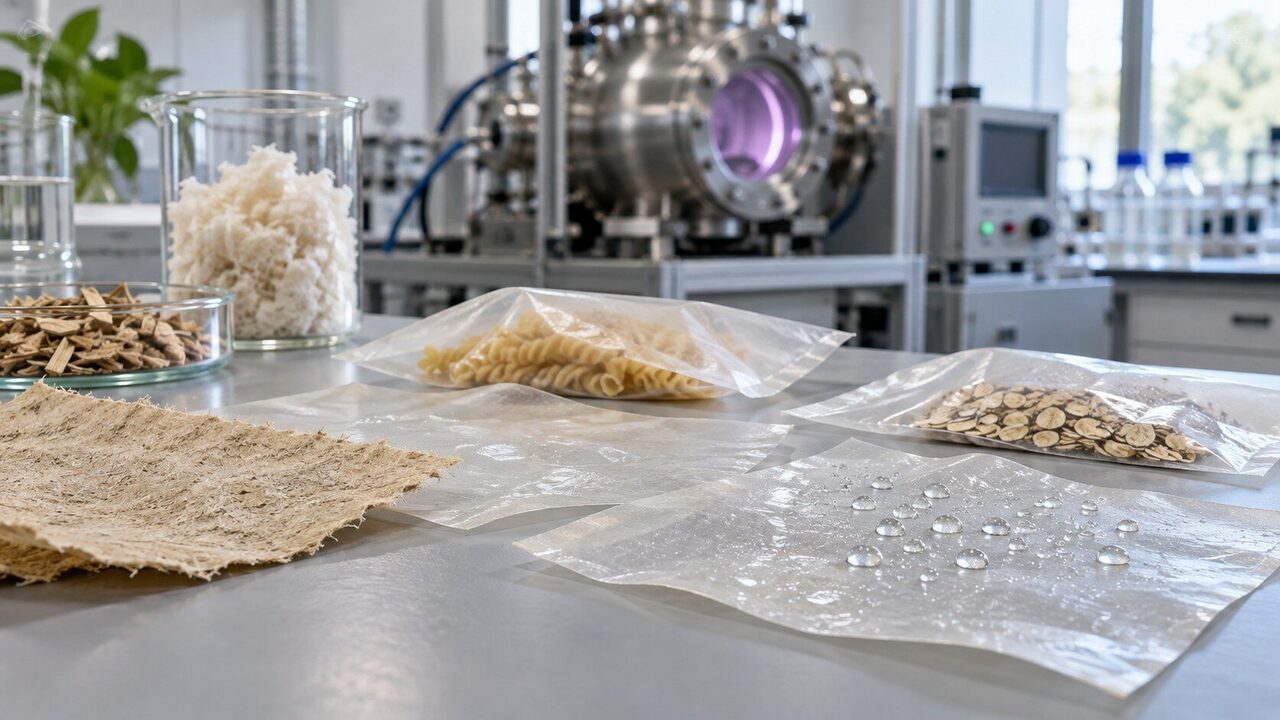
In short: researchers at North Carolina State University presented a new paper on cellulose nanofibrillas on September 18, 2026. With a plasma treatment, they applied very thin layers to the plant-based film. One variant had less than one percent water in a liquid water test. But that doesn't solve all the packaging problems yet: another layer allowed more water vapor through, and scaling, energy consumption, durability, and food safety need to be further tested.
Why Cellulose Foil Needs Protection
Cellulose nanofibers, or CNF, can be made from renewable biomass such as wood fibers, which make films that are lightweight, mechanically resistant, and provide good barriers to oxygen and fat. These are the properties that are interesting for dry foods.
The weak point is water. Cellulose attracts moisture. At high air humidity, an untreated film can absorb water, lose its firmness and alter its protective effect. For crushed products, this would be problematic: when water vapour enters, they become soft; at the same time, an inadequate barrier can shorten the shelf life of other foods.
What the plasma treatment changed
The team used a method called dielectric barrier discharge, in which an electrical discharge produces a plasma that can change the surface of a material. In the experiments, organosilicon-containing fragments were removed from a source material called TMCTS onto the CNF films.
The researchers compared a static coating with multilayered variants and modified carrier gases, treatment duration and layer chemistry, so they could influence whether the surface rejects water more strongly or allows water vapour to pass more easily.
At the same time, the study showed a conflict of objectives: another treatment weakened the water vapor barrier. For a real food packaging, both requirements must match.
What is new and practically relevant
Many snacks, sweets, and bags are now made of multiple layers of plastic, paper, or aluminum. They provide good protection, but are often heavy to separate and recycle. A high-performance film made of plant fibers could reduce the percentage of fossil plastics if it achieves the same protective, machine-friendly, and safety performance.
The plasma process is already known in parts of the packaging industry, which makes it easier to transfer it later to a completely new production machine. Nevertheless, the published work is a material study. The researchers themselves cite other tasks: higher coating speed, energy consumption, mechanical durability, costs, and environmental and social security.
Why plant-based does not automatically mean PFAS-free
The study does not investigate PFAS analysis and does not advertise the film as a PFAS-free end product. The biogenic origin of cellulose does not therefore suggest that any coating is free of perfluorinated and polyfluorinated alkyl substances or other problematic substances.
Food contact materials are subject to safety requirements in the EU. Substances must not pass into food in quantities that are hazardous to health, irrepressibly alter its composition or affect taste and smell. Migration and application tests for intended food, temperatures and contact times would therefore be necessary before being placed on the market.
Four Questions to Ask When Buying Packaging
- Is it possible to do more than one? A single-use packaging that is avoided saves material regardless of whether the single-use film is fossil or biobased.
- How is it disposed of? organic based does not mean compostable automatically. The Environment Agency points out that plastic packaging made of bio-based or biodegradable plastics is also not included in the biotones, in principle in yellow tonnes, yellow sacks or high-value tonnes.
- Is the statement concrete? Terms like plant-based, biodegradable, and industrially compostable describe different things. A material can be bio-based and yet not compostable.
- Does the protective effect fit? Not enough packaging protection can increase food waste. The ecologically better solution must take product loss and packaging costs together.
If you buy unpacked or in larger units, you should only choose the quantities that are actually consumed. (Recipes for ingredients; One-pot courses)
What the study does not show
- No ready-made supermarket bag: no material samples have been examined, no complete supply chain or serial production.
- No overall environmental benefit: a lifecycle analysis of raw materials, coatings, use and disposal was not the subject of the work.
- No promises of composition: biological origin and biodegradability are not the same thing.
- No evidence of PFAS: The publication does not provide analytical evidence for a PFAS-free packaging.
- No declaration of approval: suitability for food contact must be demonstrated for the specific material and the specific application.
Conclusion: Interesting building blocks, not yet a packaging revolution
The new work shows that the moisture properties of cellulose nanofibril films can be precisely altered with plasma and very thin layers, which is relevant because water sensitivity is a central barrier to plant-based barrier films.
However, questions remain open until the shopping bags or snack packaging, and consumers should therefore follow specific material and disposal instructions rather than deriving from plant-based compostable, recyclable or pollutant-free.
Sources and status
- NC State University: Plasma Technology Could Help Plant-Based Packaging Replace Plastic, published on September 18, 2026.
- Artner et al., Applied Surface Science: Surface modification of cellulose nanofibril films via organosilicon deposition using dielectric barrier discharge plasma, primary study.
- European Food Safety Authority: Food contact materials, safety and migration requirements as examined on 8 January 2026.
- Federal Environment Agency: Biobased and biodegradable plastics, terms and directions for disposal.
Author: Kochzauber editorial team. Information and update status: 20 September 2026. The footage described is a research approach and not a verified purchase product. The title image is an editorial icon.