CBD in food: What the new EFSA assessments really mean
EFSA assessed three specific CBD applications differently. Why a positive safety assessment for 2 milligrams is not a general authorisation for CBD oils.
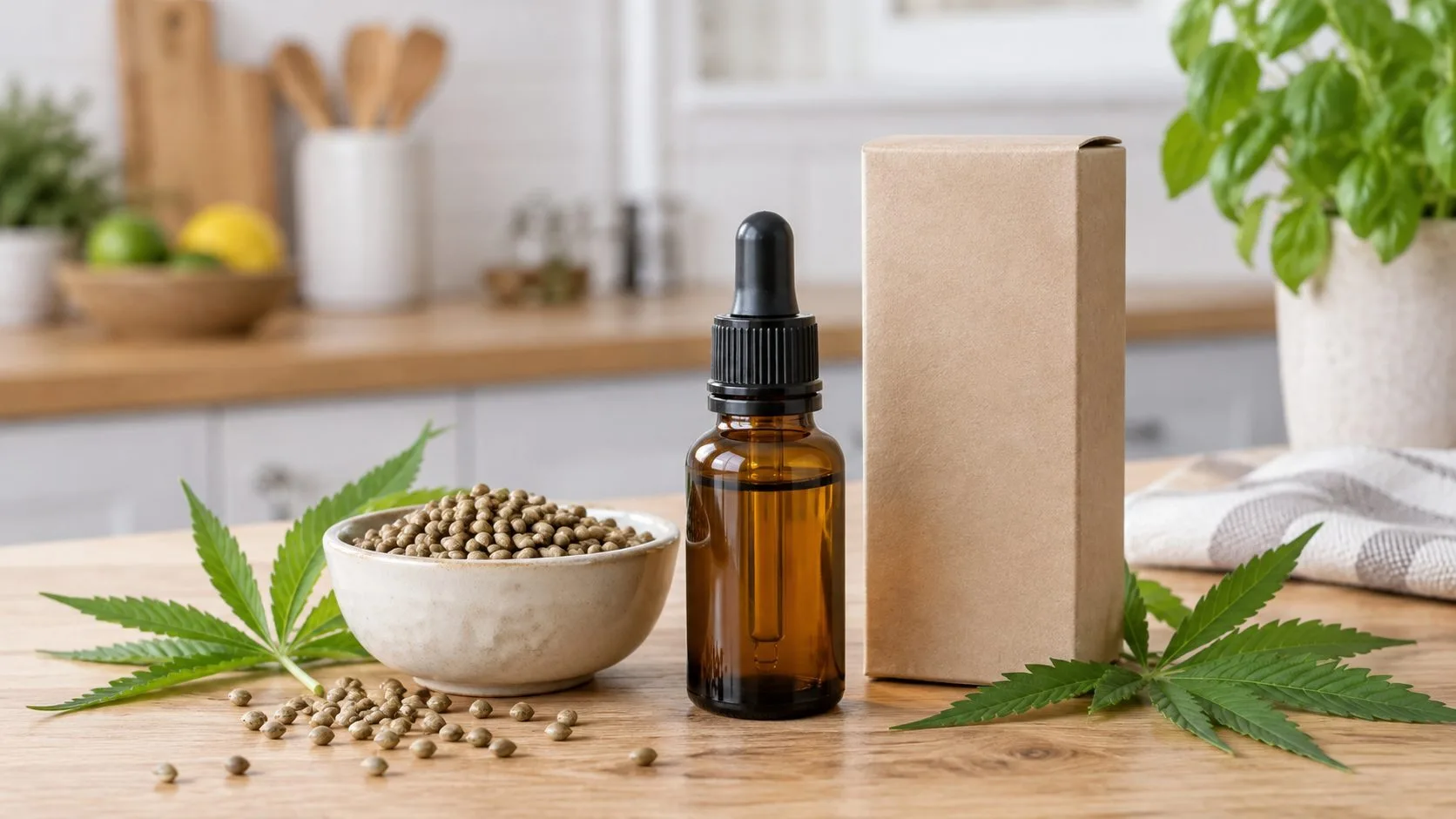
In short: the European Food Safety Authority (EFSA) published three opinions on different CBD ingredients on 18 and 21 September 2026. A synthetic cannabidiol containing at least 98 percent pure cannabidiol in MCT oil rated safe for up to 2 milligrams daily under strictly limited conditions. In the case of two plant-based products with daily doses of 30 and 60 milligrams respectively, safety could not be established due to lack of data. This is neither a phase-out nor a general ban on all hemp products.
Three applications, three clearly separated products
The new EFSA texts do not treat CBD as a single interchangeable product. The positive application concerned synthetic CBD with a purity of at least 98%, exclusively soluble in MCT oil. The maximum intended dose was reduced from the original 25 mg per day in the procedure to 2 mg per day. The target group is adults over 25 years of age; pregnant women, breastfeeding women and people taking medicines are excluded.
The second application also involved at least 98% pure CBD, this time from cannabis sativa and up to 60 milligrams per day. The third product was a more complex hemp extract containing 57 to 65 percent CBD and other cannabinoids, requested for up to 30 milligrams per day. For both plant applications, EFSA requested additional information, including on identity, manufacture, composition, genotoxicity and reproductive and developmental risks. The applicant did not answer these questions and therefore the safety of the products concerned could not be established.
What the 2-milligram rating says
Product-specific data were available for the synthetic CBD, including a 90-day study in rats. The liver was the most sensitive target organ. Using the derived reference point and an uncertainty factor of 400, the panel established a safe intake for this product of 0.026 milligrams per kilogram of body weight per day. Rounded, this corresponds to 2 milligrams for a 70-kilogram adult.
This figure is not a general dosage recommendation for CBD oils available for free circulation but applies to the ingredient tested, its defined purity, the manufacturing process described, the MCT oil formulation and the proposed target group. For people under 25, pregnant, breast-feeding and people taking medicines, the use was not classified as safe. EFSA also examined safety, undesirable effects such as improved sleep, relaxation or pain relief.
An EFSA assessment is not yet a marketing authorisation
For novel foods, the roles are separate: EFSA prepares a scientific risk assessment at the request of the European Commission. The approval, conditions of use and possible labelling are then decided by the European Commission and the EU Member States. A positive opinion is therefore an important procedural step, but it is not yet possible to sell any CBD products as food in Germany.
CBD isolates and CBD extracts are considered novel foods in the EU because no significant consumption is recorded before the relevant deadline of 15 May 1997. As of March 2026, the Consumers' Centre points out that CBD-containing foodstuffs have not yet received the necessary authorisation. The fact that products are offered online as aromatic oils, oral care or cosmetics does not make them food.
Hemp oil is not automatically CBD oil
For purchases, the distinction is important. Ordinary hemp seed oil is made from the seeds and can be used like other edible oils. CBD-rich extracts, on the other hand, are typically derived from other parts of the plant or are synthetically produced and added specifically.
A hemp plant on the packaging alone says little about the type, authorization, or dosage of the product. Those looking for a regular food should check the list of ingredients, purpose, and supplier information. You can find recipes for normal seeds and pantry staples in recipes for ingredients; hearty ideas without special products are available at fast dinners. (Fast food)
What consumers can now test in practice
- Product category read: A cosmetic, perfume or flavoring oil is not a food and is not included in food or beverages.
- Not to generalize CBD quantity: the 2 milligrams refer to the synthetic product specifically evaluated and a narrowly defined target group.
- Taking medication seriously: For people taking medicinal products, safety could not be established in the positive EFSA assessment.
- Skepticism about health promises: Reviews show no effect on sleep problems, pain, stress, or other ailments.
- Hemp foods are distinguished by: hemp seed and hemp seed oil are something different than fortified CBD oils or extracts.
What the Opinions Do Not Mean
Safety could not be established does not mean that the two plant products have been shown to cause harm. It states that the data submitted and available are not sufficient to assess the use requested as safe. Conversely, safe under the proposed conditions does not mean that higher quantities or other compositions would be safe.
Also, the origin natural or synthetic does not decide on the risk alone: identity, purity, contamination, manufacture, administration, dose and target group are important. This is why novel food applications are examined product-specifically.
Conclusion: A tight safety framework instead of a driving licence
The three new EFSA opinions present a positive product-specific CBD assessment under very narrow conditions for the first time, but at the same time show how quickly missing data prevent a robust conclusion. For everyday use, the most important message is that 2 milligrams of a defined synthetic CBD in MCT oil cannot be used to derive a general recommendation for CBD drops, rubber or beverages.
Until a formal EU authorisation with specific conditions is granted, the safety assessment remains a procedural step, and normal hemp seed and hemp seed oil should be clearly separated.
Sources and status
- EFSA NDA Panel: Safety of synthetic cannabidiol as a novel food, published on 18 September 2026.
- EFSA NDA Panel: Safety of cannabidiol isolated from Cannabis sativa L., published on 21 September 2026.
- EFSA NDA Panel: Safety of Cannabis sativa L. extract as a novel food, published on 21 September 2026.
- EFSA: Novel food Procedures, responsibilities and current opinions.
- Consumer headquarters: CBD oil legal on the market? as of 30 March 2026. (Is CBD oil legal on the market?)
Author: Kochzauber editorial team. Information updated on 22 September 2026. This article does not replace individual medical or legal advice. The lead image is an editorial symbolic image.