Cashew-gum packaging film: what the new laboratory study really shows
A new study combines cashew gum with PVOH to make flexible films with a strong oxygen barrier. The results are notable, but the material is not yet a finished replacement for plastic food packaging.
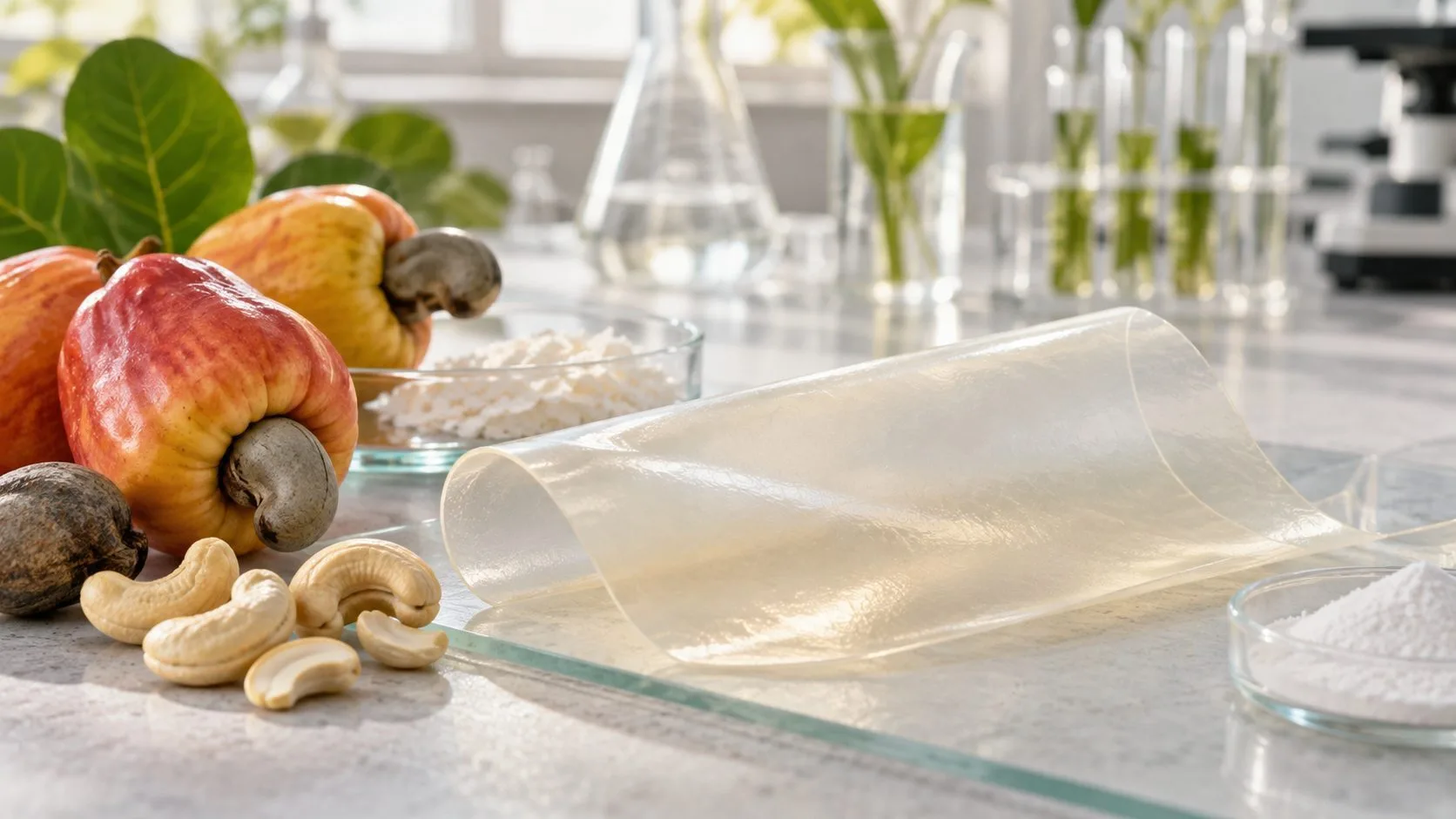
In short: A laboratory study published on 28 September 2026 describes flexible films made from cashew gum and poly(vinyl alcohol), or PVOH. Cashew gum is an underused by-product; PVOH is another polymer component that helps create the material properties. The films blocked oxygen very effectively under dry and moderately humid test conditions. This is proof of material performance, not evidence of an authorised, market-ready or wholly bio-based food package.
How the films were made
The team developed 3 blends containing more than 30 % cashew gum. The solutions were electrospun to create fine fibre mats, which were then converted into continuous films by thermal annealing. Two formulations were continuous and non-porous. The blend with the highest cashew-gum and lowest PEO content retained internal pores. This shows how strongly formulation and processing govern the final material.
What oxygen, light and stretching tests found
The experimental films blocked up to 90 % of UV radiation and achieved elongation at break above 200 %. At 0 % relative humidity, oxygen permeability was below the detection limit; at 25 %, it was 3 × 10⁻²¹ m3·m·m−2·s−1·Pa−1. At 60 % humidity, the barrier was only moderate. That dependence on moisture matters for real packaging because foods and storage conditions vary widely.
What the degradation tests mean
Under the study conditions, degradation reached 65–80 % after 65 d of composting and 36–41 % after 115 d in soil. These figures describe the exact laboratory or test settings used. They do not automatically mean that a film will disappear equally quickly or completely in a food-waste bin, a garden compost heap or the open environment. They also do not establish a disposal label.
Four limits worth keeping in view
- No packaged food: the study examined material samples, not shelf life, flavour or migration in a finished product.
- Not purely bio-based: alongside cashew gum, the film contains PVOH and, depending on the blend, PEO and glycerol.
- Humidity matters: the particularly strong oxygen barrier applied under dry and moderately humid conditions.
- No full circularity assessment: sourcing, manufacturing, disposal and scale-up were not comprehensively assessed.
Why barrier performance and food safety are separate questions
A strong oxygen barrier can protect oxidation-sensitive foods. It does not show which constituents might migrate into food under realistic contact conditions. In the EU, all food-contact materials must meet Regulation (EC) No 1935/2004: transfers must not endanger health, unacceptably alter composition or impair taste and smell. Application-specific migration and safety tests are therefore still needed.
What this means for shoppers
The study changes no disposal rule or shopping label today. Its value is in showing an agricultural side stream as a possible functional ingredient for future barrier films. For current packaging, follow the specific label, authorised use and local disposal guidance. To reduce packaging where practical, plan with Kochzauber’s recipes by ingredient or browse one-pot recipes.
Conclusion: promising film, not yet a kitchen product
The study combines cashew gum with an industrially processable polymer and achieves notable oxygen barriers at low humidity. The open questions are just as important: humidity resistance, migration, contact with particular foods, scale-up and suitable disposal routes. Those tests will determine whether the laboratory material can become safe and environmentally sensible packaging.
Sources and update
- PubMed: Electrospun-derived cashew gum/poly(vinyl alcohol) films as high-oxygen-barrier flexible food packaging, abstract and bibliographic record, published 28 September 2026.
- International Journal of Biological Macromolecules: original paper on manufacturing, barrier and degradation properties.
- European Commission: Food Contact Materials, legal framework and safety requirements for food-contact materials.
Author: Kochzauber editorial team. Information updated on 29 September 2026. This article explains a materials study and replaces neither conformity testing nor disposal advice. The cover is an editorial symbolic image.