Brown beef: What a new clean-label project aims to clarify
Researchers are using AI to search for naturally occurring bacteria that might keep beef red for longer. At home, the key rule remains: colour alone proves neither freshness nor spoilage.
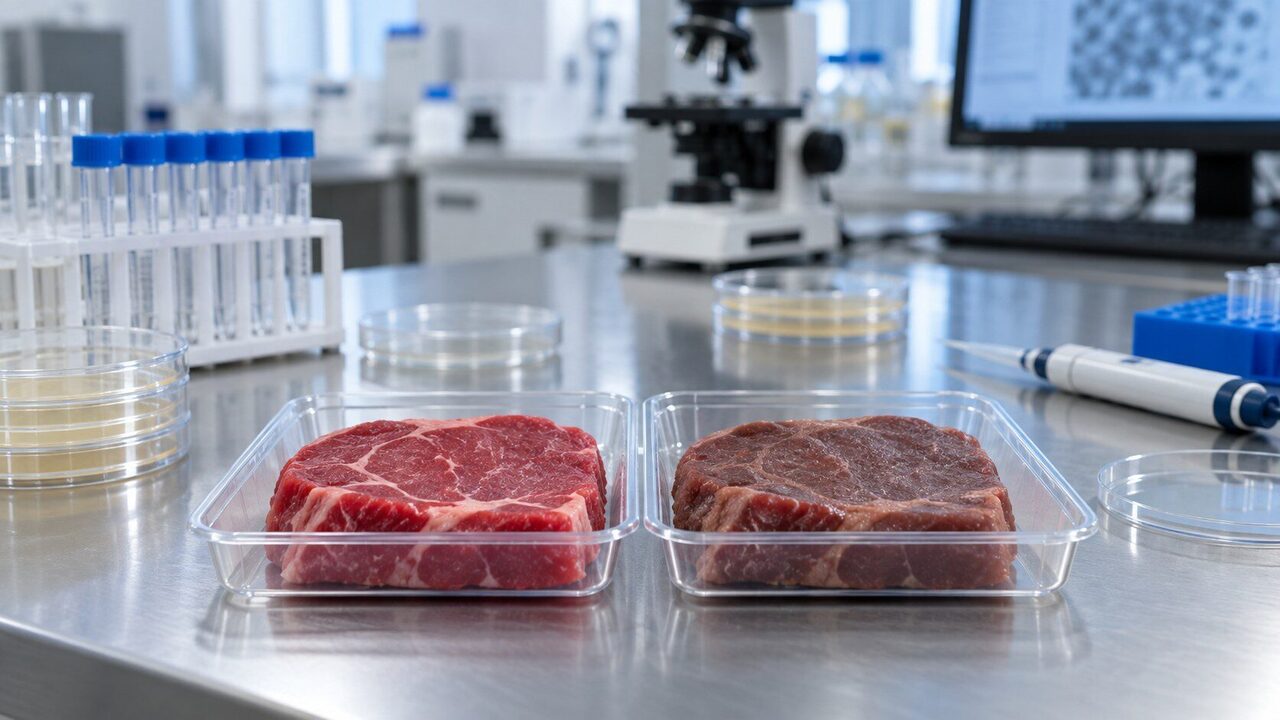
In short: on September 18, 2026, the University of Arkansas unveiled a one-year research project on early browning of beef. The team is evaluating existing DNA data using machine learning to identify five to 10 bacteria that are particularly commonly associated with stable or unstable meat colour, which could lead to natural sustainability approaches later on.
Why Beef Changes Colour
The colour of beef depends heavily on the muscle pigment myoglobin and oxygen. Fresh meat can appear purple when exposed to air. When it comes into contact with oxygen, bright red oxymyoglobin is produced.
Therefore, the surface of a packaging can be red and the interior gray-brown without the meat being spoiled by this colour difference alone. Conversely, a strong red colour is not a safety certificate. Light, packaging atmosphere, temperature, time and microbial processes affect colour impression.
What AI researchers are looking for
The Arkansas Agricultural Experiment Station team doesn't investigate any visible robots or artificial additives in meat. They use statistical learning to detect complex patterns in already existing microbial DNA data. They look for bacterial signatures that repeatedly occur along with longer red coloring or faster brown coloring.
In the meantime, a ranking of five to ten candidates is planned, and only after that would these microorganisms have to be validated experimentally: do they actually affect colour stability, under what storage conditions, and are they safe to use, dose and interact?
The project is receiving $20.000 from the Arkansas Beef Council, which is important for the classification of the industry, and the university says that the preliminary data should serve as a basis for larger follow-up applications, so the announcement describes the start of a small research project, not the completion of an independent efficacy study.
What Clean Label means here
Researchers use the industry term for a possible approach using beneficial bacteria already found naturally on beef rather than synthetic preservatives. Clean Label is not, however, a legally defined health or quality proof.
Even if a candidate proves successful, further testing would be necessary. A microorganism that correlates with stable colour does not automatically cause this stability. It could just be a companion to other storage or process conditions. Even an optically longer red surface must not cover the actual damage.
Colour is a clue, but not a judgment
The US Food Safety Authority (FSIS) states that browning by myoglobin oxidation during refrigeration can be normal. If all meat has turned gray or brown, spoilage can begin. If unpleasant odor and a sticky or lubricating surface are added, the product should not be used.
In addition, the date of consumption is crucial for Germany. Lightly perishable commodities such as beef and veal can be consumed up to. When they expire, they are no longer on the plates. This differs from the minimum shelf life date, which is mainly concerned with the guaranteed product characteristics.
- Date of consumption: For minced meat and other highly perishable goods, do not taste after expiry.
- Holding cold chain: Take meat at the end of the purchase, transport it quickly and store it in the coldest suitable refrigerator.
- Check the packaging: Damaged, bloated or leaked packaging is a warning signal.
- Use several senses: unusual smell, lubricant consistency and large-scale discoloration speak out against use.
- Dispose of: roasting does not make already rotten meat usable again.
Do not judge doneness by brown colour
Also, when heating, colour is unreliable. Beef can look brown before a safe temperature is reached inside. Conversely, it can still look pink despite sufficient heating. A clean kitchen thermometer is more meaningful than the colour impression in burgers or thick beef.
Raw meat should be processed separately from salads, bread and other ready-to-eat foods. Hands, knives, boards and work area should be thoroughly cleaned afterward. (Meat recipes; Dinner)
What the project has not yet demonstrated
- No finished culture of protection: the team is looking for microbial candidates first.
- No extended consumption period: households must continue to pay attention to date, temperature and packaging.
- No statement "brown" is certain: colour alone is neither sufficient for a warning nor for a damaging part.
- No proven waste reduction: whether a subsequent process reduces food waste practically is to be investigated first.
- No health benefits from Clean Label: the term here describes a direction of development, no medical effect.
Conclusion: research against errors, safety rules remain
The Arkansas project raises an interesting question: Can naturally occurring bacteria help preserve the optical quality of beef for longer? Machine learning can prioritize candidates faster in large datasets, but it doesn't replace lab validation and safety testing.
For consumers, nothing changes for the time being. A brown area can be created by oxygen, but date, cooling, smell, surface and packaging must be consistent.
Sources and status
- University of Arkansas Division of Agriculture: AI Helps Arkansas Researchers Target Bacteria Behind Premature Beef Browning, published on September 18, 2026.
- USDA Food Safety and Inspection Service: Does the colour of beef indicate freshness?
- Federal Centre for Food: Food shelf life, difference between minimum shelf life and consumption date. (Sustainability of foodstuffs)
- Federal Institute for Risk Assessment: questions and answers on spoiled meat, storage and deterioration characteristics. (Questions and Answers on Rotten Meat)
Author: Kochzauber Editorial. Information and update status: 20 September 2026. The article does not replace an individual assessment of a suspicious food.